
Volume 149 | July 8, 2026
Reminder to JOIN the The PhySec Collective community Slack channel to network, engage, and be part of something big! You can sign up here.
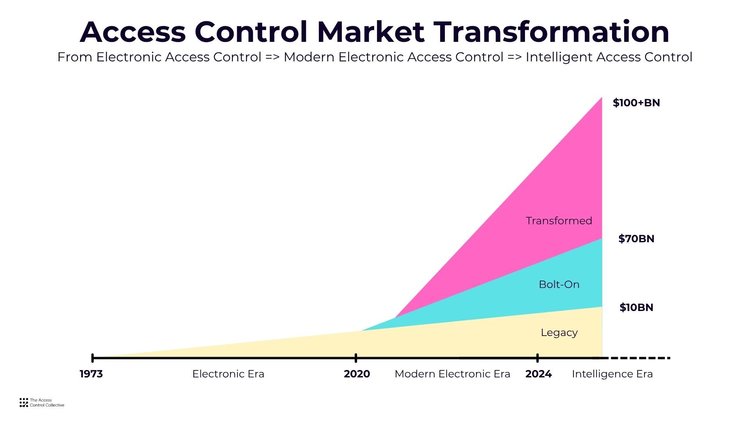
iLOQ published its 2025 Annual Report last week, and with my trip to Oulu, Finland canceled due to weather, I figured I'd cover their report instead. Inside the ESG appendices and IFRS statements is a cleaner test of my three company archetypes framework (see the chart below) than the typical annual report provides. The framework includes Legacy players with incremental growth and imagination, Bolt-On Transformed players who consciously pursue larger market opportunities, and Built for the $100B era players (more below).
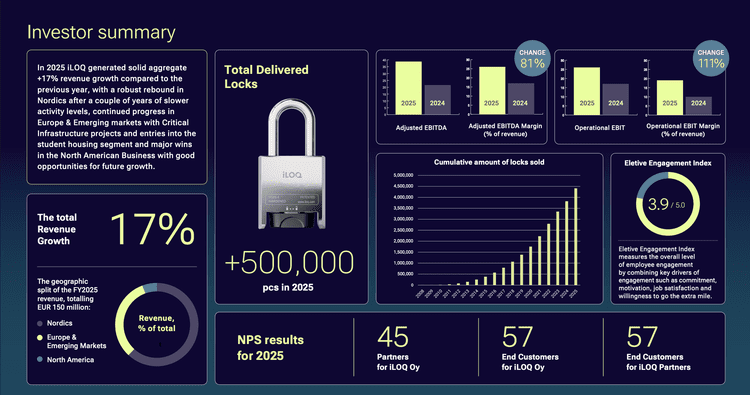
Revenue grew 17%, to €150 million (~$171M USD). Operating profit more than doubled, reaching €27.4 million (~$31.2M USD). Adjusted EBITDA was up 81%. North America went from just over €2 million (~$2.3M USD) to more than €10 million (>$11.4M USD) in a single year. None of that is unusual for a growth-stage company having a good year. The unusual part is how the growth happened (and that is where the archetype question gets interesting).
I have written before (and above) that most companies in this industry fall into one of 3 buckets. Legacy Incremental companies improve the old model without changing what it fundamentally is. Bolt-On Transformed companies acquire or partner their way to a software layer sitting on top of a hardware business that has not actually changed shape. And then there is the 3rd bucket: companies built from the ground up for the $100BN era, where the software and the identity relationship are the product, and the hardware is the delivery mechanism. I am calling this 3rd-tier Intelligent Access.
iLOQ’s numbers argue for the 3rd bucket, and the argument I have on why is below (IMO most people will skip past them, but I want to make sure they are clear):
The company’s technical differentiation is battery-free, self-powered locking with no cables, no dependencies, old expectations, or what they called “untethered.” Meaning untethered from the constraints many other systems accept as given. This is not a feature bolted onto a legacy cylinder business, but an energy-harvesting engineering bet that determines everything downstream, including the environmental story, the maintenance-free pitch to critical infrastructure customers, and the retrofit speed that won them the Empire State Building. Jonathan Salomons at Empire State Realty Trust said he did not choose iLOQ because of a nice app. He said he chose it because you cannot drill into a 1931 protected landmark, and a 3.5-minute cylinder swap solves a problem that wired access control cannot touch. That is a right-to-win built into the product's physics, not into the marketing deck. (BTW, interesting timing given the stunt that was pulled recently).
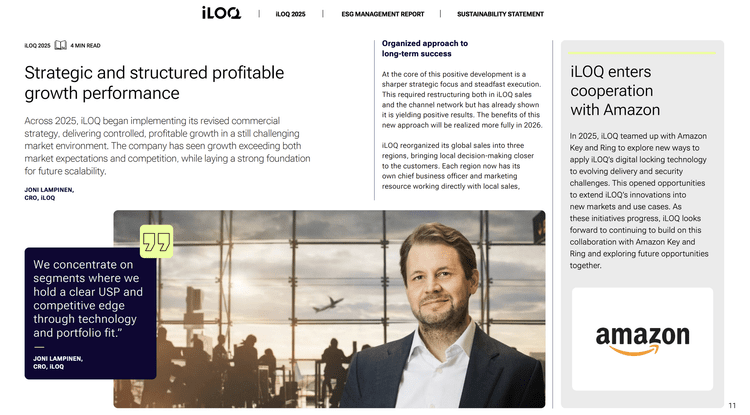
Their commercial go-to-market (GTM) backs this up, too. They have 3 regional Chief Business Officers (CBOs), a tiered global partner program with 1,800 resellers, and are building a value-added distributor model in the US and parts of Europe. They are in a GTM infrastructure platform company growth phase, not a hardware company protecting a channel phase. They report lead volume is up 40%, lead quality is up 20%, and satisfaction is above industry average. Joni Lampinen’s words in the report focused on segments with a clear USP instead of spreading resources thin. His wording shows the language of a maturing company. They have figured out where to play before figuring out how to win everywhere (similar to the leadership team at ButterflyMX). That discipline and sequencing of strategy matter more than people often realize, especially in the US.
OK, now I want to take the other side of my own argument, because this isn’t a press release 🙂.
The North America story is still building and a nascent multifamily entry (the base), not yet a diversified business (to be clear, thats natural with where they are at). It is an excellent proof point and a real reference customer, but 400% growth off a small denominator is not the same claim as 400% growth off a mature book of business. From the report, it shows that Central Europe has underperformed, and the report is honest about it without being specific about why, whether that is macro caution in Germany and France, or whether iLOQ’s channel maturity in DACH simply lags the Nordics. I’d love to dig into that more and plan to when I visit. Also, the restructuring that got them the numbers cost real headcount, down from 342 to 310, with an employee Net Promoter Score of 12 and an engagement score of 3.9 out of 5. It is neither alarming nor strong (especially given that the entire business world is talking about AI and efficiencies that are reducing the workforce so this is the new normal).
All of that said, none of that changes the core read of their report. The thing I keep coming back to in the “Identity Ownership Thesis” I have is that iLOQ is positioning itself as infrastructure that other platforms build on, rather than a standalone lock brand. They have a real enablement strategy. The Amazon Key and Ring cooperation is early and underexploited as a story right now (it will also be interesting to see if Amazon and Ring continue to be a priority since they seem to go in and out of focus), but it is the same instinct that produced the Empire State Building win: be the layer other people’s platforms depend on, not the brand competing to be just another brand.
So here is where I land with iLOQ. They had a “Nokia moment”: the temptation to defend the mechanical lock business it came from, and to add software around the edges. Instead, it built the energy-harvesting bet first and let the commercial model catch up to what the product made possible. They built to be untethered. That is the harder, more durable path. The open questions are whether Central Europe is a market-timing problem or a go-to-market problem, and whether the North American growth curve holds or scales once it has to come from new logos and repeat customers rather than one very good reference account. Knowing Robert Mancuso, I wouldn’t bet against him or the team.
More to come on iLOQ as I plan my visit to Oulu soon.

Click on the above image and use code sxst3gkbkn to hear the audio version.
PS: I am sure some of you may forward this, but please do so sparingly and encourage others to sign up here. Thank you!
