
Volume 1 | November 8, 2022
And so it begins!
Alright! I'm back, so let us ease on in and get comfortable. Time to get back on the 🐴. For those of you who were with me when we brought The Inside to market, welcome back, and thank you for joining me here at the Access Control Executive Brief. For those of you who are new altogether, welcome and thank you. We are on this journey together, and I am grateful for you joining me.
Note: Moving forward this section will not be so long :) If you’d rather watch or listen to me read this brief, click here. You can also check it out in the archives on the website by logging into www.leeodess.com. Ping me if you can't find it.
My goal with the Access Control Executive Brief is to bring some insights, thoughts, and stories and ultimately communicate what's rattling around in my head, brought to my attention, or through observations as our industry continues to evolve or, in some cases, resists the changes. So please tell me what you think, what you agree or disagree with, and if something we discuss here helps.
Some things to keep in mind regarding my writing that I think are important as you read on:
I BELIEVE IN
-
Nuances.
-
That old truths and new truths can exist at the same time and always have. So let's build that into our businesses and conversations.
-
The world isn't binary, and we shouldn't be either. Sure we need to make decisions, but when it comes to debate and critical thinking, we may have two things simultaneously happening, so use the word "and" more than "or." See old truths and new truths noted above. The concept is not new. Check out Jim Collins and his book Built to Last. “The genius of the and, not the tyranny of the or.”
-
We need more respectful debate.
-
Our industry is way too conservative with innovation and change. We need to be more aggressive.
-
We lack mainstream communication, branding, and marketing. We need it as we have a big opportunity upon us.
-
We can deliver safety and security with convenience. Yes. We. Can.
-
Our industry is both a $70B and a $10B market. One serves the mainstream market, and the other does the high-security industry.
-
We are a community, and I am grateful to be part of it.
We are going to dig deep into access control from a global business perspective. I plan to explore the business applications and opportunities in new and existing markets, look at different verticals, and do my best to highlight the companies we know but also find the ones we don’t.
So with that, let's get to it! As always, reach out if you need anything (click on the signature below to send an email). Without further delay: Volume 1.
Thank you,

PS: I am sure some of you may forward this on but please do so sparingly and encourage others to sign up here. Thank you!
PSS: Keep an eye out for “Breakdowns.” I partnered with industry experts to dig into the products and services technically with a business application POV. You will be receiving these via email and in the archives as they are complete. Enjoy!

From the Shadows to Center Stage: The Birth of a New Channel
A lot has been made recently about Apple Wallet and mobile credentials. Without a doubt, the genie is out of the bottle, and what we believed would happen as soon as the mega techs showed interest in our space is starting to take shape. There is a good amount of discussion around cards versus mobile, credentials versus identity, and speculation on the level of impact this will have on our industry—all honest conversations and ones we need to be having. But one area that needs discussion is the channel impacts. And I am not talking about the traditional channel of integrators, distributors, or system integrators, well, possibly, but it is not in the same system integrators we discussed.
Instead, this conversation is about a new opportunity and a channel of maturing contractors who have historically worked in the shadows, gluing systems and solutions together but are ready for prime time.
Before we get into this new channel, let's take a quick tour of where we've been as it relates to where we are going and give an example of a different industry to drive a relatable perspective on what I am talking about with this new channel.
WHERE WE HAVE BEEN
Historically when manufacturers, both hardware (e.g., Allegion) and software (e.g., Lenel), wanted their systems to work together, the options were for one or both of the companies to do the work needed, or they would contract out to a third party (Jonathan Lawry or BraXos) to do the job. A customer opportunity drove the desire for integration, or either or both of the companies wanted to offer their product through the others sell thru channels. For the third-party contractor, it was a project. That third-party contractor quoted the cost of doing the work, and once they were under contract, they did the job. These third-party contractors worked in the shadows. There was no channel disruption. Work got done, and everyone was happy.
YOU DON’T HAVE TO LOOK FAR
Ok, so now flip with me to another industry real quick - the Enterprise Software Industry. Specifically Salesforce for this example. (Remember when it was called Salesforce.com? Feels a million years ago). Salesforce is well known for its CRM (customer relationship management) software. They are also known for their automation (Mule Soft), communication tools (Slack), service, commerce, marketing, etc. So they are a great example of a true enterprise platform. Built around these products and services is a well-known deep network of integration partners and an app store called AppExchange, littered with applications created by third-party application vendors.
Their integration partners, called SIs or System Integrators, are a robust group of third-party companies that will consult, configure, and implement Salesforce solutions. Sometimes SIs are brought in by Salesforce to service customers, and other times the SIs generate their own opportunities. Salesforce builds programs around SIs and invests heavily in training, enablement, and community building. Check out the Trailblazer program as well as Dreamforce. Salesforce even goes as far as investing in some of the SIs to help them accelerate growth and focus. In some cases, Salesforce acquires SI's and brings them in-house as part of a professional service offering.
Another group that partners with Salesforce are called Independent Software Vendors (ISV). ISVs are a company that builds application-specific software to function on the Salesforce platform (the product is also a platform). Typically ISVs then sell their application to Salesforce customers via the AppExchange.
——————
Definitions
A System Integrator (SI) is for partners who plan to deliver servicesrelated to a software company.
An Independent Software Vendor (ISV) is for partners who want to build and sell apps.
——————
Sometimes, even more today, SIs and ISVs are blended and the same. A great example of a blended SI and ISV is Traction on Demand. Traction on Demand, now a Salesforce company ingested into their professional services group, was once a stand-alone SI consulting company and an enterprise applications company building solutions on the Salesforce platform, including CRM, marketing, and experience applications. While consulting in financial services, communications, manufacturing, and non-profits, Traction on Demand launched five software companies as an ISV. They were so good at it and showed the great potential that in 2018, Traction on Demand became one of the first four companies to receive an investment from Salesforce.
One of the software products you may have heard about from Traction on Demand is Traction Guest, now called Sign In Enterprise, an enterprise visitor management system. Traction Guest was one of Traction on Demand's first incubated products and the first product to spin off into an independent company. In December 2021, PSG, a growth equity firm based in Boston, Massachusetts, that focuses on growth-stage software companies, acquired Traction Guest.
This type of story is more common than you think.
Although new to security, the SI and ISV market goes beyond Salesforce. Microsoft, Apple, Hewlett-Packard, Cisco, Oracle, IBM, and ServiceNow (full disclosure: my wife works at ServiceNow) all have thriving SI and ISV partners.
SO HOW DOES THIS RELATE TO THE ACCESS CONTROL INDUSTRY?
I appreciate you taking a few minutes to follow me as I build some context to support why this moment in time is so pivotal as we go forward into the $70B mainstream access control market.
The SI and ISV channel has officially entered the physical security industry, specifically within the access control industry. Of course, it will go much broader than access control, but it has seated itself here first, and this is why it is so critical that we as an industry do something about it. Companies such as Any2Any, BraXos, Cohesion, Detrios, OpenVia, Remote Lock, Soloinsight, StratorSoft, SwitConnect, Tapkey, Trecerdo, Z9 Security, and even Wavelynx are all examples of SIs and ISVs.
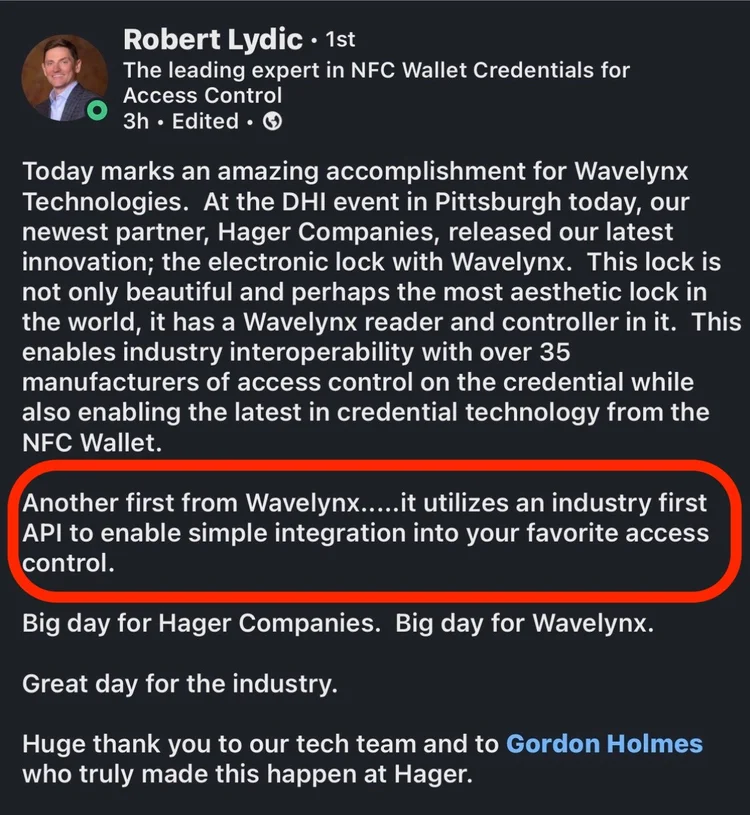
In the case of StratorSoft, they are solely focused on data pipes and dashboards which bring an entirely new suite of integrations, products, and services. The companies listed above are all used by customers, such as real estate developers, and companies external to our industry, such as Apple. They are looking to leverage the SI and ISV's technical skills and speed to fill the gaps in advanced integration that we have historically been slow to do and create the unique user experiences we have yet embraced and prioritized.
This is when our industry goes from connected products to smart products, and this channel will take us there.
The game has changed and this is only the beginning. How we engage and treat them also needs to change. The SI and ISV is a new channel that needs proper handling, communication, engagement, and, most importantly, mindset.
SO WHAT DOES THIS MEAN?
I find bullet points are an easier way to organize the thoughts on what this means, so here we go:
-
A security integrator or system integrator, as we know it to be, is different than the systems integrator I am discussing here. Don't let the S and I confuse you. We should call the historical systems integrator a security systems integrator. Yes, some security systems integrators could look like enterprise systems integrators (Northland Controls or Sage Integration comes to mind), which is my point. The industry has been moving closer and closer to this converged IT and Physical Security model for a while. It is upon us for the access control industry, and it is time to properly handle this growing channel with a new mindset, not just an evolved one. Most SIs in our industry are security system integrators that focus on the installation, set-up, configuration, and service of systems within the known industry (this access control system works with this lock company and this video company) but has the potential to take advantage of the market shift. This new type of enterprise SI works with access control systems and a wide variety of other enterprise systems. Like Salesfoce, Okta, Google, Apple, Splunk, etc. This is why we need to open our minds to this new type of integrator. We will miss the opportunity if we use old truths to define this new truth.
-
Since we have historically been a hardware industry, including the access control software companies (as they mostly make their revenue off of reselling hardware), we've viewed this group of companies doing mundane and in-the-shadows integration work (e.g., a lock integrated to an access control industry). They are now a channel for software-centric organizations creating a new higher margin and recurring economy (part of the $70B), and you need to treat them as such.
-
Shoving these companies through the same programs you have, such as PACs or integration partners, is a mistake. Not only are those programs not applicable, but most of our legacy industry will also see this as a threat to their traditional business and subconsciously and consciously treat it as such. We need to avoid creating a story that fits an historical narrative (reference cloud and mobile).
-
With the likes of Apple and Microsoft all making recent announcements, we will see others, such as Google and Salesforce, follow suit. They are all already there, including Accenture, Deloitte, etc. They focus on workplace technologies that trickle down into access control specifications. If you are not seeing it, you either will or need to pay more attention to your customers' customers. This is a new type of specification, and it will be further up the funnel than we have historically played. Firms like this are interested in three things (1) total addressable market, (2) speed, and (3) experience. Are you set up to engage with them?
SO WHAT SHOULD YOU DO?
Depends on who you are. A good rule of thumb no matter who you are: do something.
If you are an access control company or a manufacturer of goods that works with access control companies, I plan to have more on this in a future Executive Brief. Still, initially, it is essential to focus on two areas—first, mindset. You need to get curious, and you need to embrace it. Then, create programs and approach them with evolution, opportunity, and change. If anything, this is a perfect place to experiment.
If you are a security systems integrator, take a hard look at your offerings and decide if this is a path you want to take. From there, reach out to the community. You will find that many of the listed companies will either desire to partner or, at minimum, provide feedback to help you get started. It is a big market. All boats will rise here.
If you are an end-user, customer, or owner/operator developer, change your expectations of what an access control system does and is. Start demanding this type of functionality and take a hard look at what products and services you are working with.
WHAT DO I THINK WILL HAPPEN?
I believe that all the mega techs will partner, invest, and acquire our industry ISVs and SIs. This is an area of convergence and the fastest way for them to get deeper into the software value creation our industry either creates or helps activate. This is the $70B we are talking about. Some brands in our industry will see this as an opportunity and will go head first into it and reap many benefits. And history tells us many people in our industry will quickly tell you and me how this isn't a thing. I'm good to let them die on that hill as I won't.
EXTRA CREDIT. Here are some questions that this brings to mind for me that I am still noodling.
-
What other offerings from outside our industry will these SIs/ISVs start to work with?
-
How do you price this?
-
What are the secondary effects?
-
How do you support this (things like training and certification)?
What questions, thoughts, ideas does all of this spark for you? Let me know and I’ll share your questions, thoughts, ideas and feedback in the next Executive Brief.
FROM MY DESK
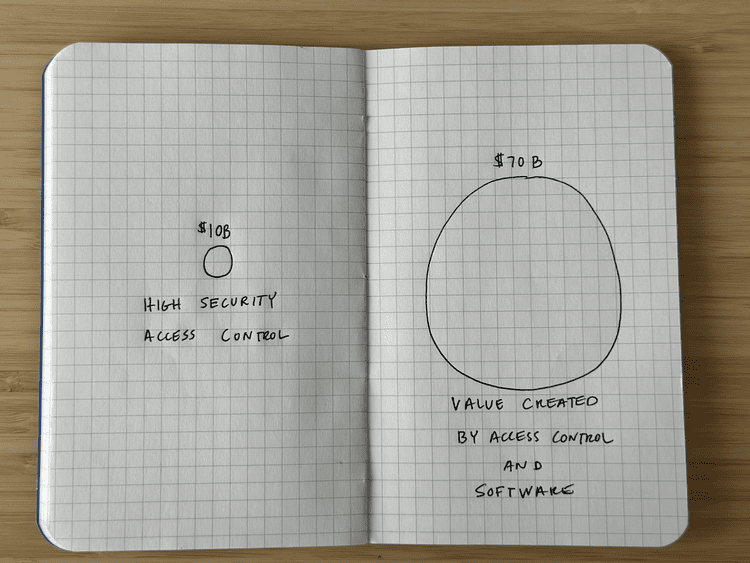
Classic example of old truths and new truths existing. One is not better than the other. They are just different. You get to choose where you spend your time and energy. You can participate in both. The question is, where do you want to be? The $10B high security market or the $70B value created by access control and software market?
CHART OF INTEREST

ARTICLES OF INTEREST
What you need to know about Leasing - Top 10 Dave Cairns was early in the WFA movement and writes a lot about what’s going on as it relates to commercial real estate. Worth the follow.
SwiftConnect, which lets employees use their phones to access the office, raises $17M Supports the conversation we are having in this Executive Brief. What to make of it? Look who is investing.
SaaS Class Of 2021 Is Down But Not Out Margins up, profits down.
[1480] $329 Smart Lock Opened in Seconds (Level Lock). There is a difference between being a safety product and a gadget. Companies should partner more.
Here are 3 skills leaders need to navigate uncertainty, according to LinkedIn Will things return to how they were?
Cretech London Great event and I highly recommend going. I will be there.
What’s Happening at Work, Part 1 of 2 Interesting read. Look forward to part 2.
Future Forum Pulse Expectations of leadership has changed. We need more leadership and less management.
LinkedIn adds internal mobility features to help employers retain talentMaybe what you need is what you already have.
Canary Technologies Flies High with $30 Million In New Funding for Its Hotel Guest-Facing Technologies Many believe this market is already saturated but looks like there is always opportunity to innovate.
Resonai raises additional $20 million for Series A to digitize the built world I am curious the role that digital twins will have on our industry. I believe it will be around specifications.
Here are some projects I am also working on for those interested: