
Volume 127 | January 13, 2026

Click on the above image and use code sxst3gkbkn to hear the audio version.
Reminder to JOIN the The PhySec Collective community Slack channel to network, engage, and be part of something big! You can sign up here.

A lot of the discussion around the supposed demise of value investing tends to start with the same premise: It no longer works the way it used to. I think that diagnosis misses the point. The issue isn’t value as a concept. It’s how we choose to measure it.
Traditional value metrics like price to earnings and price to book were designed for an economy dominated by tangible assets. Factories, inventory, physical capital. Today, much of corporate value sits in intangibles like software, brand, intellectual property, and customer relationships.
Current accounting rules struggle to capture those assets cleanly. As a result, earnings can be distorted by amortization, stock-based compensation, restructuring charges, and a long list of “adjustments.” Book value is often meaningless for asset-light businesses.
There is still one metric that cuts through most of that noise: free cash flow. Short of outright fraud, it’s very difficult to manipulate the amount of cash a business generates after paying for its operating and capital needs. That’s why I think free cash flow yield is the yardstick for modern value investing.
To make this concrete, I want to revisit a company discussed in the February 2025 edition of The Security Breakdown: Allegion plc (ALLE). In that earlier note, the framing question was simple: if Warren Buffett were investing in access control companies, which one(s) would he pick?
Allegion was one of my answers, largely because of its high return on equity (ROE) and durable competitive moat. I was vindicated in the second quarter of 2025 when Berkshire Hathaway (BRK.B) disclosed a new position in Allegion. According to the 13F, Berkshire purchased 780,133 shares for an estimated $107 million. In the context of Berkshire’s overall portfolio, that’s tiny, roughly 0.05%.
Still, it’s notable because Allegion isn’t the kind of mega-cap consumer or financial business Berkshire is usually associated with. While the purchase was largely attributed to Greg Abel and Ajit Jain, it’s hard to believe Buffett himself was completely uninvolved given the timing.
That sets up the real question: why would a value and quality investor like Buffett, and by extension Berkshire, want to own Allegion? In hindsight, there may have been an even simpler explanation than moats and ROE when you look at Allegion’s free cash flow. Here’s my new take.
A Quick Primer on Free Cash Flow
As a business owner, there’s only one question that matters: how much cash can I take out without harming the company? Free cash flow is the metric that answers that question.
From an accounting standpoint, free cash flow starts with operating cash flow. From there, you subtract capital expenditures. What’s left is the cash the business generates after paying its bills and reinvesting enough to stay competitive.
A simple example helps. Imagine you own a lemonade stand. Over the summer, you bring in $10,000 in cash sales. After paying for lemons, sugar, cups, and the kid down the street who helps you run the stand, you’re left with $4,000 in operating cash flow. You then spend $1,000 replacing your table, signage, and cooler so you can keep operating next year. Your free cash flow is $3,000.
That’s the money you can actually pocket, save, or reinvest elsewhere, and it will give you a better picture of how your business is faring versus metrics like earnings.
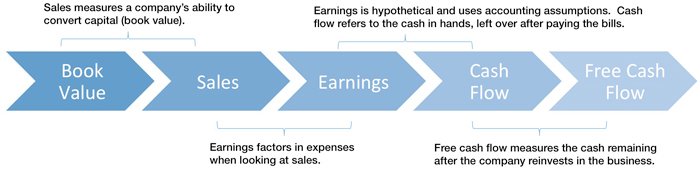
Earnings, in particular, are easy to distort. Stock-based compensation, amortization of intangibles, restructuring charges, acquisition-related costs, and “one-time” adjustments can all meaningfully change reported profits. Here’s a good example from Pacer ETFs:
“Common yardsticks such as dividend yield, the ratio of price to earnings or to book value, and even growth rates have nothing to do with valuation except to the extent they provide clues to the amount and timing of cash flows into and from the business.”
– Warren Buffett’s 2000 Annual Letter
Free cash flow strips most of that away. After you’ve paid employees, suppliers, taxes, interest, and reinvested in the business, what’s left is what’s actually available to owners. It implicitly accounts for debt servicing and reinvestment because those uses of cash reduce what’s left over.
Free cash flow isn’t a perfect metric. Capital intensity can fluctuate year to year, and acquisitions can temporarily suppress it. But it’s robust. When investing, everything ultimately comes down to assumptions. The more grounded and reliable your assumptions are, the better your estimate of intrinsic value tends to be. Free cash flow gives you one of the cleanest starting points available.
Analyzing Allegion’s Free Cash Flow
The first chart compares Allegion plc’s free cash flow per share and earnings per share against total shareholder return over the past decade. While earnings per share (EPS) have trended higher over time, there have been periods where the stock price meaningfully decoupled from EPS.
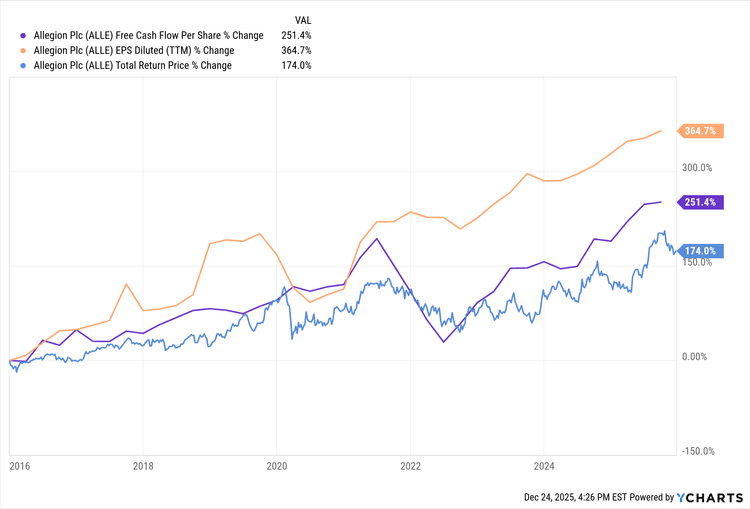
The most obvious example is 2022. On the surface, earnings held up reasonably well, helped in part by acquisition-related accounting that was accretive. But free cash flow told a very different story. It dropped sharply, but it wasn’t necessarily a sign of a deteriorating business.
Here, Allegion was reinvesting heavily, funding acquisitions that management believed would strengthen its competitive position over the long run. By most measures, they’ve executed well on that front.
But if your goal is to understand where the stock price is likely to go, earnings alone don’t give you the full picture. Share prices tend to follow cash generation, not accounting profits. When free cash flow weakens, even temporarily, the market notices. When it recovers, the stock tends to follow.
The next set of charts shows what consistent and growing free cash flow per share actually enables. Allegion has been able to deploy multiple shareholder return mechanisms over time.
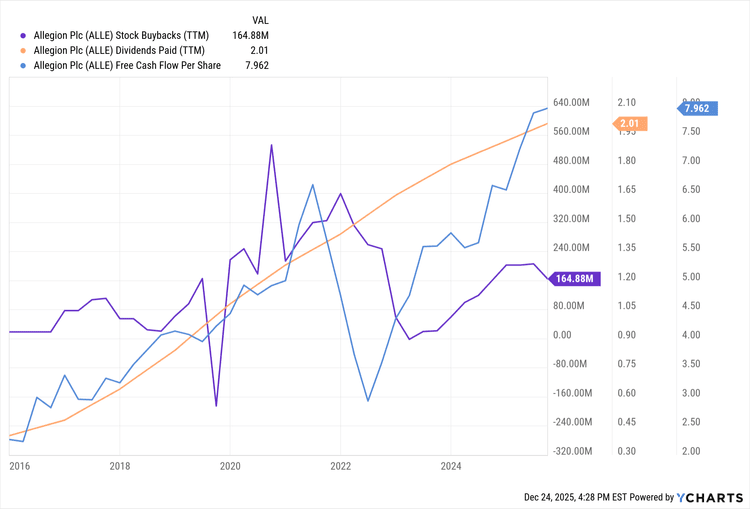
Beyond reinvesting in accretive acquisitions, the company has a long track record of steadily increasing its dividend year after year. It has also used buybacks opportunistically, stepping in when shares trade below management’s estimate of intrinsic value.
That flexibility is a direct result of having excess cash after funding operations and growth. This is an important distinction. Shareholder returns funded by free cash flow are fundamentally different from shareholder returns funded by borrowing.
If a company lacks free cash flow but still wants to pay dividends or buy back stock, it has to rely on debt. That’s how you end up with cases like McDonald’s (MCD), which maintains dividend aristocrat status while carrying a negative book value.
Now, that approach can work if a company has access to long-term, fixed rate borrowing at attractive costs. Not every company does, especially if they’re not a mega-cap. In Allegion’s case, the ability to return capital rests on internally generated cash, not financial engineering.
That’s why free cash flow sits at the center of the analysis. Without it, capital returns become fragile. With it, management retains control over timing, scale, and sustainability.
How to Use Free Cash Flow as a Valuation Tool
I’m deliberate about calling this a valuation tool, not a screening tool. By the time you’re working with free cash flow, you should already have done the heavier lifting.
Borrowing from Peter Lynch’s framework, that means you understand the company’s story, you have a view on whether it has a real competitive moat, and you’ve looked at how efficiently it uses capital through metrics like return on equity and return on invested capital.
You should also know how management treats shareholders, whether that’s a history of dividend growth, disciplined buybacks, or both. Free cash flow comes in when you’re trying to answer a more specific question: am I paying a fair price today?
To do that, we convert free cash flow into a related metric called free cash flow yield. You take a company’s free cash flow and divide it by its market capitalization (or in some cases, enterprise value). On its own, that number doesn’t tell you much. What I find more useful is comparing that yield to an alternative asset with a similar time horizon.
For me, that benchmark is the 10-year U.S. Treasury, which serves as the global reference point for long-term, risk-free returns and corporate borrowing spreads. Right now, Allegion’s free cash flow yield of 4.95% sits above the 10-year Treasury yield of 4.18%.
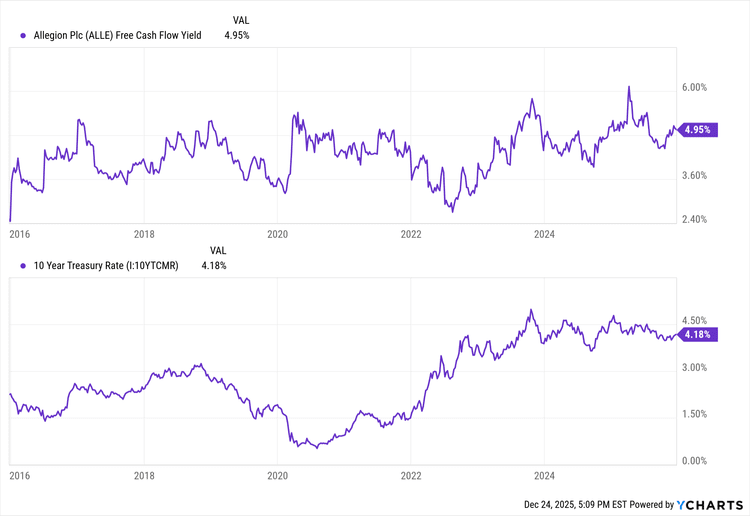
When a company’s free cash flow yield trades meaningfully above the 10-year Treasury yield, it suggests that you’re not overpaying relative to a low-risk alternative. In the case of a high-quality business, fair value is often the best you’re going to get outside of periods of extreme stress.
This isn’t a silver bullet. Free cash flow yield is one metric among many, and it shouldn’t override qualitative judgment or broader fundamentals. But it’s a tool that’s often missing from valuation discussions, despite being easy to calculate and easy to interpret. As a sanity check, it’s one I use often.
As written by Tony Dong, MSc, CETF
PS: I am sure some of you may forward this, but please do so sparingly and encourage others to sign up here. Thank you!
