
Volume 129 | January 22, 2026

Click on the above image and use code sxst3gkbkn to hear the audio version.
Reminder to JOIN the The PhySec Collective community Slack channel to network, engage, and be part of something big! You can sign up here.

I’ve been on the road more than usual this month, which meant a lot of time listening to audiobooks. One of them was One Up on Wall Streetby Peter Lynch.
There’s a section where Lynch lays out his own informal taxonomy of equity investments. Slow growers, fast growers, stalwarts, cyclicals, asset plays, turnarounds. It’s not meant to be rigid, but it’s a useful way to impose some structure on an otherwise messy universe of stocks.
Reading that in the context of today’s capital markets got me thinking. The 21st century has produced an entire class of public companies that doesn’t fit neatly into Lynch’s original buckets. I’ll give them a name though: shitcos.
A shitco usually has a micro or small market cap, a vague or overhyped product, promotional management, persistent dilution, heavy stock-based compensation, and a habit of mashing thew dilution button whenever cash runs low. The unifying feature is persistent negative earnings.
That last point matters. Negative earnings are a necessary but not sufficient condition for shitco status. In other words, not every company with losses is a shitco, but every shitco loses money.
The distinction is important because there’s an asymmetry here that trips up a lot of investors. Some companies with negative earnings end up being terrible investments for years and then disappear into chapter 11 bankruptcy. A few flip seemingly almost overnight and go on sustained runs.
You’ve probably seen examples of the latter. Palantir (PLTR) is a good one. Loss-making for years, widely dismissed, then suddenly profitable, self-funding, and repriced accordingly. Once that switch flips, the market reaction tends to be fast and nonlinear.
So, the real question isn’t whether negative earnings are bad. It’s how to tell the difference between a shitco and a potential 10-bagger. Or more precisely: when is it justifiable to invest in a company with negative earnings?
Like Lynch, I’m going to try to answer that by building a small taxonomy of two situations. This isn’t universal, and it’s not meant to be. It’s just a way to organize thinking in a very chaotic space.
Negative Earnings, Positive Earnings Trajectory
This is the first case where negative earnings can still justify an investment: when the trajectory of earnings growth is clearly improving, and you believe that trajectory is likely to turn positive faster than the market expects.
That last part matters. It’s not enough for losses to be shrinking. The opportunity shows up when fundamentals and management execution suggest that the inflection point in earnings power is closer than consensus models imply.
Uber Technologies Inc. (UBER) is a clean example of how this works in practice. For years, the company reported negative EPS, which caused many investors to dismiss it outright. But beneath the headline losses, the unit economics were steadily improving.
One part of the chart is especially instructive: the period between 2022 and 2024. The stock price was effectively in the gutter, sentiment was poor, and Uber was still widely categorized as a loss-making tech platform. But during that same window, EPS losses were rapidly narrowing, eventually approaching zero and then turning positive.
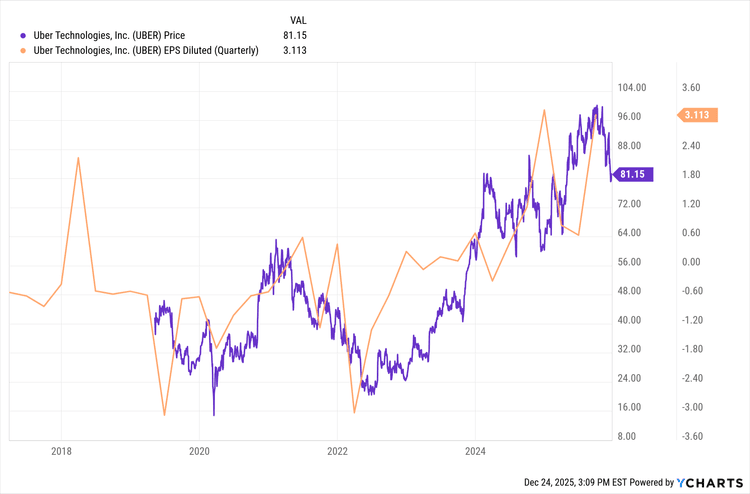
That divergence—price weakness alongside improving earnings power—was the opportunity. What changed wasn’t the business model overnight, but the economics underneath it. Incentive spending normalized post-pandemic, cost discipline improved, and scale finally began working in Uber’s favor.
By the time EPS flipped positive and the story became obvious, the stock had already repriced. That 2022–2024 gap is a textbook example of when negative earnings can still justify investment, provided the trajectory is moving faster than the market expects.
Now, if you were running one of Uber’s businesses as a general manager at that time, these were the metrics that mattered: contribution margin per trip, take rate stability, customer frequency, and incentive intensity. It’s always been about unit economics.
Over time, Uber reduced rider and driver subsidies, improved marketplace efficiency, and increased utilization without sacrificing demand. Each ride was generating more incremental profit, even if the company as a whole was still reporting losses.
This is what investors should have been watching during the negative-EPS years. Gross bookings per user were rising, variable costs per transaction were falling, and fixed costs were being leveraged across a much larger revenue base.
Of course, this approach isn’t foolproof. You can be wrong. Markets are complex, adaptive systems, and the prevailing view is that this information is always fully priced in. But looking at Uber, it clearly wasn’t.
Many analysts covering the stock failed to anticipate how quickly earnings would inflect once unit economics reached critical mass. That gap between perception and reality is why alpha still exists, especially for retail investors willing to do the work.
Binary, Asymmetrical Event with a Catalyst Date
Here, the investment case is not built around a company steadily becoming profitable over time. It’s built around a specific, overwhelmingly positive catalyst that can trigger a rapid repricing. Sometimes that repricing gives you a clean exit. Other times it ends with an outright acquisition by a larger rival.
The most obvious place this shows up is biotech, but this niche requires deep, specialized knowledge. You need a working understanding of FDA processes, clinical trial design, endpoints, statistical significance, adverse events, trial phases, and how regulators actually make decisions.
If that isn’t your background, that’s fine. It doesn’t mean this framework is invalid. It just means you should be honest about whether you’re equipped to execute it. You can also find similar setups in industries like offshore oil and junior mining.
One example that illustrates the structure well is CRISPR Therapeutics AG (CRSP). For those unfamiliar, CRISPR develops gene-editing therapies, and it has an FDA-approved treatment called Casgevy for sickle cell disease. Commercialization is ongoing through a revenue-sharing partnership with Vertex Pharmaceuticals (VRTX), split 60% to Vertex and 40% to CRISPR.
What matters for this discussion is what came before that approval. For most of its public life, CRISPR followed the standard biotech playbook. The company burned cash quarter after quarter while investors focused on binary events along the roadmap. Trial readouts. Regulatory decisions. Approval milestones. Each successful step created the potential for a sharp repricing, even while earnings remained negative.
If you look at the chart, you’ll notice that investing during long stretches of negative EPS would not have been irrational. Investors understood there was a known catalyst ahead. The losses were tolerated because they were financing an asymmetrical payoff.
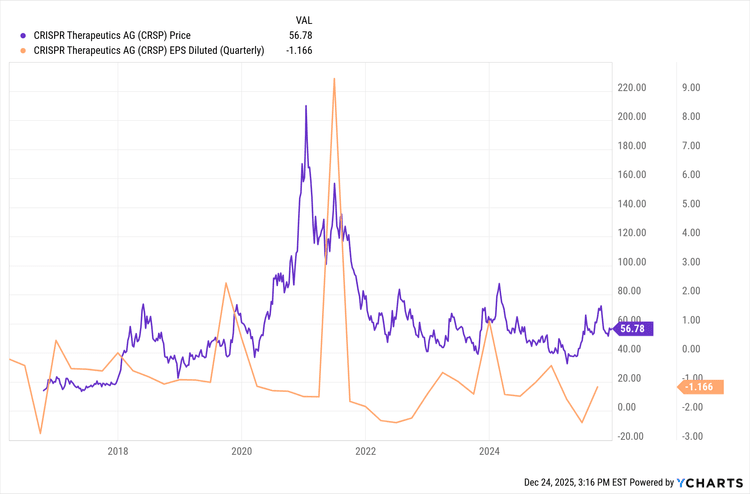
When the stock rallied on positive trial data or regulatory progress, management often used that strength to raise capital, fortify the balance sheet, and extend runway. That dilution was not ideal, but it was survivable because the upside events were discrete and meaningful.
Managing this type of investment is harder than the first category. You’re not only estimating the probability of success, but also timing and runway. If approval takes longer than expected, or a trial misses its endpoint, dilution can overwhelm any future upside.
If this is the type of negative-earnings company you’re considering, you need to be precise with your exit plan. Do you have a plan to take profits on a pump, or are you explicitly underwriting a longer-term acquisition that may arrive at a valuation you don’t control?
But there’s also a third outcome that often gets overlooked. Instead of a buyout or a well-timed exit on a catalyst-driven spike, the biotech can successfully commercialize the product on its own and transition into a self-funding business. When that happens, the negative EPS story stops being event-driven and starts to resemble the first category we discussed with Uber.
In my view, that’s the path CRISPR appears to be moving toward with Casgevy. The unit economics support it. The therapy carries a price tag north of $2 million per treatment, and the total addressable market for sickle cell is large enough that even modest penetration can move earnings meaningfully.
If you decide to stay in a trade like this beyond the catalyst phase, your job as an investor changes. You start paying close attention to cash on hand versus debt, how much of that debt is short-term or long-term, and what the coupon structure looks like.
You look closely at management’s history with dilution and stock-based compensation to gauge how shareholder-friendly they are likely to be as revenues ramp. Most importantly, you set a personal tolerance window for negative earnings. You’re effectively underwriting how long you’re willing to endure losses while commercialization scales.
EPS still matters here, but context matters more. You track it every quarter, but you also look at what’s driving it. You want to see recurring revenue building, not one-off accounting items or temporary adjustments. When negative earnings are paired with steadily rising, durable revenue, that’s when it can potentially evolve into a long-term compounder.
As written by Tony Dong, MSc, CETF.
PS: I am sure some of you may forward this, but please do so sparingly and encourage others to sign up here. Thank you!
