
Volume 132 | February 6, 2026


Click on the above image and use code sxst3gkbkn to hear the audio version.
Reminder to JOIN the The PhySec Collective community Slack channel to network, engage, and be part of something big! You can sign up here.
My summary in 4 words: Peak performance, platform opportunity
Download the State of Security Integrators 2026 report here.
An industry at its inflection point
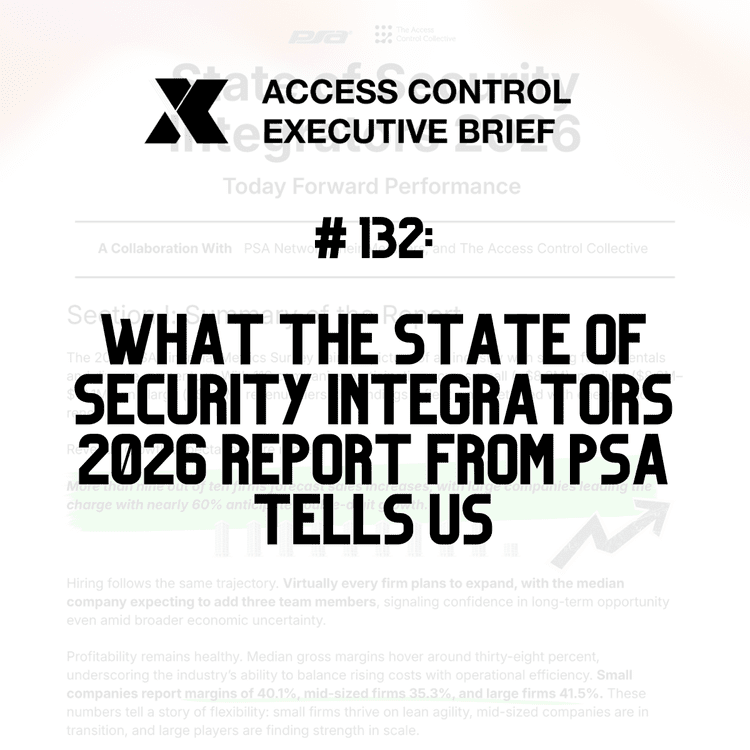
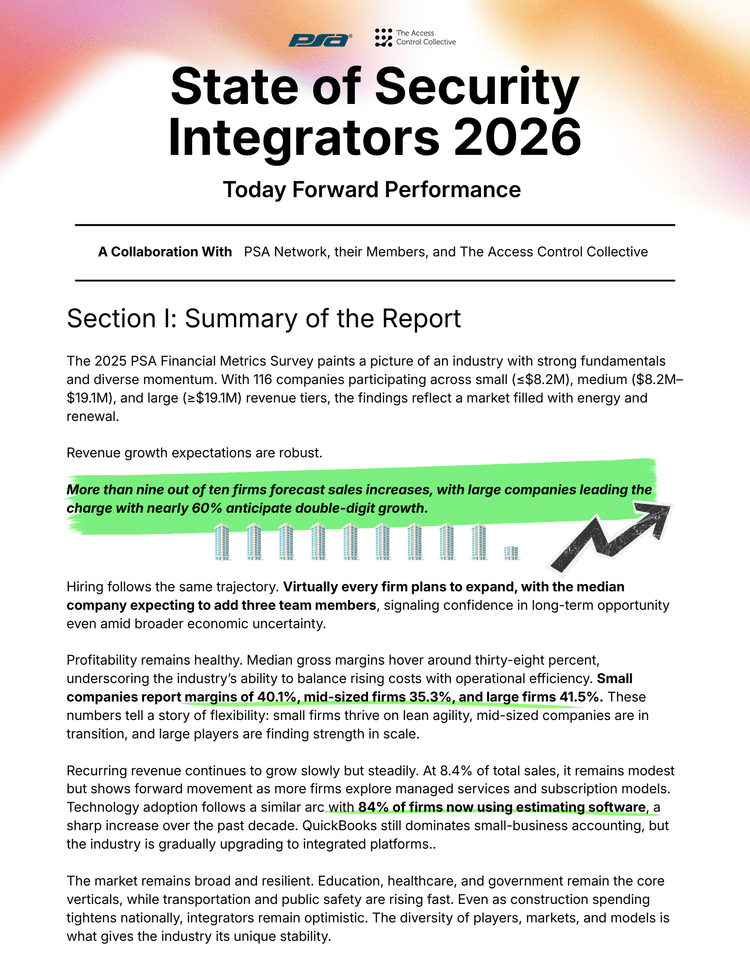
As you may have heard, we partnered with PSA to create the State of Security Integrators 2026, based on PSA’s proprietary 2025 PSA Financial Metrics Survey, which included 116 security integration firms. The report reveals an industry at the threshold of its greatest transformation (one we have written a lot about). The report told us that over 90% of firms expect revenue growth. Nearly 60% of large firms forecast growth above 10%. Every surveyed firm plans to hire. Gross margins hold steady near 38%. The demand is real, the momentum is clear, and the opportunity window is wide open.
But the same data also reveals why this moment matters so much: the industry’s current success is built on a foundation that won’t support its future. When 92% of revenue comes from one-off capital projects and recurring revenue accounts for just 8.4%, integrators aren’t building businesses; they’re running on treadmills. The good news? The path forward has already been mapped by enterprise software systems integrators (a.k.a. SI’s) who faced this exact inflection point 15 years ago and emerged as strategic advisors, managed service providers, and essential infrastructure partners.
This is the security integrator’s moment to make that same leap as market conditions are favorable, technology platforms exist, customer demand for outcomes over installations is growing, and the firms that move first will capture disproportionate value as the industry transforms from project-based installation to platform-enabled service delivery.
The opportunity in becoming infrastructure+ managers
The most exciting opportunity in the survey data isn’t what integrators are doing today. For me, it was what they could be doing tomorrow. Consider what happens when recurring revenue moves from 8% to 25% of total sales. Project volatility smooths out, cash flow becomes predictable, valuations multiply, talent retention improves because employees see career paths, not just jobs, and customer relationships deepen from transactional to strategic.
This isn’t hypothetical. Enterprise software systems integrators made this exact transition. They started as implementation shops installing Oracle and SAP systems. Today, they’re managed service providers delivering continuous optimization, cloud migration, AI integration, and strategic advisory services. They transformed from “rack and stack” to “architect and optimize.” The same path lies open to security integrators right now.
The emerging service categories are already clear:
Identity-as-a-Service: Managing credential lifecycle across physical, digital, and cyber domains. As organizations converge their access systems, they need partners who can manage the whole identity infrastructure, not just install readers and controllers.
Compliance and Audit Support: Delivering continuous compliance monitoring, automated reporting, and audit readiness as a service. Every regulated industry needs this, and most organizations lack the internal expertise to do it well.
Outcome-Based SLAs: Guaranteeing uptime, incident response times, and system performance rather than selling time-and-materials labor. This shifts the conversation from cost to value and positions integrators as risk managers, not vendors.
AI-Enabled Predictive Maintenance: Using data analytics and machine learning to predict failures before they happen, optimize system performance, and reduce operational friction. This transforms reactive service calls into proactive infrastructure management.
Cloud Migration and Platform Integration: Helping customers transition from on-premise systems to cloud-native platforms while maintaining security, compliance, and operational continuity. This is table stakes for the next generation of access control deployments.
These services don’t require abandoning installation work (which is currency if you use it). They require adding layers of value on top of installation that customers will continuously pay for, because they deliver continuous outcomes.
Scale can be your advantage
The margin data shows something important: medium-sized firms, with 35.3% gross margins, are underperforming both small firms at 40.1% and large firms at 41.5%. But this isn’t a condemnation of growth at all. What it is is a signal that growth without operational transformation hits a ceiling.
The firms that break through will be those that use scale as a platform for investment. Larger operations can afford to build dedicated service delivery teams, invest in business intelligence systems, develop standardized service frameworks, and attract specialized talent that smaller firms can’t justify. The key is recognizing that growth and efficiency require intentional design, not just more projects and more hires.
Enterprise software integrators proved this. The leaders invested in delivery frameworks, offshore capacity models, and technology partnerships that converted linear labor into leveraged service delivery. Security integrators can make the same investments. The difference between a $15 million integrator and a $50 million integrator shouldn’t just be headcount. The difference should be in capability, sophistication, and margin structure.
Technology adoption is accelerating
The survey shows 80% of firms now use estimating software, up from 60% in 2013. This signals an industry increasingly comfortable with digital tools and process automation. The next wave of technology adoption, like professional services automation, cloud-based business systems, and customer relationship management platforms, will separate the firms building durable businesses from those still running on spreadsheets and manual processes.
The opportunity here is enormous ($100B). Modern business systems don’t just track revenue. What they do is enable resource optimization, margin visibility, project forecasting, and customer intelligence. They allow integrators to operate like technology companies rather than construction contractors. And as cloud-native platforms become the norm in access control, integrators with cloud-native business systems will have natural advantages in service delivery, customer engagement, and operational efficiency.
This isn’t about replacing QuickBooks out of snobbery. It’s about building the infrastructure required to deliver managed services at scale, manage complex customer relationships over time, and compete with software-native entrants who are building services-as-software business models.
Vertical strength creates service opportunities
Education, government, and healthcare dominate integrator revenue, while transportation and public safety show the strongest growth. This concentration in critical infrastructure creates natural opportunities for recurring service models. Schools need continuous compliance monitoring. Hospitals need guaranteed uptime. Government facilities need audit-readiness and incident-response capabilities.
These aren’t installation problems. What they are is ongoing operational requirements. And organizations in these verticals increasingly prefer partnering with service providers who guarantee outcomes rather than managing vendor relationships themselves. The integrator who can say “we’ll guarantee 99.9% uptime and handle all compliance reporting” wins against the integrator who says “we’ll install the system and be available for service calls.”
The vertical concentration also creates opportunities for specialization. The firms that develop deep expertise in healthcare regulatory requirements, K-12 safety protocols, or government security standards can command premium pricing and build defensible competitive positions. Specialization allows smaller firms to compete effectively by offering domain expertise that generalists can’t match.
The 2027 horizon and time to go hybrid
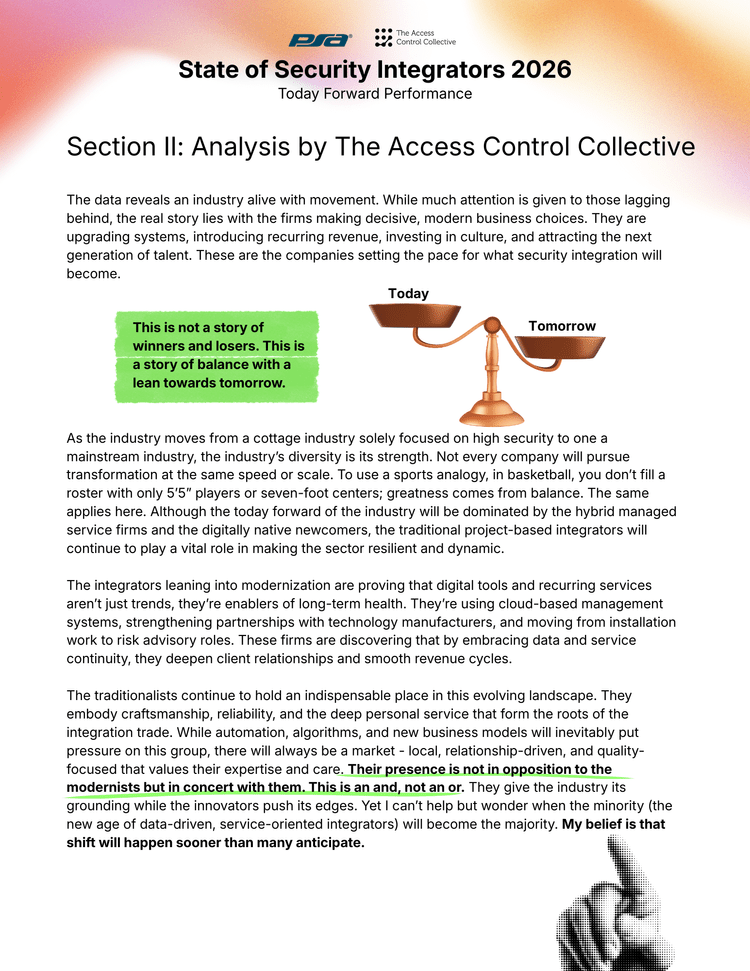
Within two years, we’ll see the first wave of security-native managed service providers that represent the industry’s future. They will combine traditional integration capabilities with cloud platform expertise, API fluency, data analytics, and outcome-based service delivery. They will compete not just with other integrators but with enterprise software vendors, cloud identity platforms, and facilities management companies.
These hybrid firms will look like technology companies that happen to understand physical security, rather than security contractors trying to add technology services. They will attract software engineers, not just technicians. They will sell subscriptions, not projects. They will measure success in customer outcomes, not installation volume. And on and on.
The firms that make this transition won’t come from the top 10% of today’s integrators. They will come from the 5% willing to make irreversible bets on new business models. They’ll be the ones who see platform partnerships as growth engines rather than threats. They’ll be the ones who invest in service delivery infrastructure before customers demand it. They’ll be the ones who hire for the business they want to build, not the business they have. (Notice a cadence? Good).
Market consolidation will accelerate this transformation. Just as Accenture, Deloitte, and Infosys rolled up the IT services industry, expect roll-ups in physical security driven by firms seeking scale, capability, and geographic reach. But consolidation creates opportunities for independents who specialize deeply or build distinctive service capabilities, making them attractive acquisition targets or preferred partners.
The path forward with these 5 strategic moves
The integrators who will lead the industry’s next chapter are already making these moves:
First, they’re deliberately building recurring revenue. Not hoping it appears organically, but launching specific service offerings like credential lifecycle management, compliance reporting, and managed monitoring, with dedicated delivery teams and clear pricing models. The target is to reach 20-30% recurring revenue within 24 months, transforming the business model and customer relationships.
Second, they’re investing in business systems infrastructure and moving beyond basic accounting to professional services automation platforms that integrate customer relationship management, resource planning, project tracking, and financial analytics. These systems enable the operational sophistication required to deliver managed services profitably at scale.
Third, they’re repositioning around outcomes, not installations, and leading sales conversations with business value, with reduced operational friction, guaranteed compliance, improved user experience, rather than product features and technical specifications. This shifts the discussion from price to value and positions integrators as strategic advisors.
Fourth, they’re redefining talent and career paths. Positioning roles as “identity infrastructure engineer” rather than “security technician” and building apprenticeship pipelines with technical colleges focused on cloud platforms, APIs, and service delivery. The work itself is changing, and firms that acknowledge this will win the talent war.
Fifth, they’re embracing platform partnerships early. Aligning with cloud access providers, identity platforms, and AI-enabled monitoring tools as strategic partners rather than reluctant vendors. The firms that become the local delivery arms for platform-first solutions will capture more value than those trying to maintain proprietary integration approaches.
A cautionary tale of the AV Integrator
To understand what happens when an industry waits too long to transform, look at the commercial audiovisual integration industry. Twenty years ago, AV integrators (note: I used to own an AV integration firm here in DC called Energy + Light + Control. I met my wife at CEDIA. I love the AV industry) were highly specialized professionals commanding premium pricing for complex installations in conference rooms, auditoriums, and control centers. They sold expensive proprietary systems that required deep technical expertise to configure and maintain (I still have some old AMX, Crestron, and Elan systems in boxes in my basement storage).
Then three things happened. First, hardware commoditized. Display technology improved so dramatically that “good enough” became excellent, and prices dropped 90%. Second, software platforms like Zoom and Microsoft Teams, and standardized control systems, eliminated most custom integration work. Third, IT departments absorbed AV responsibilities as systems became network-based rather than standalone.
The result? AV integrators who defined themselves by installation expertise found themselves competing primarily on labor rates for commodity deployments. Margins collapsed. Differentiation evaporated. The firms that survived either moved dramatically upmarket into highly specialized niches, think high-end homes, stadiums, and broadcast facilities, or transformed into managed service providers focused on monitoring, optimization, and user experience rather than equipment sales.
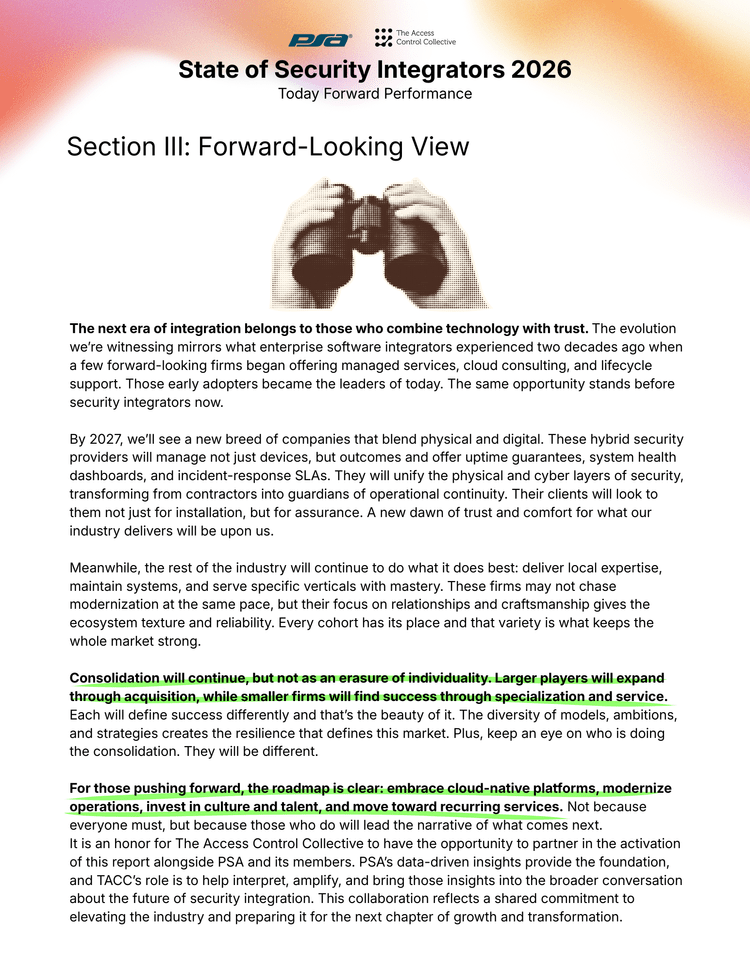
The parallels to physical access control are uncomfortable. Hardware is standardizing, cloud platforms are eliminating the need for proprietary configuration expertise, and IT and facilities teams are converging. The window to transform from installer to infrastructure manager is open now, but it won’t stay open indefinitely.
The AV integrators who saw the shift coming and moved early. They built service delivery capabilities, partnered with platform providers, and repositioned around outcomes. Not only have they survived, but they have thrived. The ones who insisted “our relationships and expertise will always matter” discovered that relationships without differentiated capability have limited value when customers can deploy systems themselves.
This isn’t fear-mongering. It’s pattern recognition. The security integration industry has perhaps three to five years before cloud-native platforms, AI-enabled configuration, and direct-to-customer models fundamentally reshape competitive dynamics. The firms moving now aren’t reacting to a crisis, but positioning for opportunity while they still have runway to build new capabilities.
It is go time
The state of the integrator in 2026 is not fragile…it’s transitional! The industry is experiencing peak demand and strong performance precisely when its business model needs to evolve. This is the ideal time to transform. There’s cash flow to invest, there’s customer demand to validate new services, and there’s market momentum to support bold moves.
The survey data doesn’t reveal an industry in crisis, but one that is being handed an extraordinary opportunity on a silver platter. The question isn’t whether transformation is possible… enterprise software integrators have already proved it is. The question is who will move first, who will move fast, and who will still be running installation-only businesses when the market has moved on.
There has never been a better time to be in this industry. The organizations that need what integrators can provide, like schools, hospitals, government facilities, and commercial real estate, are not going anywhere. The demand for secure, compliant, user-friendly access control is only growing. The technology platforms that enable new service models already exist and are maturing rapidly.
The winners will be the firms that see 8.4% recurring revenue not as a limitation but as a starting point. It will be the firms that see platform partnerships as growth accelerators rather than threats. It will be the firms that redefine themselves as infrastructure managers rather than installers. And it will be the firms that move now, while they’re still profitable and growing, rather than waiting until transformation becomes survival.
This is not a warning. It’s an invitation to lead the industry into its next era.
Who is with me??!!??!! 🙂
PS: I am sure some of you may forward this, but please do so sparingly and encourage others to sign up here. Thank you!
