
Volume 136 | March 11, 2026
Reminder to JOIN the The PhySec Collective community Slack channel to network, engage, and be part of something big! You can sign up here.
In one of my earlier briefs, I walked through how, despite a customer base that is quite literally dying off, Altria Group has delivered total returns, including reinvested dividends, that have meaningfully outperformed the S&P 500 over long stretches of time.
The point wasn’t to glorify cigarettes. It was to highlight that there can be opportunity in so-called legacy industries. Businesses that lack flashy year-over-year revenue growth. Companies whose management teams aren’t pitching ambitious five-year TAM expansions or AI-enabled transformations.
Some industries are about extraction. These are what I call depletion industries. This is one in which the underlying monetizable base, whether that’s customers or natural resources, is expected to decline over time. The product is either socially discouraged, environmentally constrained, or physically finite.
In tobacco, the monetizable base is smokers. In developed markets, smoking rates have been trending downward for decades due to regulation, health awareness, and taxation.
In oil, the depletion is more literal. Hydrocarbon reserves are finite. Even if demand remains durable for longer than many expect, each barrel extracted reduces the remaining stock in the ground.
On the surface, both industries look structurally challenged. Yet companies in depletion industries are not judged solely on top-line growth. That may not be great for society or the environment. But for shareholders, it can be extremely lucrative.
Through pricing power, cost discipline, capital allocation, and occasionally financial engineering, management can extract increasing amounts of value from a shrinking base. They can consolidate competitors. They can cut costs. They can raise prices faster than volumes decline. They can return capital aggressively through dividends and buybacks.
Today, we’re going to revisit the Altria case and contrast it with another depletion industry: Big Oil. Specifically, we’ll compare tobacco’s capital-light, pricing-driven cash machine with the capital-intensive, cyclical world of oil, using Exxon Mobil as our reference point.
Both operate in industries facing long-term structural headwinds. Both generate enormous cash flows. Both return significant capital to shareholders. But the way they deplete their underlying base, and the way that depletion translates into shareholder outcomes, is very different.

Click on the above image and use code sxst3gkbkn to hear the audio version.
Altria: Depletion, Pricing Power, and Per-Share Alchemy
It’s no secret that Altria Group has had stagnant revenue for years. On the surface, that seems incompatible with what we’re taught makes a good investment.
Inflation erodes purchasing power. If a company isn’t growing its top line meaningfully year after year, logic suggests that the multiple investors are willing to pay should compress. Less growth, lower valuation, lower stock price.
But public markets don’t price companies on what they sell. They price them on what they keep. More specifically, what they keep per share.
If you look at Altria over the past decade, total annual revenue from 2016 to 2026 has barely moved. It’s up roughly 4% over that entire stretch. Cumulative inflation over the same period has been far higher. On a nominal basis, this is stagnation. On a real basis, it’s decline.
Yet that’s only one lens. Look at revenue per share over that same period. That figure has increased more than 20%. The pie didn’t get much bigger, but the number of slices shrank.
Now zoom in further. Revenue per employee is up roughly 47% over that same stretch. That’s an enormous increase in productivity. The cost to produce and distribute a pack of cigarettes has been relentlessly optimized.
https://images.squarespace-cdn.com/content/5e0a665869e6a309a7008bd3/92da87d2-931d-46e1-a3ba-3d4370cd38d8/depletion+1.png?content-type=image%2Fpng&format=750w
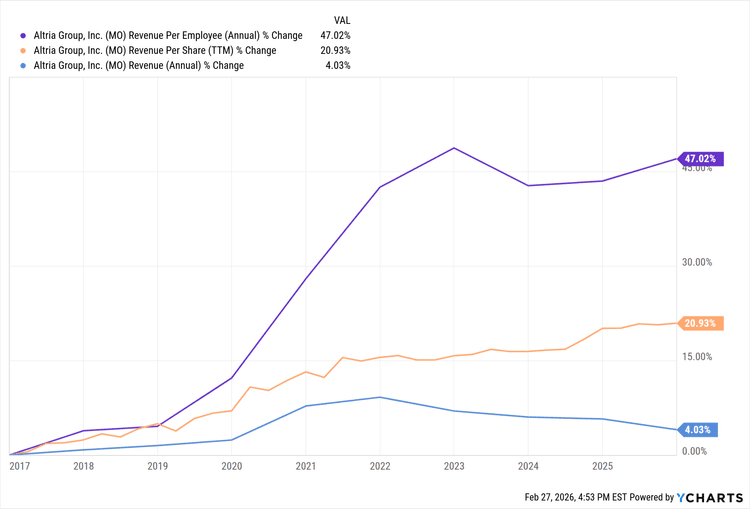
This is the essence of a well-managed depletion business. The underlying monetizable base, smokers, is shrinking. Volumes decline each year. But Altria offsets that with price increases and cost discipline.
If you smoke a pack a day, and the price goes from $20 to $22 next year, you likely don’t quit over a 10% bump. For the consumer, it’s incremental. For Altria, assuming costs remain stable, that price increase flows disproportionately to margin. That’s the power of addiction combined with inelastic demand.
Now look at what that operating model enables. While revenue barely budged over the decade, dividends per share nearly doubled, from about $0.56 quarterly to roughly $1.06 today. That’s a twofold increase in shareholder payout without meaningful top-line growth. Altria is one of a small group of Dividend Kings that have raised their payout for more than 50 consecutive years.
When management believes the stock is undervalued, they also retire shares. Through aggressive, opportunistic buybacks, Altria reduced shares outstanding so that each remaining share represented a larger claim on the same revenue base.
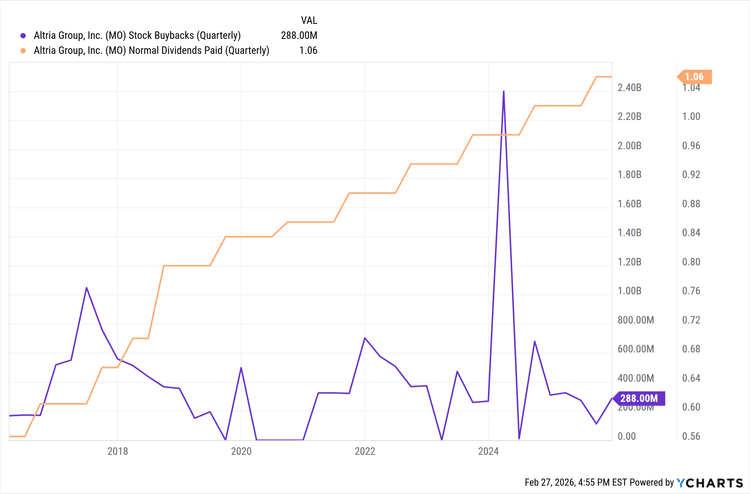
Altria optimized a shrinking base, extracted more profit per unit, reduced overhead, and concentrated ownership through buybacks while returning 80% of their free cash flow on average as dividends. That’s how a depletion industry, with flat revenue and declining volumes, can still deliver strong total returns.
ExxonMobil: Depletion in an Earlier Stage and Strategic Consolidation
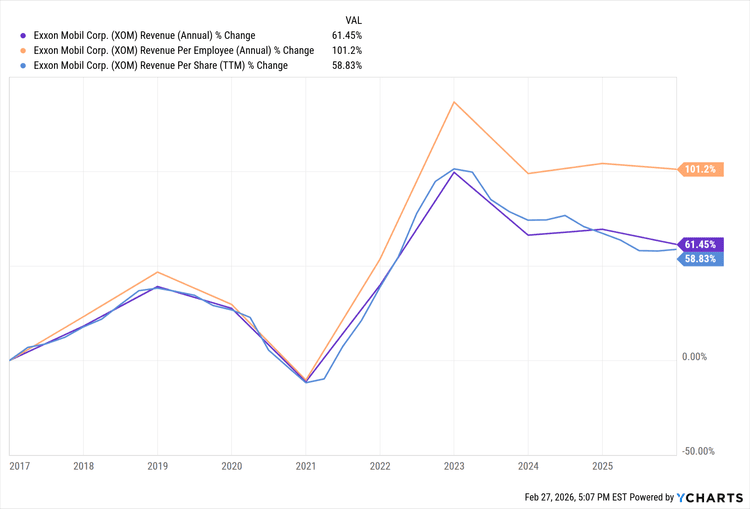
Where Altria’s top line has been essentially flat over the past decade, ExxonMobil tells a very different story. Over the same period that Altria’s revenue barely budged, ExxonMobil’s total revenue has grown meaningfully even as it operates within its own version of a depletion industry. That alone underscores a key distinction: not all depletion dynamics look the same at the same stage of the cycle.
But the patterns around per-share metrics tell a similar efficiency story. Revenue per share and revenue per employee have also risen over this period, a sign that ExxonMobil hasn’t just grown its top line but has become more productive and capital-efficient as it integrates acquisitions and scales operations.
Part of this contrast reflects the historical trajectories of their industries. Tobacco’s “glory days” of growth were largely behind it by the early 2000s, as regulation, litigation, taxation, and public health campaigns eroded smoking prevalence in developed markets. Big tobacco shifted into pricing power, cost discipline, and capital returns as a way to extract value from a shrinking customer base.
Big oil hasn’t yet faced an equivalent secular decline in its monetizable base. There are meaningful long-term headwinds — energy transitions, climate policy, electric mobility — but the demand curve for hydrocarbon energy has been supported by industrial growth, emerging market consumption, and geopolitical realities.
Advancements in drilling and extraction technology — horizontal drilling, hydraulic fracturing, deepwater platforms, enhanced oil recovery — have unlocked vast reserves, extended the life of existing fields, and expanded economically recoverable resources far beyond what was once thought possible.
These structural and technological tailwinds have allowed ExxonMobil to continue growing revenue in an industry where historically the depletion of resources was assumed to lead to structural decline.
How ExxonMobil deploys its cash flows also reflects industry realities. ExxonMobil, like Altria, returns capital to shareholders through dividends and buybacks. It has a long standing record of dividend increases — over 25 consecutive years — that places it among the dividend aristocrat cohort, and it has complemented that with episodic buybacks when management deems the shares attractively valued.
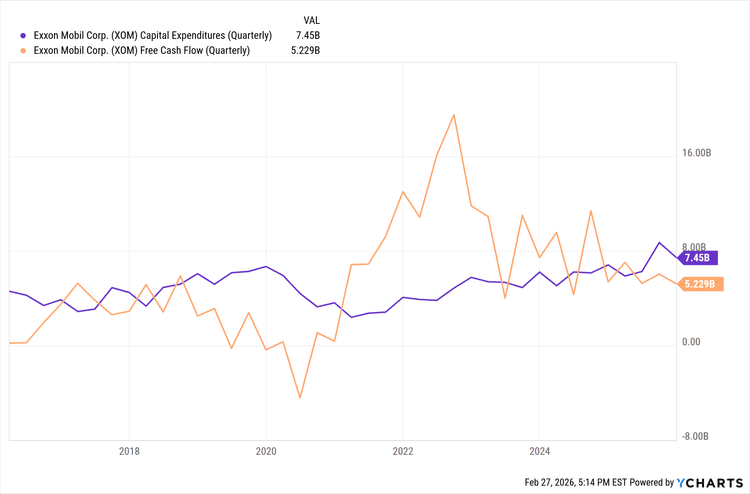
But ExxonMobil also uses its financial firepower for consolidation and strategic asset acquisition in ways that are distinct from Altria’s buyback-led extractive model. Big oil is capital-intensive. The economics of finding, developing, and producing hydrocarbons are expensive, risky, and scale-dependent. You can see it here with how much they spend on capex relative to their free cash flow.
One of the most consequential recent deals was ExxonMobil’s acquisition of Pioneer Natural Resources, a Permian Basin operator in a transaction valued at roughly $60 billion. The combined company controls more than 1.4 million net acres with an estimated 16 billion barrels of oil equivalent resources — a rare scale in one of the world’s most productive hydrocarbon basins.
This kind of deal isn’t about growing EPS. It’s about extending the lifespan of ExxonMobil’s reserve base, securing advantaged production positions, and achieving lower unit costs over decades — effectively shifting the depletion curve outward.
In oil, analysts watch reserve life, cost per barrel produced, and trajectory of proved reserves as much as earnings metrics, because the value of an acquisition often lies in the future cash flow those barrels will generate over many years or even decades, discounted appropriately for commodity prices, political risk, and environmental constraints.
Contrast this with the way acquisitions are often viewed in tech or traditional corporate playbooks. In software, accretion to earnings or removal of overlapping costs is a core metric. In energy, paying a fair premium for proven reserves that meaningfully improve long-term production potential can justify a large multiple today if it extends the runway of future cash flows substantially.
This pattern also underpins the broader structure of the oil industry. There’s a small hump of supermajors like ExxonMobil, Chevron, Shell, and BP, followed by a long tail of small and mid-cap explorers and producers. Smaller firms may strike a rich well or unlock a basin, but very quickly they find themselves acquirable.
Therefore, it’s often more capital-efficient for a supermajor to buy proven reserves than to fund risky exploration from scratch. That dynamic keeps ExxonMobil and its peers as the consolidators of choice, even as the underlying depletion story unfolds over decades rather than years.
In ExxonMobil’s case, revenue growth, strategic consolidation, and disciplined capital returns combine to illustrate a depletion industry that hasn’t yet run out of runway. It has simply transitioned from broad upstream growth to targeted reserve extension and efficiency-driven deployment of capital.
PS: I am sure some of you may forward this, but please do so sparingly and encourage others to sign up here. Thank you!
