
Volume 137 | March 19, 2026
Reminder to JOIN the The PhySec Collective community Slack channel to network, engage, and be part of something big! You can sign up here.
Hello! I wanted to get this Brief out to you before I (we all) headed to ISC West, but it got lost in the trade show shuffle.
This Brief does something the quarterly earnings calls rarely allow.
Allegion’s CFO, Mike Wagnes, sat down with J.P. Morgan at the J.P. Morgan Industrials Conference last week. This interview offers a bit less scripted guidance language. Sure, there are some industry relations-approved talking points on repeat, but it felt more like a conversation, and in that conversation, he said some things worth paying close attention to for what they confirmed and for what they also revealed.
Below is my transcript summary, analysis, and comparison to prior Briefs on Allegion, ASSA ABLOY, and dormakaba, as well as to this week's ISC West Frame.
Where these overlap is where it gets interesting.
Before I get into it: ISC West is here. If you’re heading to Las Vegas, I created a one-page resource, the ISC West Frame. It includes a sentence explaining the industry, summaries of the market shift, the five forces reshaping access control, four types of people on the floor, and three booth types. I built it with the whole show in mind, not just access control. (A hard copy is in Slack or reply to this Brief and I can send you it via email).
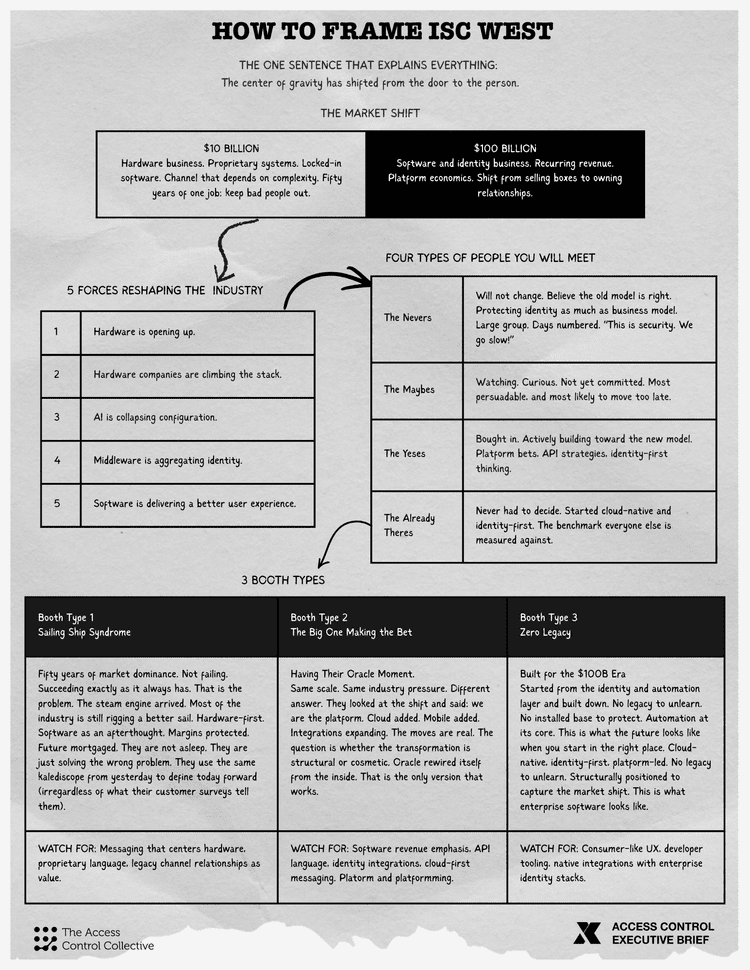
The analysis below maps directly to it. Please read the Frame first. It will change how the Allegion section lands.
For those not attending: the Frame is still the right lens for following ISC West coverage this week. Please use it in your own company and when you are engaging with the industry.
If you're in Las Vegas, please say hello. Thank you to the 400+ who attended the PhySec Collective Breakfast and the 40+ who joined us in the show's official podcast studio.
See you there.
Lee


Click on the above image and use code sxst3gkbkn to hear the audio version.
What was discussed by Allegion at the JPMorgan Conference
Mike Wagnes covered six areas: business overview, mechanical-to-electronics transition, end-market resilience, margin management, capital allocation, and AI. The framing was classic Allegion: disciplined execution, institutional stickiness, pricing power, and steady electronics tailwind. Nothing surprising or off script.
Headline numbers matched prior earnings: $4B in revenue, 25% EBITDA margins, over 30% of the portfolio in electronics (including software/services), continued residential softness (slightly down for 2026), and the Americas non-residential as the core engine.
How does this fit against what I shared in prior Briefs?
On earnings consistency: This transcript tracks exactly with what the Briefs have documented across multiple quarters. Allegion’s Q3 2025 showed revenue of $1.07B with 10.7% reported growth and 5.9% organic, with adjusted operating margin at 24.1% and free cash flow up 25% year over year. Wagnes’s JPMorgan framing is consistent with that trajectory: strong Americas execution, international still lagging, residential a drag.
The Q2 2025 earnings showed Allegion breaking $1B in quarterly revenue for the first time, with adjusted EPS up 4.1% and Americas non-residential growth in the high single digits. But international was down organically by 2.2% again, and residential softness continued. The JPMorgan conference confirmed the same pattern. International is a persistent weakness Wagnes acknowledged, though he reframed the narrative as a “great improvement story” from 0% operating margin in 2013 to industry-standard mid-teens today. I love this framing. The fact is this, though... international should be a persistent strength, and you don’t get a cookie for growth from 2013 (13 years later). Unfortunately, this is a “what have you done for me lately” market, and lately, international has been a persistent (and fixable) weakness.
On the transformation narrative: Wagnes characterized the company as having more electronic engineers than mechanical engineers today and as having moved from “point solutions to platform solutions” (uh oh...notice the word “platform?”) in its electronics portfolio over the last four to five years. The Briefs noted that Allegion’s heavy dependence on the Americas market, price increases, and weak international growth raised concerns about concentration risk, and that hasn’t changed. Wagnes confirmed that the Americas account for 80% of revenue and shows no sign of diversifying.
On M&A as inorganic growth: Acquisitions have been closely tracked. Allegion acquired Gatewise, a Houston-based SaaS company with smart gate entry systems, expanding Allegion’s perimeter-to-unit coverage and complementing the Zentra platform for multifamily. They acquired Waitwhile, a cloud-based appointment scheduling and queue management platform powering over 300 million visits across healthcare, retail, and education. This inorganic growth has been framed as aligning with the “right access to the right people at the right time” thesis. They also acquired Trimco Hardware, adding 75 years of premium door hardware manufacturing expertise and expanding specifiable mechanical offerings. What Wagnes described at JPMorgan as roughly “50% of free cash flow to M&A” is visible in the acquisition cadence the Briefs have documented.
Here is how I see it in comparison to ASSA ABLOY and dormakaba
This is where it gets interesting.
Q3 2025 analysis noted that Allegion outgrew and outmargined ASSA ABLOY, but ASSA still led the digital transformation narrative with 12% growth in electromechanical solutions. The two companies were characterized as more side-by-side than competitors: Allegion winning through efficiency, ASSA through transformation.
That framing still fits. Wagnes isn’t telling a transformation story, but an execution story. The themes are “pricing and productivity cover inflation and investment,” “we compete on value, not price,” and “complexity is where we win.” This is a moat defense, not a market creation pitch.
ASSA ABLOY’s language is different. Their Global Technologies division is posting 8% organic growth and 18.5% EBIT margins. They complete 5 to 7 acquisitions per quarter. Their framing is offense, not defense.
dormakaba under Till Reuter is a third story. dormakaba announced a strategic joint venture with KINLONG, strengthening its position in the Chinese market and reflecting a more aggressive posture than prior leadership. Plus a flurry of acquisitions (the latest Any2Any) and interesting strategic investments (SwiftConnect and Safetrust), dormakaba is restructuring to compete more aggressively globally. Still mid-transformation, but directionally different from Allegion’s steady-state posture.
There were also new insights. In particular, these were evident when compared to the ISC West Frame I shared above.
Here are three things that stood out and haven’t been stated before.
1. Allegion positioned itself as a non-enterprise access control company.
Wagnes said it clearly: “We are not playing in the enterprise access solutions space. We partner with them.” This is a significant admission, and I am not sure it will stand the test of time. Against the ISC West tour framework, on the surface, this places Allegion firmly in Booth Type 2 territory. The company says it is making the bet by adding cloud and mobile, expanding integrations, but explicitly choosing not to own the platform layer. The “partner of choice” strategy is their answer to the platform squeeze (note: in enterprise. With Zentra, they are clearly looking to go up the stack and be the hardware and software of choice). The question the ISC West Frame raises is whether that position holds as middleware aggregates identity, and those enterprise partners become the center of gravity. If Allegion is perpetually partnering up the stack, they risk becoming a hardware vendor that happens to make premium hardware, which is exactly the Sailing Ship Syndrome dressed in better clothing. The question I have here is, “Is this cosmetic change or a structural change?” If it's cosmetic, they will be exposed. If it is structural, look out as you can expect significant long-term growth. My bet is they are still figuring it out, and that's what we are hearing.
2. The AI response was about operations, not strategy.
When asked about AI, Wagnes’s answer was order entry automation. That is a cost efficiency play. It is not a “we are rethinking how access control works” play. The ISC West tour describes Force 3 as “configuration is collapsing. AI and modern platforms are reducing weeks-long installs to minutes, and the legacy professional services moat is evaporating.” Allegion’s moat is partly built on complexity in the institutional channel. If AI commoditizes configuration, Allegion’s demand-generation model, which influences architects, creates campus standards, and pulls product through the channel, becomes less defensible. Wagnes’s answer suggests they are not yet treating AI as a structural threat to their core business model. That is worth watching closely.
3. The “complexity is where we win” idea cuts both ways.
Wagnes used this phrase twice. In the current market, it is true. Allegion wins because the institutional buying process is complex. Its distribution relationships are deep, and the product specifications are locked in for decades. But the ISC West tour is explicit: Force 5 is a cloud-native entrant delivering a generational UX gap. The Already Theres on the ISC West map started without complexity as their moat. Allegion’s answer is to bet that complexity will never go away in its core vertical. This is probably right for K-12 and government campuses over the next five years. Whether it holds for healthcare, higher ed, and commercial over the next decade is the real question.
To sum up the broader implications...
Allegion is executing well. The financial results are real, with strong margins and consistent electronics growth. But the JPMorgan transcript confirms what the Briefs have documented across multiple quarters: Allegion is a Booth Type 2 company that is very good at being one. The Oracle moment is happening. The question is whether it is structural or cosmetic. The explicit choice to stay out of enterprise access control, the AI-as-cost-reduction framing, and the complexity-as-moat thesis all suggest the transformation is disciplined but bounded. That is a different bet than ASSA ABLOY is making, and it is a very different world than the Booth Type 3 companies at ISC West are building toward.
FWIW, I do think it is structural.
That contrast is exactly what makes for a valuable conversation on the show floor.
PS: I am sure some of you may forward this, but please do so sparingly and encourage others to sign up here. Thank you!
