
Volume 139 | April 7, 2026
Reminder to JOIN the The PhySec Collective community Slack channel to network, engage, and be part of something big! You can sign up here.
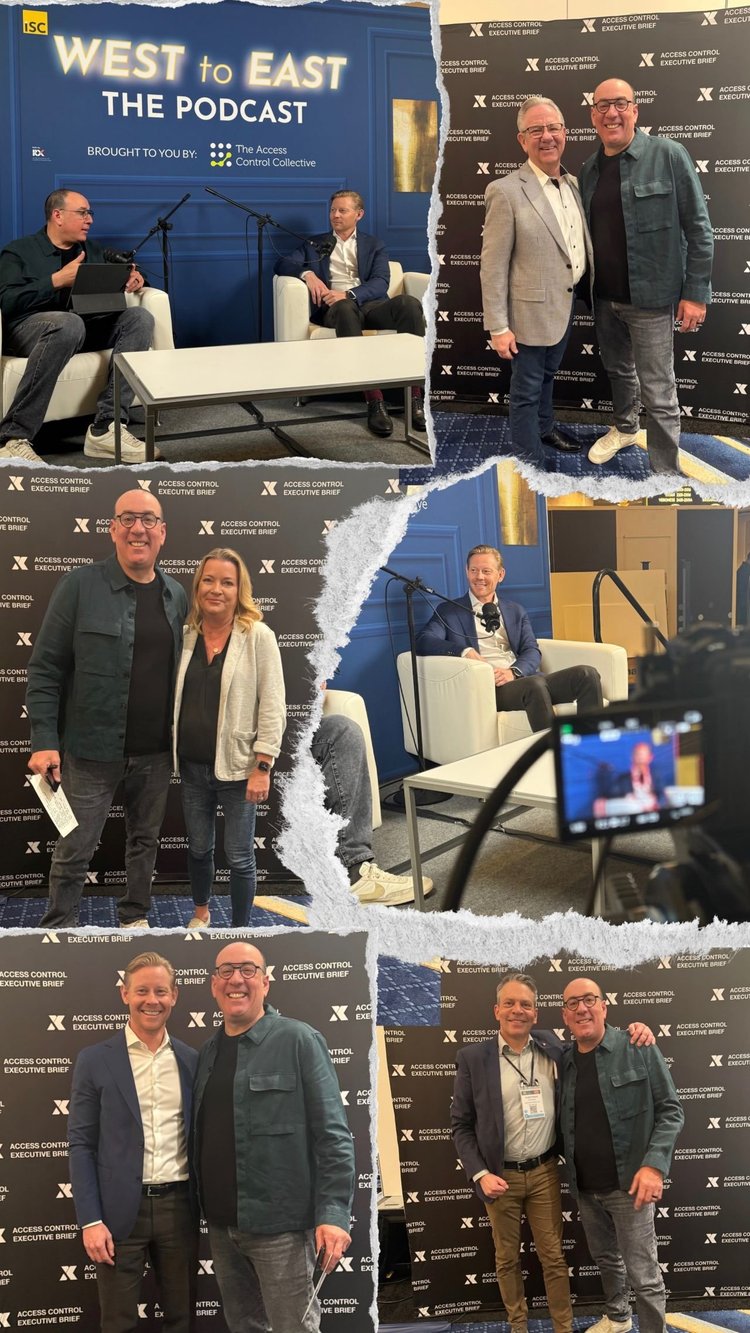
Part of my process when preparing to moderate a discussion or conduct interviews is working from large speaker cards. On those cards are my questions and the details I want to make sure I cover, and I always leave space to take notes in real time (hence the Sharpie I also always have with me). I was never formally trained to moderate or interview people, but what I do have is hundreds upon hundreds of both under my belt, and over time, that experience built a system that actually works for me.
I have also come to realize that moderation or interviewing is not something you can just pick up and do well (I know some leaders in our industry believe that because you have a VP or C-Suite title means you can... and I would argue you are wrong). You need practice and experience because you are doing several things at once: listening, reacting, managing time, reading the room, and staying curious. All of this happens in real time. The cards keep me on track, and they give me a place to capture what is happening as it happens.
One card in particular is where this kind of content comes from. I keep one blank card reserved specifically for tracking trends, interesting quotes, and topics worth coming back to. That card is how a Brief like this one comes together, quickly, after a run of interviews.
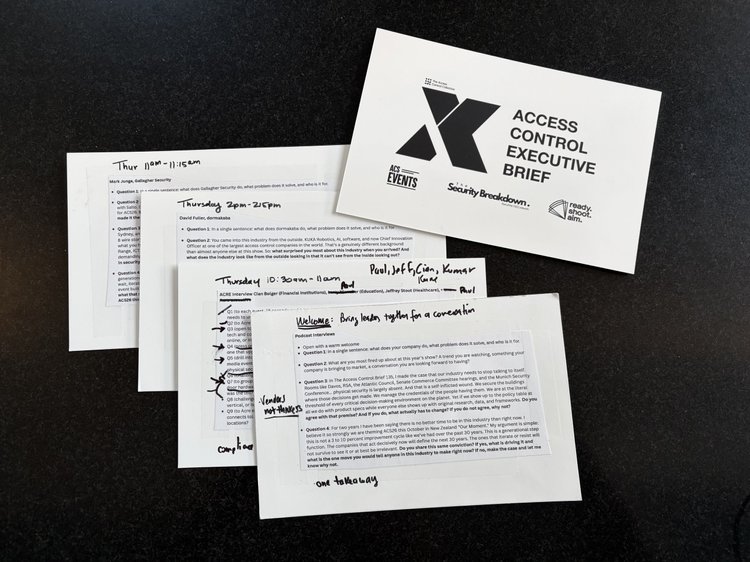
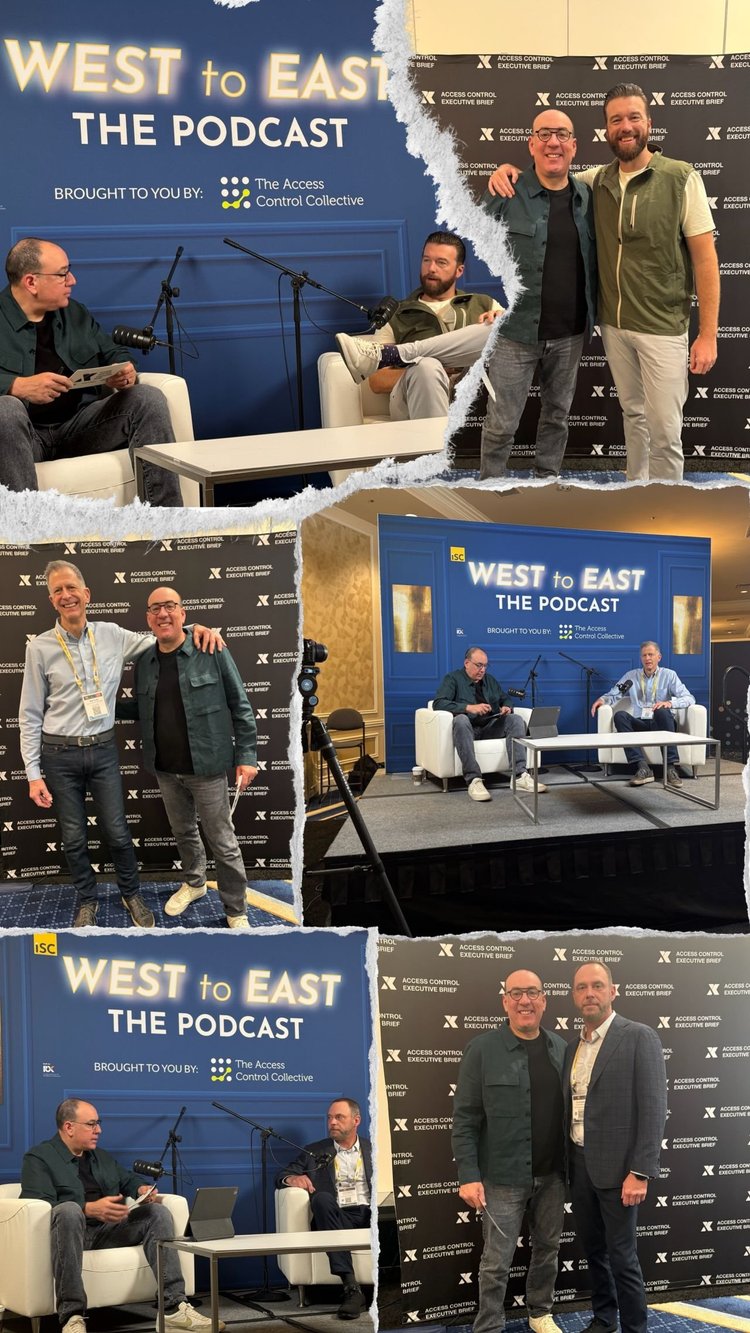
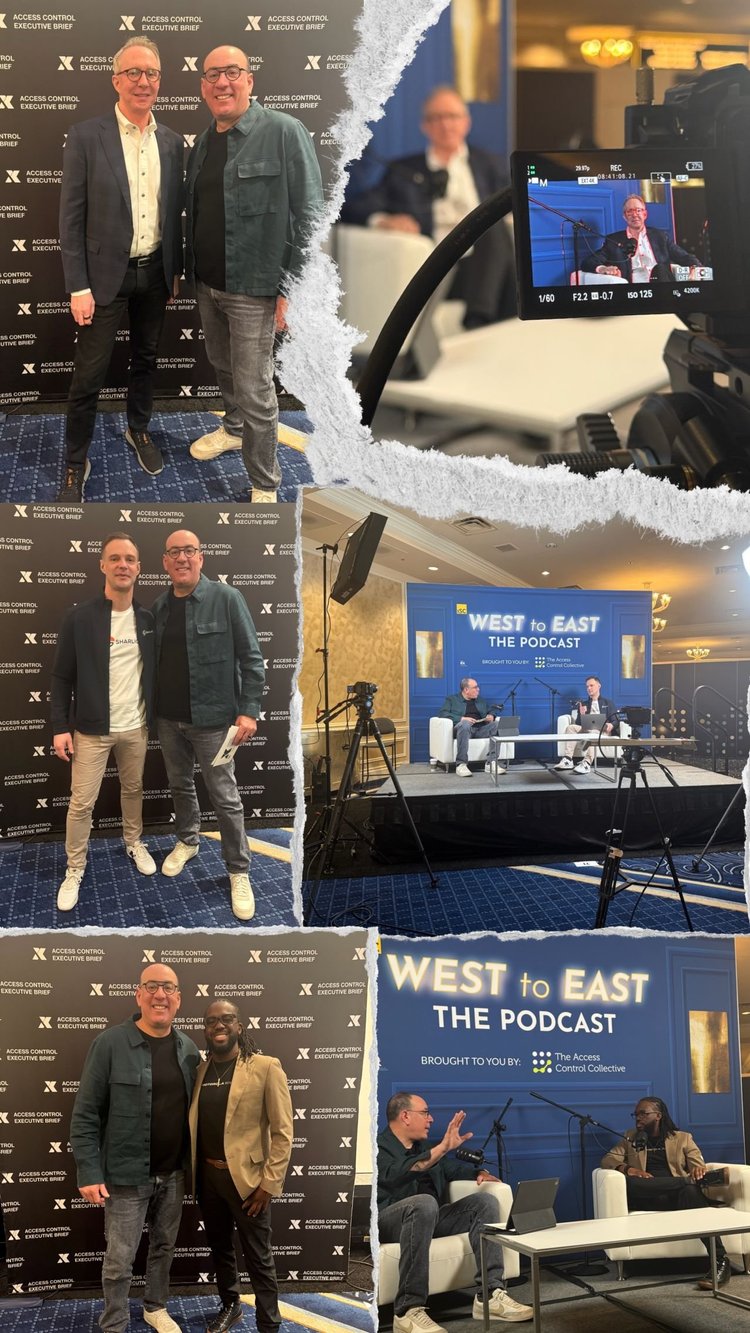
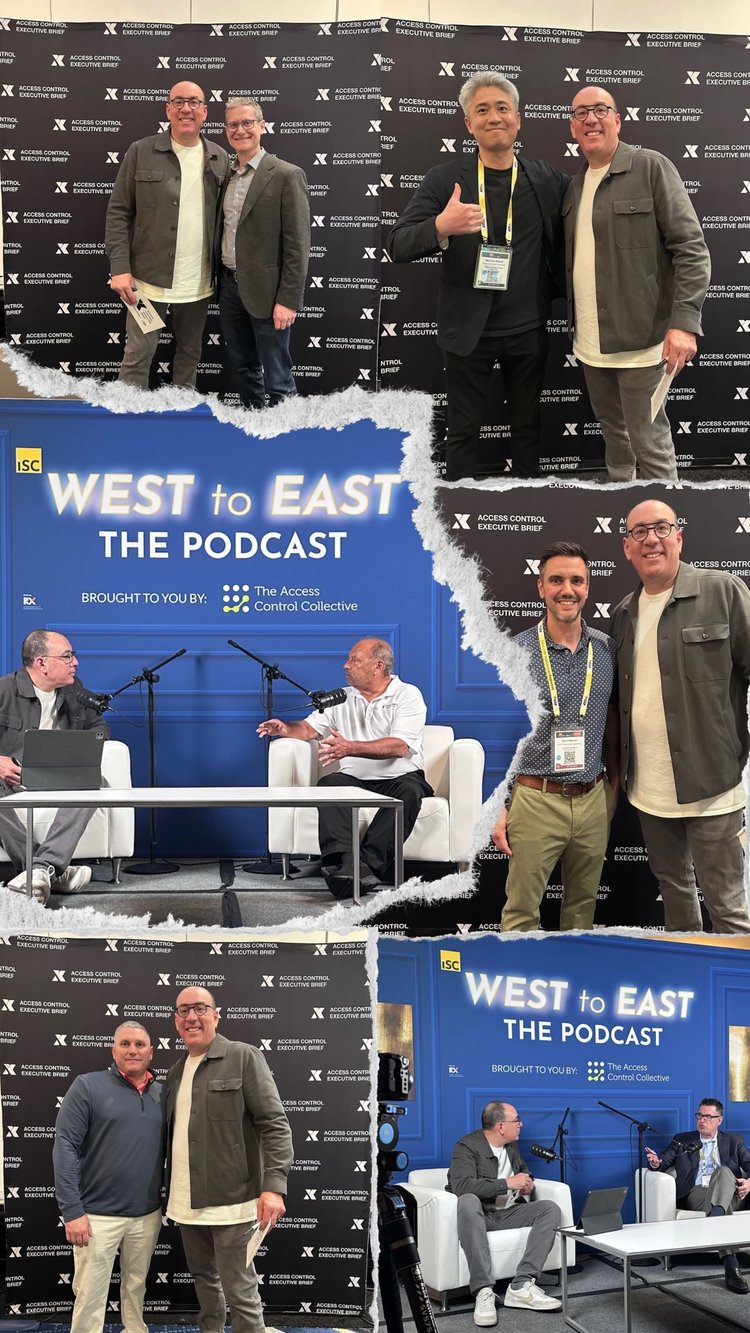
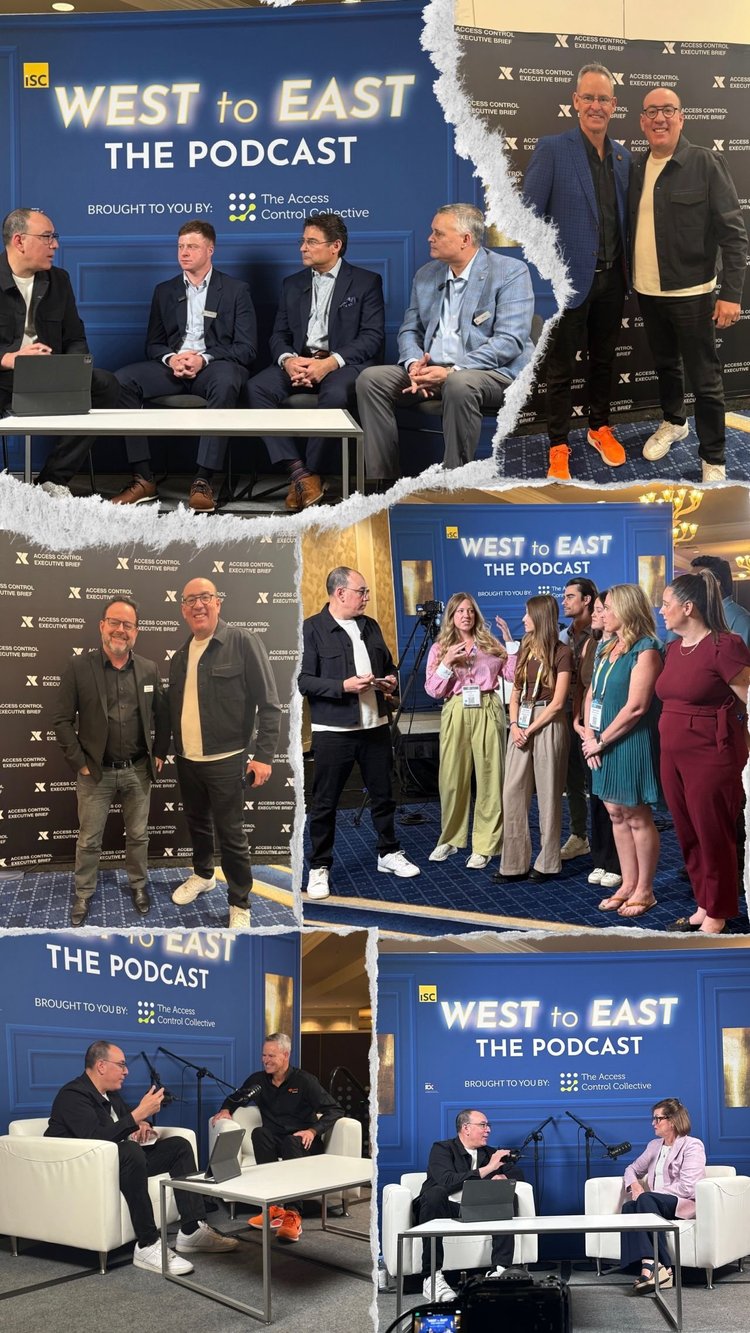
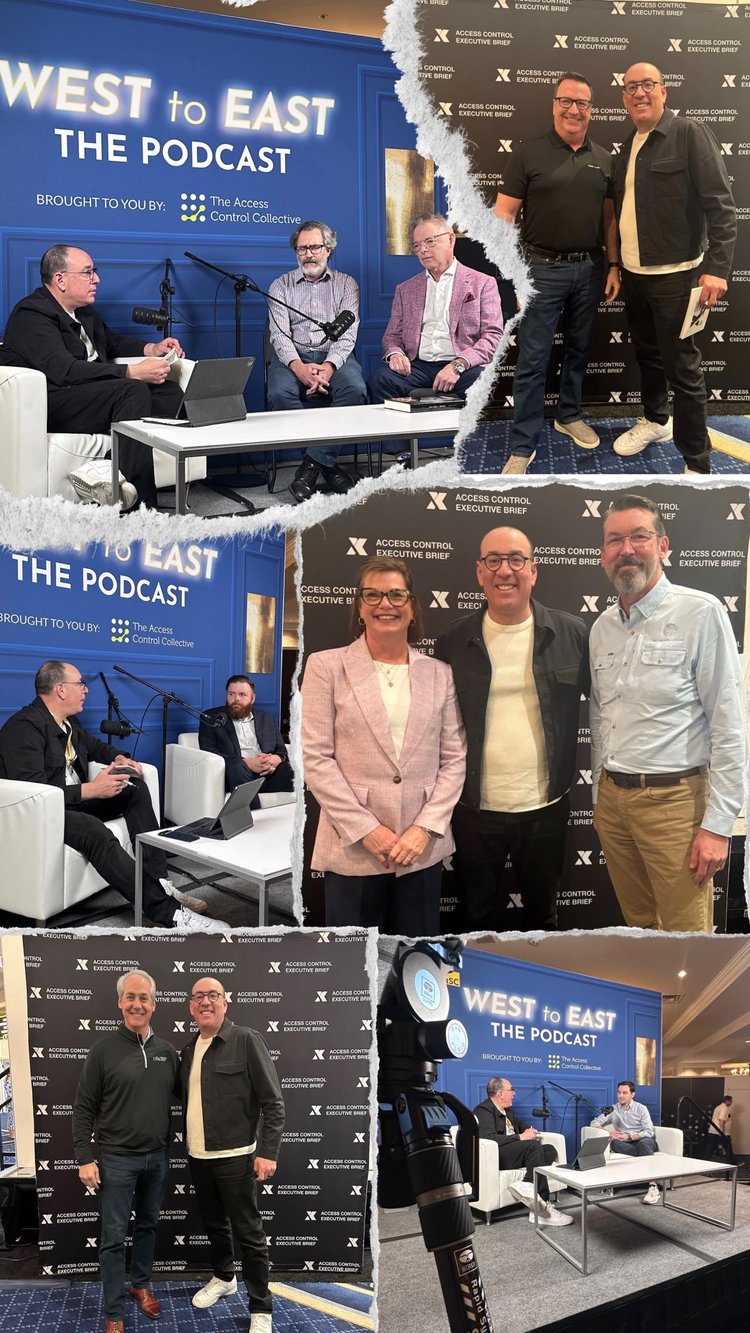
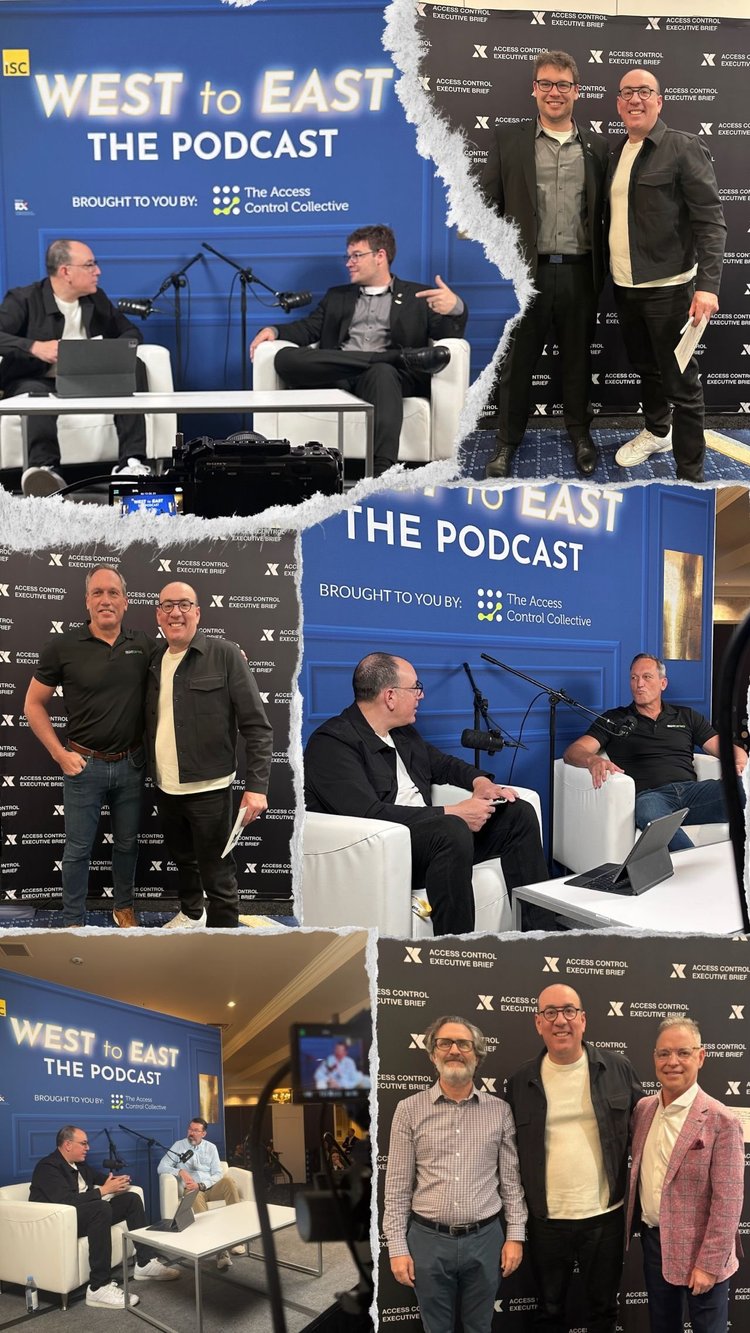
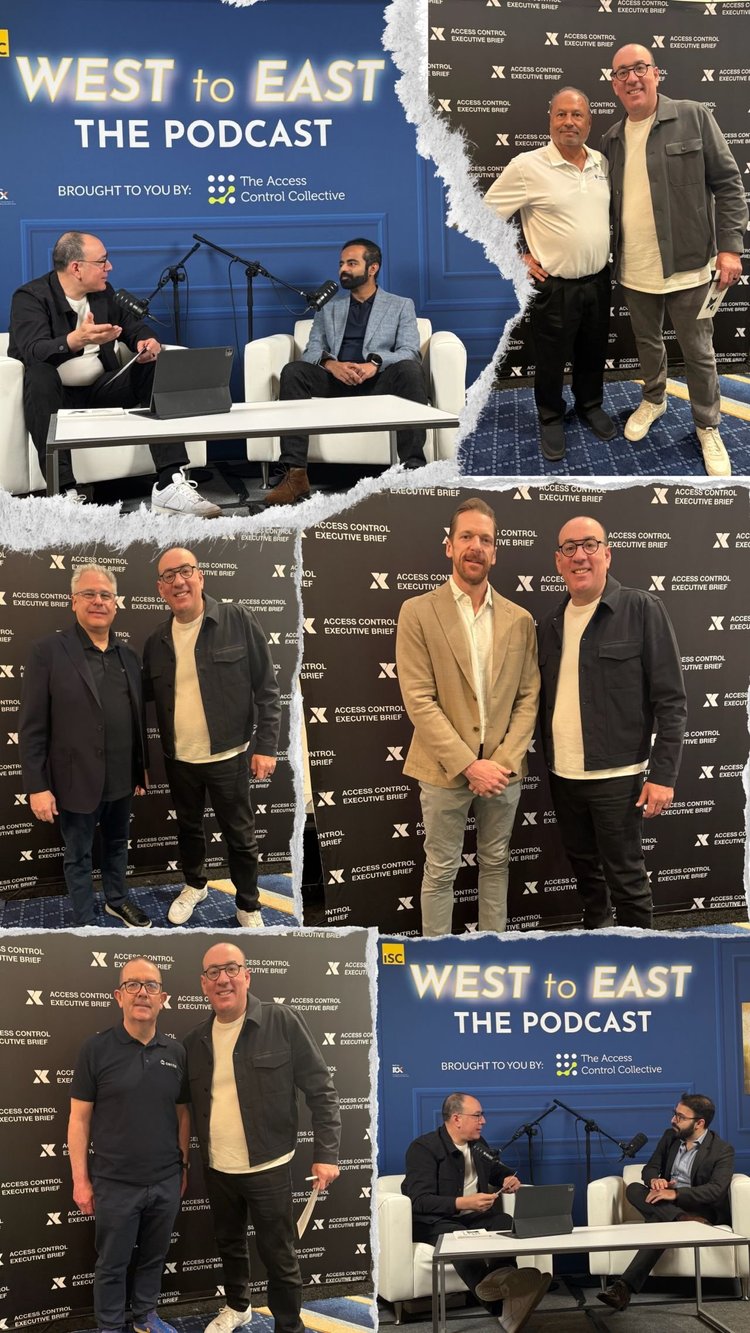
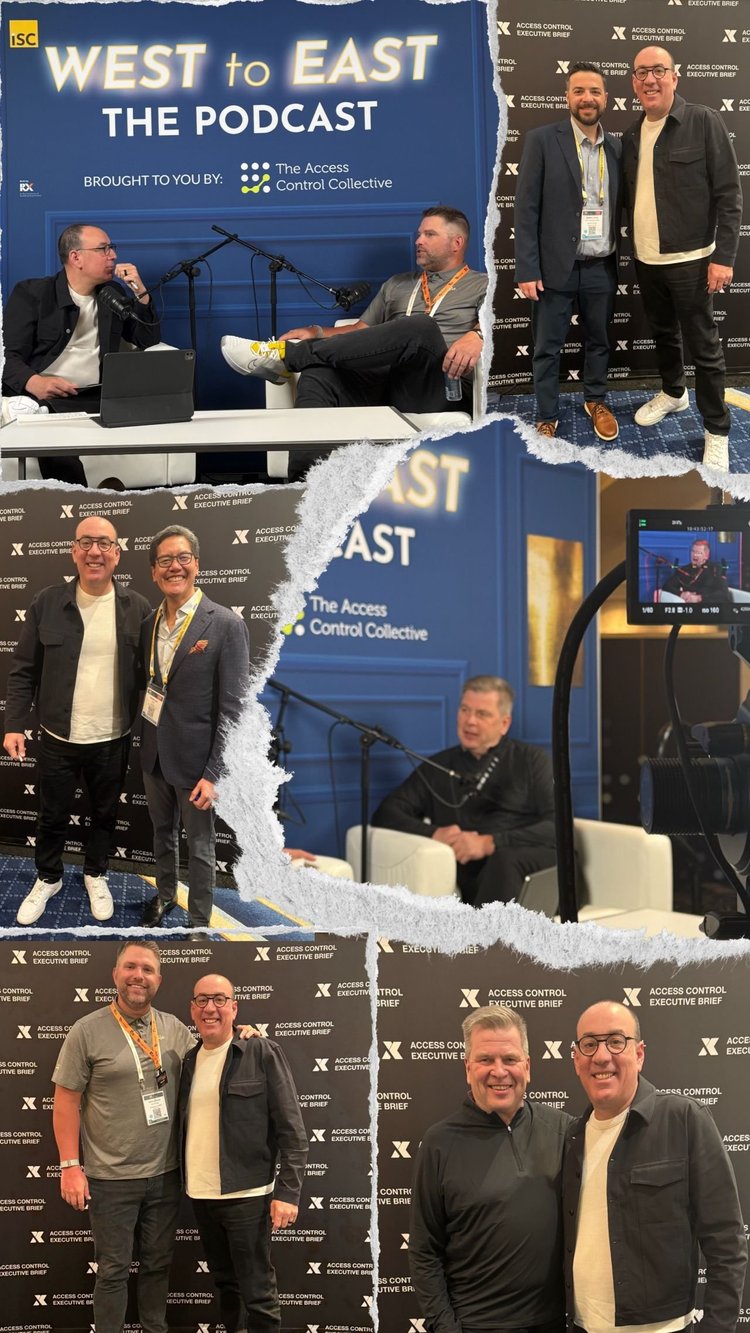
Because we planned to use these 45 conversations as the foundation for the official ISC West podcast, West to East, I took detailed notes. The result is a nice summary of the key trends and takeaways from 45 interviews with industry executives. I hope you find it as interesting as I did.
Reflecting on the event itself, this year's ISC West felt different for reasons that became clear during these conversations. Not because of any single thing I saw in a booth, but because of what I heard from 45 different leaders over three days as I asked most of them versions of the same questions.
45 interviews were conducted with 45 companies. The guests ranged from platform CEOs to integrators to recruitment executives to standards bodies. I asked them about AI, identity, Aliro, and whether they believe we are in the mainstream moment I keep writing about.
Here’s what I heard during those conversations and how I interpret it.


Click on the above image and use code sxst3gkbkn to hear the audio version.
The guest list said something on its own
Before I get into the themes, I want to acknowledge who was there, as the participants shaped the conversation:
-
4S Security: Leor Elfassy, Director of Client Services
-
Acre Security: Andrew Rapsey, Chief Marketing Officer
-
AMAG: Kyle Gordon, EVP, Global Revenue & Customer Experience
-
Ambient.ai: Shikhar Shrestha, CEO
-
Axis: Fredrik Nilson, VP Americas
-
Babel Street: Chris Herndon, VP, Commercial Sales
-
Brivo: Steve Van Till, President
-
Cento: Brett Ennals, CEO
-
Centrios: Lucas Mason, Marketing Manager
-
Connectivity Standards Alliance: Tobin Richardson, CEO
-
Door and Hardware Institute: James Gammon, CEO
-
dormakaba: David Fuller, Chief Innovation Officer
-
FaceTec: Jay Meier, Chief Identity Technology Strategist
-
Freevision Technologies: Jack Palmer, Channel & B2B Sales Manager
-
Fujitsu North America: Naohiro Kawaji, Head of Trusted Society Americas
-
Gallagher Security: Mark Junge, CEO
-
HID Global: Bjorn Lidefelt, EVP & Head of HID Global
-
HID Global: Michael Smith, Director of Solutions Engineering, Biometrics
-
HiveWatch: Jordan Hill, Co-Founder & Head of Product
-
iLOQ: Heikki Hiltunen, President and CEO
-
Interface: Steve Womer, SVP Product
-
Johnson Controls: Rick Focke, Director, Product & Market Development
-
Kastle: Haniel Lynn, CEO
-
Motorola Solutions: Xander Alexander, Technical Evangelist
-
NGA Security Advisors: Charles Johnson, Founder & CEO
-
US CPTED: Joelle Hushen, Founder & Director
-
Prodatakey: Dallan Labrum, Exec. VP Sales
-
RealSense: Allen Ganz, Head of Sales & Strategy
-
Resideo: Scott Harkins, VP of Sales
-
RightCrowd: Darren Bain, VP of Strategy
-
SAFR: Chris Carlson, VP, North American Sales
-
Safetrust: Jason Hart, CEO
-
Secure Passage: Andrew Jones, Chief Technology Officer
-
Security Industry Association: Lauren Bresette, Senior Manager, Government Relations
-
Sharlic: Karl Hill, CEO
-
SwiftConnect: Matt Kopel, Co-CEO
-
Titan Protection & Consulting: Ryan Smith, President & Founder
-
Verkada: Andrew Bowers, VP Product
-
Wavelynx: Julia Webb-Twoomey, VP Wallet & Leaf Community
-
YourSix: Jacob Hengel, CTO
-
Zenitel: Dan Rothrock, SVP Global Business Development
This speaker list tells its own story. Just a few years ago, most of these companies would not have been in the same conversation. Now they are and that signals a fundamental change in the market.
Moving to a key observation: AI is past the debate stage, and the real question is economic capture.
Every single interview surfaced AI. Not one person argued against its relevance, and it is clear the debate has moved. The question is no longer whether AI matters in physical security, but how fast the application matures and, more importantly, who captures the economic value when it does.
Andrew Bowers put the pragmatic frame on it plainly: the goal is not AI hype but using technology and automation to solve actual problems. Jordan Hill at HiveWatch described it as a GSoC upgrade that connects disparate systems. It reduces the noise analysts have to sift through before they can act. His observation was direct: if AI takes an analyst four minutes instead of forty hours, that changes the business model of security operations entirely. Shikhar Shrestha at Ambient.aicalled his approach proactive, automated physical security operations. This is a fundamentally different product category from what most of this industry sells today.
What I found the most interesting divergence was not on AI itself but on what happens when AI compresses configuration time. It reduces installation labor and flattens the complexity that specialists have historically been paid to manage. If an AI agent can configure a system in minutes, when it used to take a skilled integrator a week, where does the value go? To the platform? To the end customer who no longer needs a specialist? To whoever owns the identity relationship underneath all of it? Nobody on the show floor has answered that question yet. The conversations acknowledge it and then move on. The companies that answer it first will build a very different kind of business, and that is transformative.
Another topic that received nuanced responses was the question of our industry’s “Mainstream Moment.”
The theme for ACS26 in New Zealand this October is Our Mainstream Moment. The premise is that something generational is happening in this industry right now, something more exponential than what we have seen in prior cycles. I pushed on this in almost every interview, and the answers were honest.
Most guests agreed, but with a nuance worth paying attention to. Andrew Bowers described the shift as layered. The change is from low voltage to network to now cloud. Cloud is now unlocking AI and simplification at a pace that compounds. Steve Womer, who runs Interface Systems and has years in the traditional integrator model, used a familiar frame: the Blockbuster and Netflix moment. The billable hour is the old world. His warning was not abstract: by the time the music stops, there may not be seats left for late adopters. Haniel Lynn at Kastle, seven and a half years into his tenure as CEO, described the moment as a convergence of mindset, not just technology. The industry is finally asking the right questions.
The honest pushback came from my own closing conversation with Hilary at the end of the show. I told her plainly: I walked the floor, hoping for more radical disruption, but saw a lot of sameness instead. Booth after booth covered similar ground. My read was more in line with Haniel and that the mindset shift is real and visible. The product differentiation that should follow is eighteen to twenty-four months behind the conversation. There is more openness between companies that used to compete in closed ecosystems. More partnerships are forming between organizations that wouldn't have spoken three years ago, but the products reflecting that openness are still catching up.
The mainstream moment is a bet imo, not a verdict. The people in this industry who are moving fast are placing that bet with conviction, while those who are waiting for proof may wait too long.
Turning to interoperability, Aliro is real, and the industry needs to examine what “Open” truly means.
Aliro came across in nearly every conversation where interoperability came up. Matt Kopel at SwiftConnect announced Aliro-related capabilities at the show. He framed the customer problem the way good operators do: how do you get one credential to work across different systems? Multi-tenant buildings, mixed-use environments, and portfolios where one landlord has hardware they did not choose, and tenants have something different. That is the problem Aliro is solving. It is a large commercial problem.
Tobin Richardson from the Connectivity Standards Alliance made the point I found most interesting. The difference with Aliro versus prior interoperability efforts is universality: It is not just commercial, as the consumer side has adopted it, vehicles have adopted it, and that the ecosystem spans sectors in a way that prior standards never achieved.
But there is a risk the industry needs to name and watch. In several conversations, I asked a direct question: Can someone take an open standard and make it proprietary again? The honest answer was yes. Opening at the credential layer does not guarantee opening at the platform layer. A company can adopt Aliro for reader and credential exchange, while keeping a closed, proprietary ecosystem everywhere else. The standard moves the lock up one level. That is progress, but it is not the same as the open ecosystem the market needs to fully unlock innovation.
The industry should hold the line on what open actually means at every layer, not just the one we agreed on first.
This leads directly to the core issue of identity: whoever owns identity owns the future, and the industry does not yet own it.
At the show, I also moderated a session titled “Who Owns Identity Owns the Future” and it relates to the interviews as well. While a definitive answer remained elusive, the session left us with a more thought-provoking question and one that may shape the journey ahead.
The big takeaway, which I have been thinking about since, is that this industry does not own identity. It owns the credential, and the expertise exists here, but the underlying identity is owned by the person, delivered through systems that the physical security industry does not control and, in most cases, did not build. The prevailing belief from the session is that it will eventually look like a mobile driver’s license, government-issued, sent into access systems the way a token is sent into a payment terminal. If that happens, the physical access control system becomes an execution endpoint, not the system of record, not the identity authority. Just the door.
Matt Kopel at SwiftConnect, Darren Bain at RightCrowd, Carter Kennedy at SoloInsight, and Andy Jones at Secure Passage are all addressing this gap, treating identity governance as a software layer that sits on top of physical access rather than embedded in it. That framing matters because it means the companies that win the identity relationship in this industry may not be the ones that manufacture or install the hardware. They may be the ones who abstract it.
The Nokia moment I have written about is this. Not the reader becoming irrelevant tomorrow, but the system of record shifting to someone who entered from a different direction, and the physical security industry realizing too late that the door was never the asset. The identity database was.
The integrator model is at an inflection, and the business model is not there yet.
Steve Womer said his company has historically been a traditional systems integrator. They are trying to go beyond alarm signals and dispatching police. They are building toward psychological safety, de-escalation, and AI-assisted deterrence. That is a different product, with a different cost structure and a fundamentally different relationship with the end customer.
The Blockbuster frame he used kept surfacing in other conversations, too, even if not explicitly stated. The billable-hour model, what I have written about as the numerator and denominator that are changing forever, is under structural pressure from multiple directions simultaneously: AI compressing labor, platforms aggregating more of the stack, and end customers demanding outcome-based relationships rather than project-based ones. The integrators who survive and thrive in this environment are doing two things well. They are building recurring revenue and getting operationally close to the customer’s problem, not just the installation event.
The talent dimension underneath all of this is real and underappreciated. Brett at Cento described a buoyant, growing market where companies are still actively hiring, but the generational workforce transition is underway. The people who built their expertise on the old infrastructure are aging out faster than the new model is being trained in. Succession planning is not keeping up, and that gap will show up in execution before most companies realize it is a risk.
What 45 conversations told me
I’ll keep it simple…Our Mainstream Moment is not a conference theme but a bet on the direction this industry is heading. Forty-five interviews in three days told me the bet is right. The only question is how you are positioned when it lands.
We will roll these interviews out over the next 9 months, and you will find them on YouTube and your favorite podcast player under the Secured Podcast banner. Next up: The Security Event, where we will have another 30 interviews and 2 days of thought leadership on stage.
PS: I am sure some of you may forward this, but please do so sparingly and encourage others to sign up here. Thank you!
