
Volume 143 | April 28, 2026

Reminder to JOIN the The PhySec Collective community Slack channel to network, engage, and be part of something big! You can sign up here.
Here is the model Tony used for the following article: JCI DCF Bonus Model
For some reason or another, the industrial sector has always had a higher frequency of corporate actions, particularly divestitures and spin-offs. It’s almost part of the DNA of the space.
The most recent high-profile example is General Electric, which split itself into three separate entities across aerospace, energy, and healthcare. Honeywell is now planning a similar path, carving out its businesses across building automation, aerospace, and advanced materials.
This isn’t new. Go back a few years and you’ll see the same pattern. Honeywell previously spun off Resideo, which itself is now exploring further separation of its security distribution arm, ADI. Industrial conglomerates tend to build, consolidate, and eventually break apart.
So, it really wasn’t much of a surprise when news surfaced that Johnson Controls is considering yet another divestiture. This time, the company is reportedly evaluating the sale of up to two businesses within its security segment, specifically access control and intrusion, with an estimated value of around $4.5 billion. The current plan is to sell them separately, although a single buyer remains a possibility.
What makes this notable is that Johnson Controls has been here before. The company has a long history of reshaping itself through divestitures, including the sale of its residential and light commercial HVAC business to Bosch.
I think an interesting thought experiment here is: “If you were a Johnson Controls executive planning this move and woke up to be visited by the ghosts of spin-offs past, present, and future like Scrooge, what would they show you?”
That’s the exercise today. We’re going to look back at how Johnson Controls’ previous divestitures have played out, assess where the company stands today from a valuation standpoint, and then think through what the standalone value of its access control and intrusion businesses could be if separated.
Because with conglomerates, it always comes down to the same question: Is the whole worth more than the sum of its parts, or less? And as you’ll see, the answer can go either way.
The Ghost of Spin-Offs Past: Adient
Let’s start with a clean, recent example. I’m not going to dig into private transactions like the HVAC sale to Bosch. There’s a much easier, public case to analyze.
In October 2016, Johnson Controls spun off its automotive seating business into a standalone entity, Adient. For every 10 Johnson Controls shares held, investors received one share of Adient, with no fractional shares issued.
Adient was a massive global operation, with over 200 manufacturing facilities across more than 30 countries. Management emphasized its strong position in China, diversified customer base, and what they described as improving profitability and opportunities for margin expansion. The messaging was clear. This was a market-leading business that could thrive independently.
But more importantly, it didn’t belong inside Johnson Controls. At the time, Johnson Controls was focused on building systems. HVAC, building automation, fire safety, security, and energy management. Automotive seating had very little overlap with any of that. Different customers, different supply chains, different cycles. The lack of synergy was obvious.
So how did it play out? If you compare the two on a total return basis since the spin, including dividends, the divergence is stark. Johnson Controls compounded at roughly 16.9% annually, more than tripling shareholder value over the period. Adient, on the other hand, declined at about 7.2% annually, cutting shareholder value roughly in half.
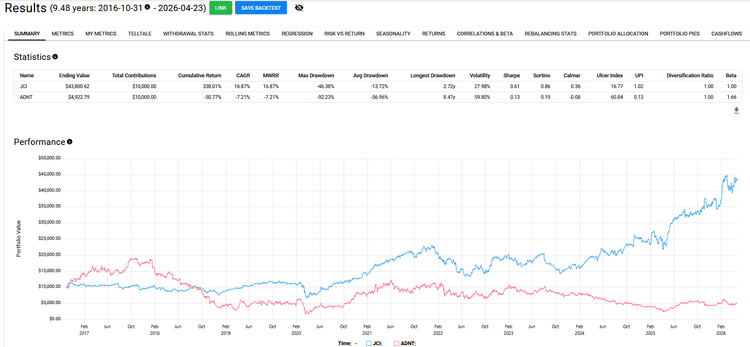
Today, Adient still looks troubled. On the surface, it screams “cheap.” It trades at a low forward earnings multiple, a low PEG ratio, and even slightly below book value. But the underlying economics are weak. Operating margins sit around 2.4%, return on equity is negative, and the only real bright spot is that it can cover short-term liabilities with a current ratio of 1.09.
In hindsight, the spin-off was clearly the right move. Johnson Controls exited a highly cyclical, capital- intensive, globally exposed business that had no real strategic fit. It removed a drag on margins, simplified the story, and allowed the core business to compound without distraction.
From that lens, the outcome speaks for itself. Had Johnson Controls retained Adient, it would have acted as a drag on consolidated financials. Loss-making or low-margin segments make valuation harder From a shareholder perspective, the experience was mixed. On the spin date, your Johnson Controls shares dropped to reflect the distribution, and you received Adient shares that subsequently performed poorly. That’s never a great feeling. But the ratio matters. At one Adient share for every ten Johnson Controls shares, the overall impact was limited.
In hindsight, even if you held both and did nothing, you still came out well ahead due to Johnson Controls’ performance. And if you sold Adient early, as many investors do with spin-offs, the outcome was even cleaner.
If I’m the “ghost of spin-offs past” advising management, this one looks like a success. Not because Adient thrived independently, but because Johnson Controls removed a structurally weaker, non-core business and allowed the remaining company to focus and compound more efficiently.
The Ghost of Spin-Offs Present: Johnson Controls Today
To get a sense of what kind of business Johnson Controls is today, I built a simple five-year discounted cash flow model (DCF) using an EBITDA exit multiple. A DCF is just a way of estimating what a company is worth today based on the cash it’s expected to generate in the future, discounted back to present value.
The “discount” part reflects the time value of money and risk. The EBITDA exit multiple is a shorthand for estimating what the business might be worth at the end of that projection period, based on how similar companies are valued in the market. There are a lot of moving parts in a model like this, but two assumptions matter more than anything.
The first is the discount rate. It represents the opportunity cost of your capital, meaning the return you could reasonably earn elsewhere for taking on a similar level of risk, and therefore the minimum rate the company must exceed to justify your investment.
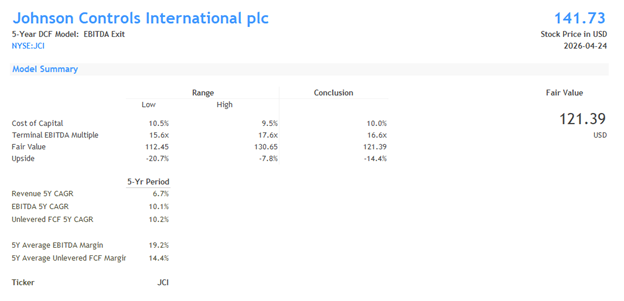
For Johnson Controls, I used a range of 9.5% to 10.5%, landing on an average of about 10%. That estimate is grounded in the company’s cost of debt, specifically yields on its senior notes, plus a reasonable equity risk premium over prevailing Treasury rates. In simple terms, it reflects what it costs Johnson Controls to raise capital, adjusted for risk.
The second key input is the terminal EBITDA multiple, which is used to estimate the company’s value at the end of the forecast period. Get this wrong, and the entire model can look precise while being directionally useless, because a huge portion of the valuation often comes from that final exit value rather than the cash flows you model year by year.
Rather than guessing blindly, I benchmarked this against peers of similar market capitalization and industrial profiles. That resulted in a range of roughly 15.6x to 17.6x EBITDA, with a midpoint of 16.6x as a reasonable assumption.
From there, the rest of the model is relatively straightforward. Based on Johnson Control’s financial statements, I used a five-year revenue compound annual growth rate of about 6.7%, a five-year average EBITDA margin of 19.4%, and unlevered free cash flow conversion of roughly 10.2%.
Putting it all together, I arrive at a fair value estimate of $121.39 per share, which implies about 14.4% downside relative to the current share price of $142.49 as of April 24, 2025. I’ve attached the full model for anyone who wants to dig into the assumptions.
Now, calling Johnson Controls “overvalued” in this context doesn’t mean it’s a bad company. In fact,quite the opposite. Many high-quality businesses trade above what a conservative DCF would suggest is fair value. That’s often the price of owning durable cash flows, strong market positions, and predictable earnings streams. However, if you invest in it right now, you are likely overpaying.
The Ghost of Spin-Offs Future: How Do You Value the $4.5B Carve-Out?
The idea is that conglomerates often trade at a blended multiple that can obscure the value of higher quality subsegments. If access control and intrusion can command a cleaner multiple as a standalone, divesting it could theoretically unlock value.
However, valuing this properly is a messier than it should be, and that is primarily due to how Johnson Controls reports its financials.
JCI doesn’t break out access control and intrusion as standalone operating segments. Instead, it reports revenue disaggregated by geography (Americas, EMEA, APAC) and by category (Products & Systems vs. Services). There’s no clean line item that says, “this is access control EBITDA.”
So, you have to work backwards. Management has publicly floated a $4.5 billion valuation for the assets.
From there, you triangulate using the follow comparable transaction and trading multiples. Pure-play access control and security names like Assa Abloy and Allegion typically trade in the mid-teens EBITDA range, often 15x to 18x, with a premium for software exposure and recurring revenue.
If we assume this carve-out is more hardware-heavy with some service overlay, it likely clears toward the lower mid end of that range. At $4.5 billion, that implies EBITDA somewhere around $250 million to $300 million. That’s a reasonable inference given what we know about the scale of JCI’s building solutions footprint.
But this cuts both ways. If the remaining JCI business skews more toward lower-growth, service-heavy building systems, the multiple on the remaining entity could compress.
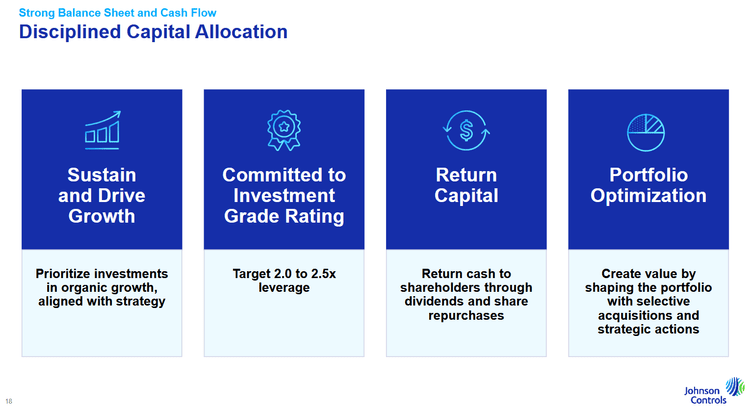
It’s not about whether $4.5 billion is fair, but whether JCI can redeploy the net proceeds of that $4.5 billion into areas where it actually has an edge, or, as management suggested in their latest 2026 Q1 presentation, return cash to shareholders via dividends and share repurchases.
My personal view is that this is not a bad deal. JCI is unlikely to outcompete the Assa Abloy and Allegion duopoly in access control long term. Those players are deeply entrenched, have tighter vertical integration, and are already executing on the shift toward software and recurring revenue.
I think JCI’s strength lies elsewhere. Integrated building systems, HVAC controls, energy management, and services; higher-level system orchestration rather than component-level dominance. Competing head-on requires sustained capital and focus, while divesting access control and intrusion looks less like giving up growth and more like refocusing on core competencies.
PS: I am sure some of you may forward this, but please do so sparingly and encourage others to sign up here. Thank you!
