
Volume 2 | November 16, 2022
Our ESG Story and Opportunity
Hello from Japan, and welcome to "The Access Control Executive Brief Volume 2." I am on an eight-day trip in Tokyo, mixing work and fun while taking advantage of my wife having a work trip along with my parents in town watching our kids. This trip has reminded me, outside of my love for sushi, that we are part of a global community. Sometimes it is hard to see a global community because we are so focused on what is in front of us but trips like this remind me of just that, our global community. Our industry is impressive, gracious and welcoming. My hope was to meet people locally and gain some insights into the market, the solution, and their culture. Well, they did that, and more. The community here in Japan showed up, opened their arms, and welcomed me full throat. After years of being locked down and unable to travel, I am grateful for this opportunity. If you ever have the chance to visit Tokyo and meet with the local industry, please do. I, for one, have been changed by this experience, and I can't thank you enough.
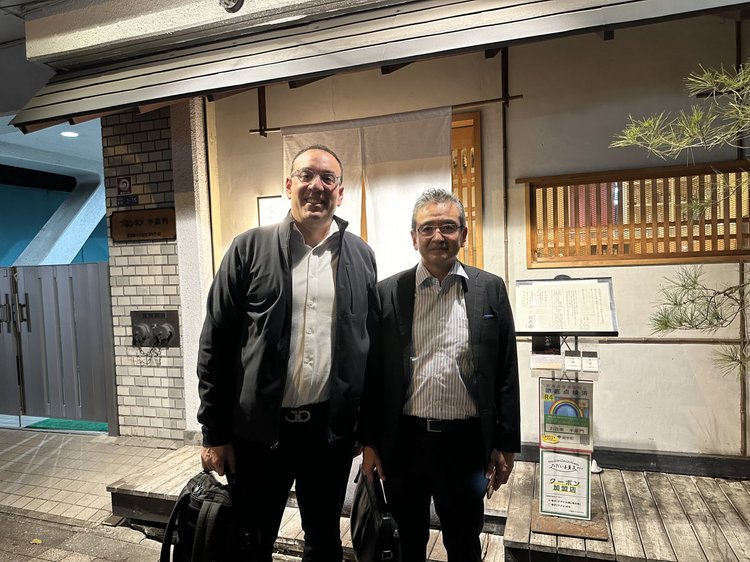
Picture with Toshiro Typhoon Sakai (坂井 敏郎), General Manager, Builders' Hardware Division, Ryobi Limited after an amazing traditional Yakitori (焼き鳥) dinner. I was introduced to Toshiro-san by Travis Willis of dormakaba.
When you signed up for the Access Control Executive Brief (thank you again for doing so), I told you that I would write the Brief once a month with periodic product insight and business reports in between. Well, in proper form, I have tweaked that a bit and have decided to write at least once a month, if not more. So, what I plan to do is just write. Sometimes it will be once a month, and other times, more. I am not sure yet, and I will not worry about it. I figured that as long as I deliver value, you won't mind and, if anything, will see more value in the monthly or yearly subscription. So, again, I am just going to write and share.
In this Brief, we dig into ESG and the opportunity we have regarding it.
My call to action, in the end, is this: I would like to know if you agree. So please reply, text, or call and let me know your thoughts.
Thank you,

PS: I am sure some of you may forward this on but please do so sparingly and encourage others to sign up here. Thank you!
Our ESG Story and Opportunity

Photo by Simone Hutsch on Unsplash
We can apply this story to the broader physical security industry. Still, for this Brief, I am going to stick to the opportunity as it relates to physical access control (also referred to as "we" or "our industry"). I also recognize that some of you are aware of the broad topic of ESG, but I have a thesis and a story about an opportunity within ESG.
Seeing that this Brief is a bit long, below is the TL;DR of my thesis:
-
Our ultimate customers, enterprise and commercial real estate developers/operators, are focused on ESG or will be soon.
-
The few companies in our industry that focus on ESG are too focused on the materials we use, how we interact with our suppliers, and our corporate governance. This narrow focus misses a massive piece of the story we should be telling.
-
When we tell our product and solutions story, we focus on the technical and total cost of ownership (TCO) but miss the return on investment (ROI) story that ESG supports.
-
We need to focus on ESG as it relates to our solution's impact on society, such as safety and security, resulting in positive economic effects (e.g., GDP).
-
The S of ESG is our story and our opportunity. No other industry has the permission or prospect that we do.
-
How we quantify it and tell a G still needs to be determined (this is where associations, such as SIA, come in).
-
And while we are at it, we should add the R, or as some call it, ESG+R, because that is also right in our wheelhouse.
-
But I will take a solid S and G right now, so let's focus on that.
And this is my story.
Let's start with a bit of background. What is ESG, and what about the R?
In short, ESG is an investment framework used to measure how a company impacts the world around it. That framework gets applied to companies, initiatives, and anything, even commercial real estate, “to achieve strong risk-adjusted returns and positive societal impact.”
The E stands for ENVIRONMENTAL. E considers how a company performs as a key player in the physical environment. Examples include air and water pollution, waste management, and climate change.
The S stands for SOCIAL. S considers the company's various relationships with people, institutions, and communities. S includes customer satisfaction, community relations and involvement, employee engagement, and data protection and privacy. S also has employee health, safety, and security. Note: Foreshadowing
The G stands for GOVERNANCE. G comprises a set of standards used to evaluate a company's controls. It takes a look a the policies and processes, amongst other things like transparency.
I mentioned the R and ESG+R in my thesis above. The R is about RESILIENCY. R considers the capacity to "identify, address, mitigate, and respond to risks and opportunities."
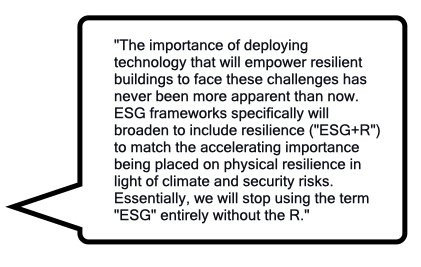
Arie Barendrecht, CEO and founder, WiredScore, explains it in a Commercial Observer article:
Now that we have the basic definition of ESG+R, why is there such a focus on ESG+R? [Note: for this Brief, I will focus primarily on ESG and call it ESG for simplicity's sake].
The United Nations first developed ESG in a close working relationship with the finance industry. A subsequent report stated that ESG could help protect organizations from financial risks from worker disputes, human rights issues, poor governance, and climate change. Over the years, ESG has gained momentum with governments, corporations, and within vertical markets such as commercial real estate.
Like many things, there is controversy surrounding ESG. Still, the market has responded, and the momentum by governments, corporations, and citizens has shown that this genie is out of the bottle. So, for this Brief's purpose, I will put the controversy and politics aside and focus on what is a no-brainer opportunity for our industry.
For the environment, ESG has multiple benefits. It brings awareness to the different climate issues and encourages businesses to adopt practices and policies that are better for the environment. The social part of ESG forces equality amongst customers, the ecosystem, employees, and shareholders and brings all stakeholders' health and safety needs upfront. It is also a framework that helps companies avoid lousy or outdated business practices. It forces prioritization and innovation where prioritization and innovation probably would not happen. The results are comprehensive but what cannot be argued are the different opportunities it uncovers.
The adoption of ESG is growing, and it forces companies' hands. They can either be part of the solution or be part of the problem. When done properly, you can attract employees and customers, as it offers an unarguable report card on a company.
In summary, ESG is now an essential part of how companies work.
In reading or engaging in a conversation on ESG, you will notice, as I did, that most conversation centers around the E. This observation triggered me to ask:
Why is there so much focus on the E and not as much on the S and G?
I posed that exact question to a group of experts in a network I participate in called Nexus Labs. Nexus Labs, founded and run by James Dice, is a community of engineers, energy managers, technology vendors, building operators, and real estate investors that exists "to move the smart buildings industry forward." For a good reason, the smart building industry focuses heavily on ESG.
Here is how some of the members from Nexus Labs responded to my questions (thank you for the feedback, guidance, and inspiration):
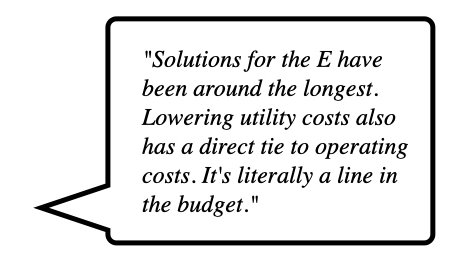
James Dice, Founder at Nexus Labs, said:
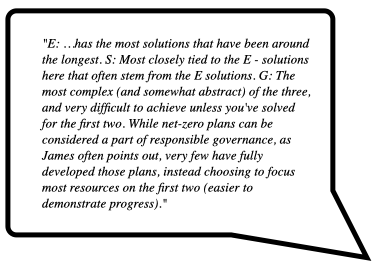
Joe Gaspardone, COO at Montgomery Technologies, LLC, said:
Mandi Wedin, Founder + CEO at Feroce Real Estate Advisors, said:
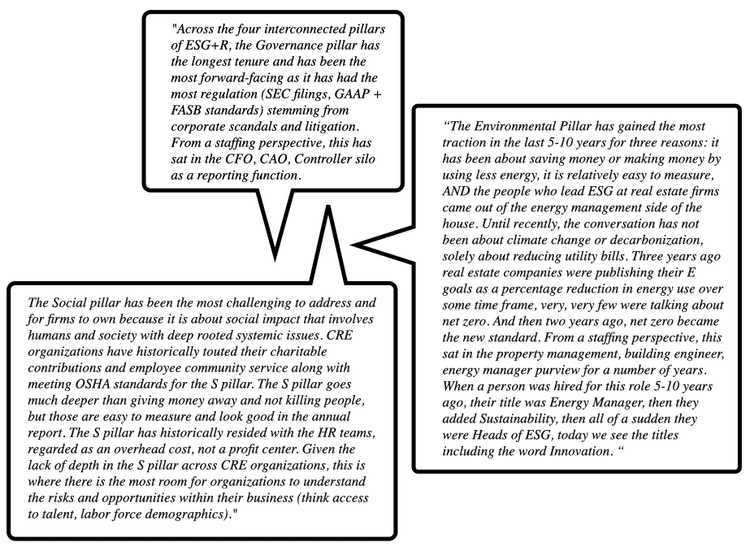
And John Forester, Vice President Real Estate Services, Energy & Sustainability at The RMR Group, concluded:
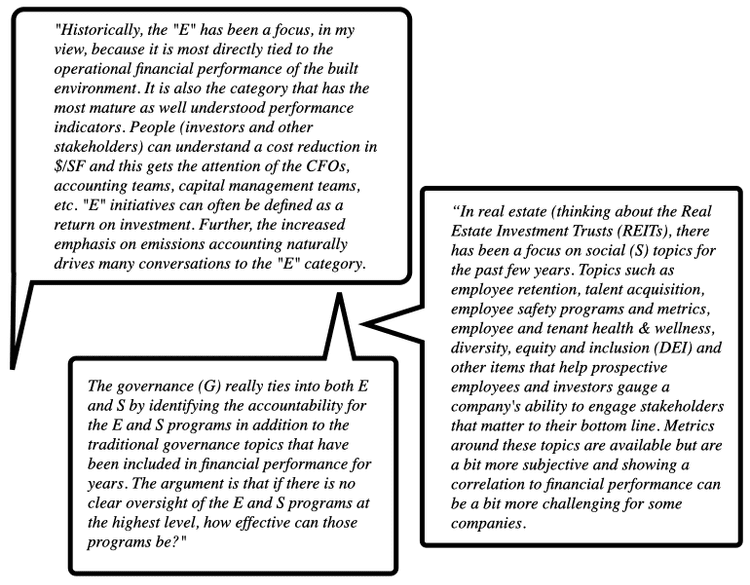
With the increased focus and importance of ESG, let's look at the opportunity and why we as an industry should care.
Outside of being a board-level initiative, which makes it a C-Suite and middle management expectation and focus, a majority believe that an ESG focus is good for the environment, society, and people. So, putting aside the intrinsic benefits, I'll summarize why we should care like this:
It is vital to your customers as this is how they are or will be governing their companies (not your dealers if you are a manufacturer but your customer's customers). So we, as an industry, should deliver a message that resonates and supports this initiative. Plus, having safe cities or spaces is typically something everyone can rally around, and our industry is a critical component in delivering safe cities and spaces.
So why not play to our strength?
Think about it like this; we are already doing it, so why are we not talking about it?
But it will take more than just some marketing speak to capitalize on the opportunity entirely. We will need to come together as an industry and create the G part, the governance, so there are measured, credible, and easy-to-communicate results behind the high-level messaging. From what I am reading and told, the S is not easily understood and is not easy to measure. So we need to jump on this and start at the process now. In my opinion, the G is the opportunity associations, such as SIA, have to drive standards and reporting criteria. As Sal D'Agostino, CEO at IDmachines and Co-Founder Zero Public Network, said at SIA's Securing New Ground conference in October when we were discussing the security industry, ESG, and Proptech, "A lot of focus on the E, we have a story for S, and a good place to start is with the G." Well said, Sal.
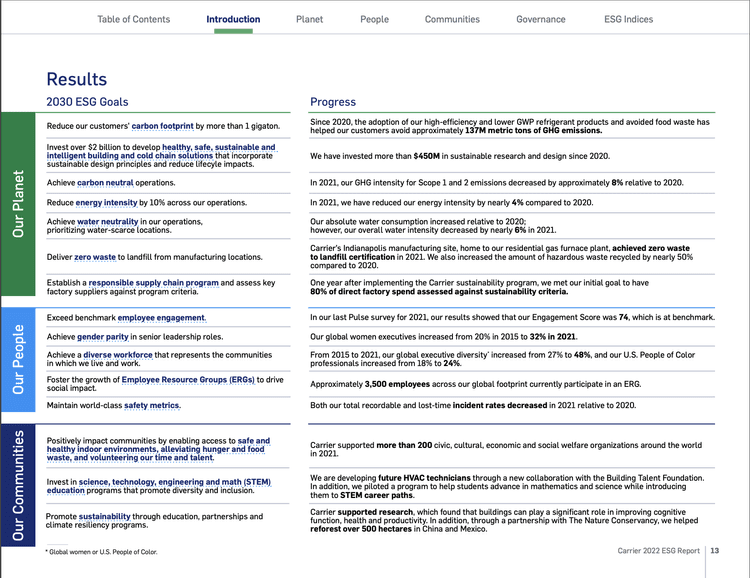
Example of Carrier’s 2022 ESG Report.
Let's look at the impact of an ESG customer focus on your business.
For incumbents, a meaningful impact that can transform your business to support innovation engines would be a metric to track your company's effectiveness beyond KPIs, quality, P&L, or employee engagement surveys. ESG would give us a way to quantify the impacts our safety products deliver for companies on people, buildings, and society. If we then tie those quantifiable safety metrics to our products, we can drive investments in our products, services, and initiatives that align with many of the companies in our industry's core values. If we are delivering safety value for our customers beyond the binary metrics we have used in the past of "safe or not safe," and this framework for which we measure, will confirm if we are or are not delivering. And if we are delivering, we can make a quantifiable decision to continue to invest or not.
To be clear, we can either do it, or it will be done to us by shareholders, activist investors, employees, and customers.
For start-ups or companies looking for growth capital, the need for an ESG message is easy. The need comes down to this: a substantial amount of venture and private equity is being invested in companies focused on ESG, even through downtimes. Investors enjoy the low-risk investments associated with an ESG-centric brand.
Here are some stories, quotes, and data to support this:
From an early 2022 Protocol article:
-
When it comes to betting on the messy business of wrangling environmental data from disparate sources, investors spent more than $570 million backing start-ups in the first six months of 2021 alone, according to a report by PwC.
-
BlackRock CEO Larry Fink wrote in a recent letter to CEOs that sustainable investments had already reached a whopping $4 trillion, indicating the magnitude of investor appetite for ESG-conscious assets. "We focus on sustainability not because we're environmentalists, but because we are capitalists," he wrote.
From a recent Commercial Observer article written on November 8, 2022:
-
PropTech Insider asked a wide range of proptech CEOs, venture capitalists and other influencers about what's in store for the industry in 2023. Their answers ranged from a continued heavy focus on ESG to a serious dip in venture capital investments to an increase in mergers and acquisitions (M&A) activity, among other prognostications. [PHILIP RUSSO]
-
Over the last six months, ESG risk has quickly become a priority, as investors are now realizing the influence that their ESG strategy has on valuation and returns. Working with our clients to co-create solutions that mitigate ESG risk and ultimately help reduce the built world's impact on the environment is very exciting. [Oli Farago, CEO, and co-founder of Coyote Software]
-
ESG will also continue to be a priority driving owners and operators to increase the efficiencies of their buildings, which only proptech can accomplish effectively. [Haniel Lynn, CEO of Kastle Systems]
-
As far as what's exciting, one thing that continues to be on everyone's mind is ESG and ESG-related solutions. There is investor and regulatory pressure focused all across the real estate world and broader corporate America on ESG solutions. [from Zak Schwarzman, general partner, MetaProp]
-
CRE offices in particular are embattled on multiple fronts because of the call for ESG and sustainability progress. Tenants' decisions are heavily based on ESG factors, and buildings need to meet tenant demands about Scope 3 emissions. Simply said, tenants will pay more for properties that can demonstrate ESG credibility. [Sonu Panda, CEO, Prescriptive Data]
Right now, though, we are missing the ESG message and investment opportunity.
And as mentioned above in regards to brand, there is a brand identity and marketing opportunity that will become part of the standard way of communicating. Having a meaningful ESG brand message for any organization is another case of "when" not "if." ESG is a now and today message and will be a tomorrow and forever message. If you are selling and marketing only on fear, being "frictionless," mobile, smart, all about conveniences or operational efficiencies, you are missing a message that resonates and lands with customers.
This brand identity focus pertains to integrators and distribution, not just manufacturers. There is a differentiated message for you here as well. Back in my Lutron days (early 2000's) and when LEED was booming, we saw companies separate themselves from traditional contractors by properly messaging their focus on “offering energy efficient solutions.” They branded themselves as progressive partners for the design and specification community. These progressive integrators and distributors did not replace their core business offering. It became the lead of what they delivered. This effort led to generating new opportunities. They just started with a different message and followed that up with action. It is an excellent example of separating yourself from a noisy and monotone industry message of safety and security.
OK, cool. I will assume you agree there is an opportunity. But why should you care? You are full of potential initiatives. So, why this one?
I'll keep it simple: It just hits different. If you don't, plenty of companies inside and outside our industry will.
Still not sold? Here are just two examples that took about 5 minutes to find.
Who is Infogrid? They are an intelligent building tech company focusing on "healthy, efficient, and sustainable" buildings. Sure doesn’t sound like an access control system but reread the quote above. Sounds like an access control system.
As another example (which I have no inside information on), I would bet the house that Microsoft will integrate their ESG solutions with their Connected Workplace offerings and their RealEstateCore, a smart building ontology for digital twins offering. The Microsoft example is just one of many that you can connect dots on that represent the "easy" lift to surrounding our opportunity and running away with it.
There are countless examples to showcase how easily the bridge can be built where the pressures of these solutions will either do a value arbitrage and further commoditize our industry and it will drive specifications earlier in the customer funnel. We will be left responding versus driving.
Leading me to the question, if we are not focused on ESG, what are we focused on?
I get it and am empathetic: There is already a ton to do and focus on. There are priorities and plenty of opportunities. But if you are a company focused on today and tomorrow, you must recognize this. And as an industry, just like the Infogrid story above shows and I stated earlier, if we don't, someone will. So we have the permission and opportunity to tell our own story as an industry. We are the safety and security industry. The ESG focus is big enough to impact the entire industry, including those only focused on high security. ESG is like GDPR or cyber security initiatives.
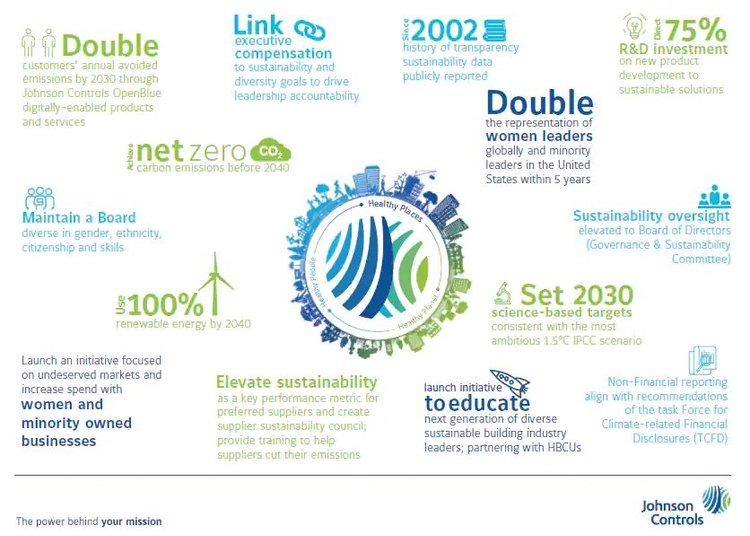
Example of JCIs ESG Strategy from their website
OK, here are some suggestions on what to do as an industry, manufacturer, distributor, dealer, and individual.
-
Curiosity: Make it a point of discussion at your company. No matter your position. If you are in a leadership position, lead. If you are not in a leadership position, hold your leadership accountable by asking about their point of view when it comes to ESG.
-
Empower: If not you, make it a priority for someone on your team to create a strategy and overview presentation.
-
Ecosystem: Learn from others, even your competitors. ESG is an "all boats rise" opportunity. Look for best practices from other industries as well.
-
Associations: Turn to our associations. Ask for help. Get involved.
-
Experts: Bring in ESG expert consultants (so there is no confusion… I am not one of them. I'd start with talking to James Dice).
Here is where I hope we get it. Amazon has a well-documented "working backward method" in product development. In that process is writing the press release so you can imagine what the success story will look like.
Here are three of mine:
-
"The physical security industry contributes roughly 5% of global GDP output, making it larger than other industries such as the automobile industry."
-
"The access control industry and its impact on delivering a safer society have resulted in an increased level of innovation that has increased global productivity year over year by 1%, making it one of the most influential levers we have across the globe."
-
"The access control industry has helped 92% of the commercial real estate industry achieve its goals of a rating above 70 by impacting the Social portion of ESG ratings for the companies who have prioritized safety and security as a pillar to their ESG initiatives."
What are yours?
Let's make this happen. It's 100% in our control and wheelhouse. I am happy to help lead, but it will take the community to get it done.
Who is with me?
Examples of companies with an ESG+R story that focuses on the E. And some that do the S. Curious if they have the G and if they have worked out the R.
-
A company with the ESG story and focus : Sharry
-
A company with a well-documented focus on DE&I: ADT
-
The PACs companies that are part of the HVAC industry and have a head start: Carrier, Honeywell, and Genea.
-
The big lock companies who report ESG now (just different than what was discussed in this Brief): Allegion, Salto, ASSA ABLOY, dormakaba
-
An intelligent building company that also does physical security: JCI
-
An integrator already communicating the ESG story to their customers: Integrated Security Technologies

Articles referenced and that influenced my POV in this Brief. Thank you!
