
Volume 26 | September 6, 2023
Welcome to Brief Volume 26!
This brief reflects many conversations and observations about what is happening in and around our industry. It highlights an unsaid issue (and opportunity) within our industry. Although some in our industry want to ignore the changes happening, and others want to see them happen faster, it's essential to acknowledge the tension this unsaid reason creates. However, we're kidding ourselves by not addressing the 800 lb gorilla in the room.
So, what is that 800 lb gorilla? It's the issue of incentives in our industry.
More on that below.
September and the remaining months of 2023 are going to be busy. Here are some highlights of where I'll be in person. Let me know if you'll also be there, and we can meet.
UPCOMING TRIPS & OPPORTUNITIES TO CONNECT
-
September 6-7: CEDIA Expo in Denver, Colorado (USA)
-
September 12-13: GSX in Dallas, Texas (USA)
-
September 27-28: The Access Control Summit in Washington, DC (USA). Visit here to purchase tickets or learn more about the event. Members get 50% off the ticket price. See you there!
-
October 14-15: Consult, Louisville, Kentucky (USA)
-
October 17-18: Securing New Ground, New York (USA)
-
October 24-25: SECTECH in Stockholm, Sweden
-
November 14-15: ISC East, New York (USA)
-
December 13-14: Security Investor Conference, New York (USA)
Thank you and back to the Brief!

PS: I am sure some of you may forward this on but please do so sparingly and encourage others to sign up here. Thank you!
The Incentive Pandemic: Why Our Industry Needs to Change to Adopt New Technology

It is time to stop blaming the channel and start blaming our incentives for the lack of adoption of new technology.
It is time to stop blaming technical reasons or legacy "security practices" and start blaming our incentives for the lack of adoption of new technology.
As someone who talks to many people and companies in our industry globally, I have noticed that when it comes to new technology adoption, we tend to blame others or make it a technical discussion instead of changing the one thing that can fix the problem at scale: incentives.
Our industry has a pandemic of its own: it is called an incentive pandemic.
Most manufacturers blame the channel, which they say is "resistant to change," while the channel blames end users who "don't want it."
While some of this may be true, the biggest issue is how we are incentived.
As an highlight of this pandemic, I recently had a "viral" (by our industry standards, at the time of writing this, it had 14,000 impressions and over 100 comments) LinkedIn post. I asked, "Which of the large lock manufacturers in the security industry will step up to the challenge and be the first to pioneer this revolutionary technology?"
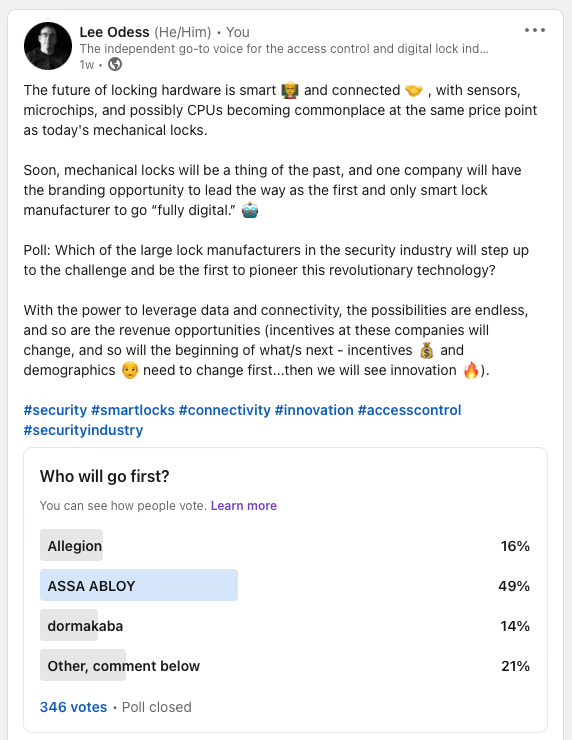
Now, the question was asked for different reasons and subsequently triggered a good amount of discussion that I answered most with:
"Fix the incentive problem, we fix the technology problem."
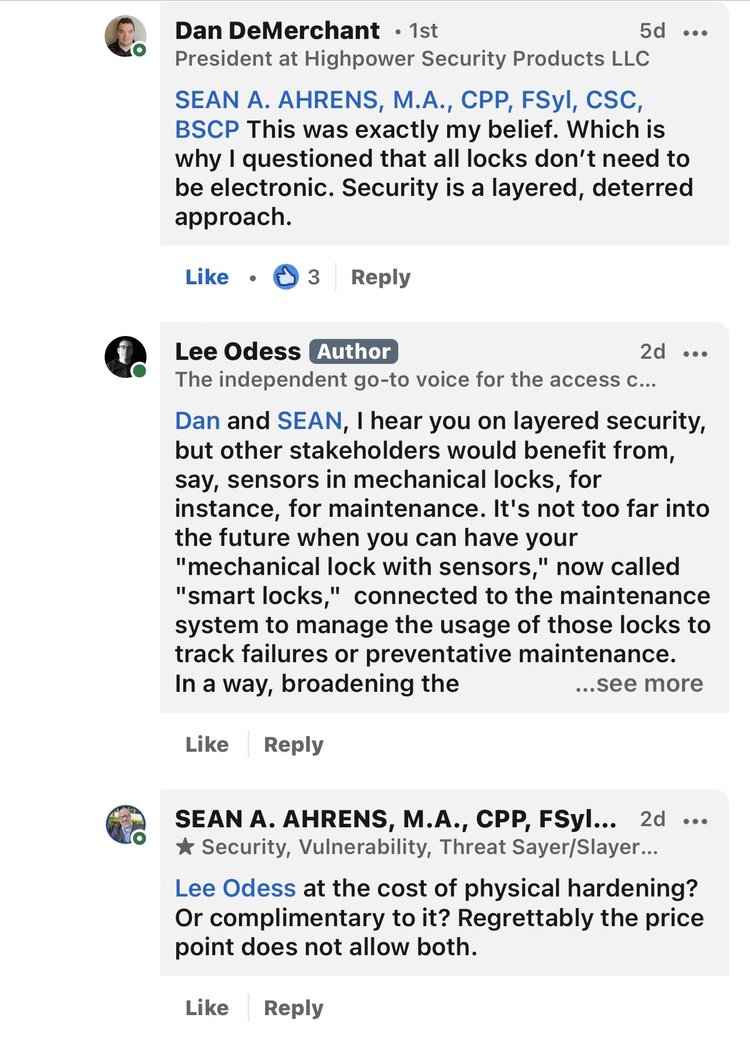
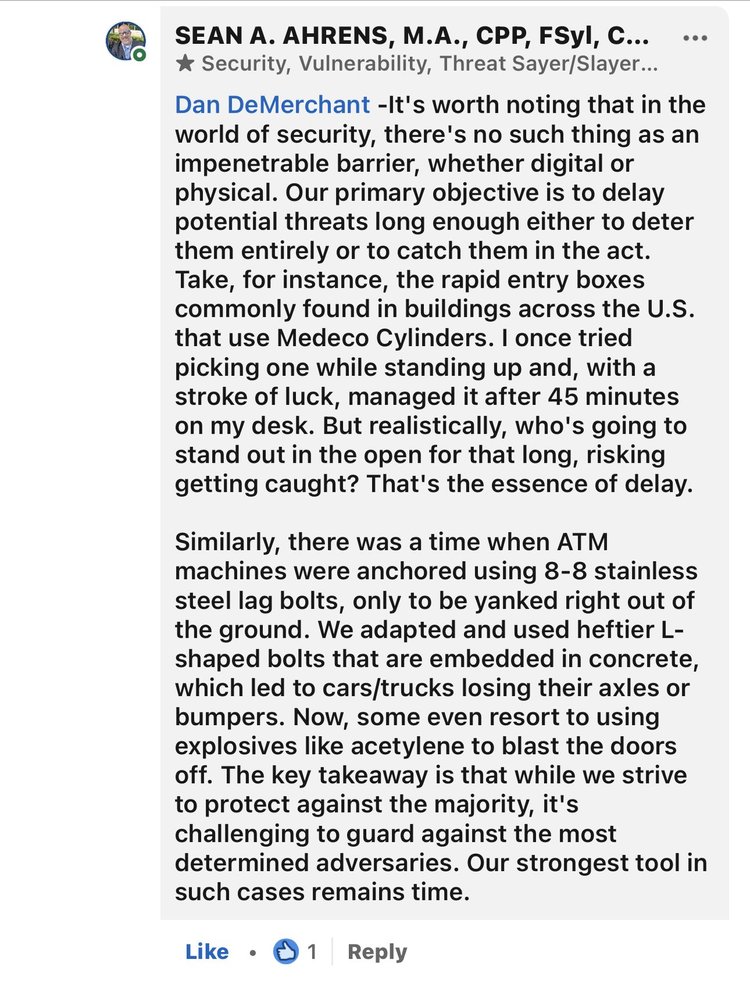
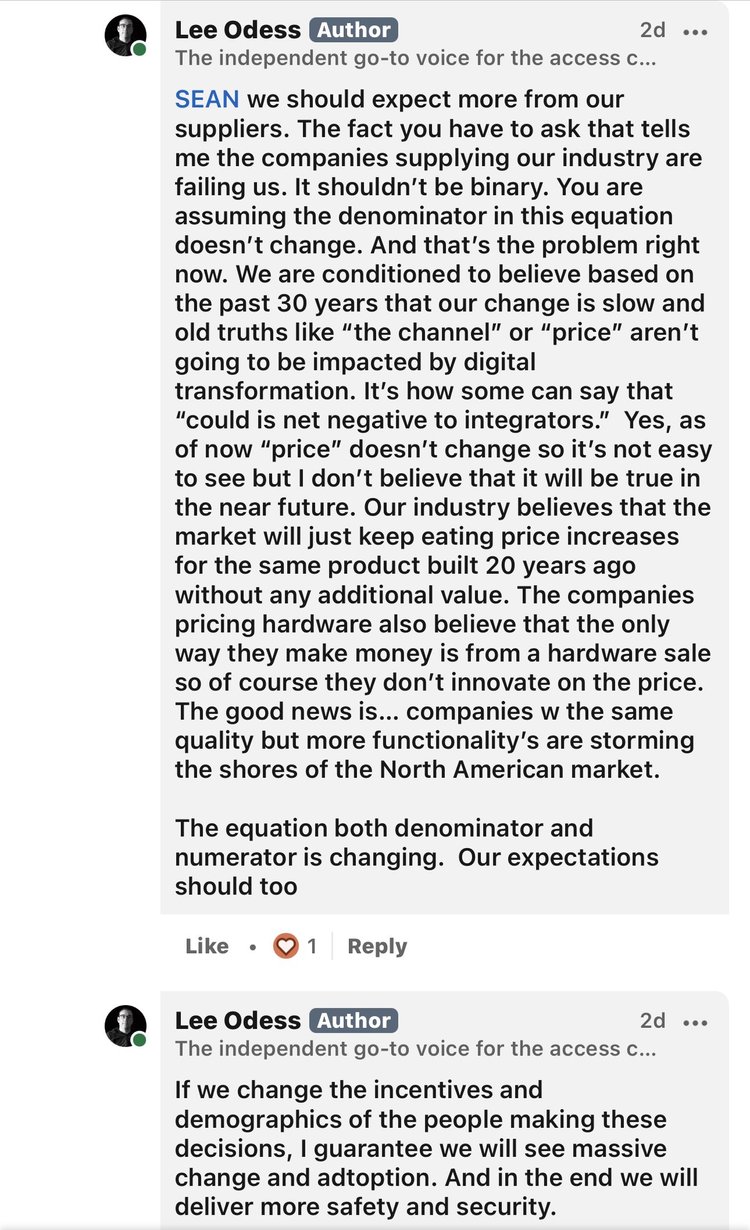
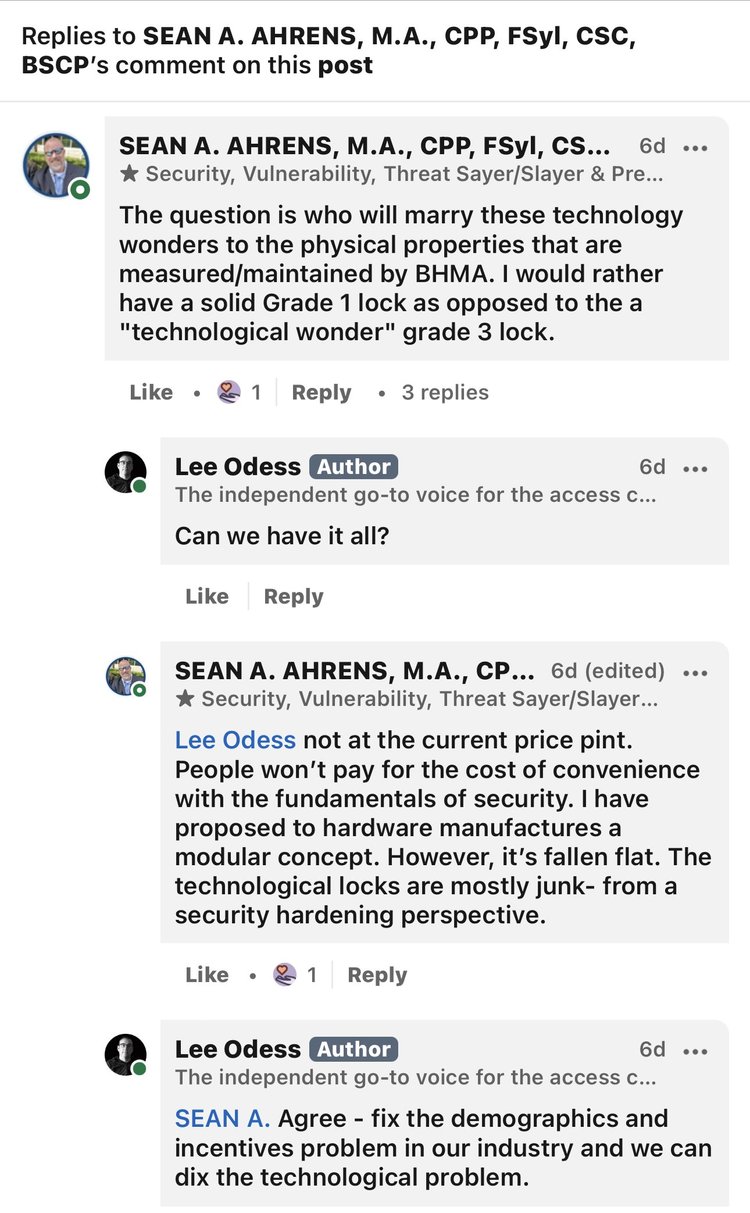
One exchange stood out.
|
Why did this exchange stand out to me? In particular it was the questions posed by Sean Ahrens: “Lee Odess at the cost of physical hardening? Or complimentary to it? Regrettably, the price point does not allow both.” This question and statement hit the industry's collective problem: We define today and the future by yesterday's truths and have succumbed to the idea that "this is how it is, and this is how it is going to be." And with that, I say: bullshit. Our ability to be the change we want comes down to desire. A desire to do the hard work and change the uncomfortable parts of the business. The personal ones. The ones that are not technical. |
|
Here is the actual problem. Our current incentives are not aligned with promoting innovative solutions, bringing safer and more convenient products to market, and doing what is right. And if we did the hard things, the results would be astounding. Changing the way we incentivize companies and people would lead to significant improvements in our industry (and subsequently the general public). If we fix the incentives, we can command the space we occupy and capture a much larger market opportunity ($70B opportunity). Most companies in our industry are incentivized to have incremental growth based on yesterday's technology and performance, rewarding individuals from the board of directors to the C-suite to the outside salesperson and everyone in between. Bonuses are given for meeting and exceeding target numbers, but these targets are often tied to products and services built within the last 30 years and are based on increments not exponentials. The older the product, the better the margins, so please, "more of it." Our industry is on a steady diet of all sugar, no protein. New technology is never given the chance to see daylight. Here's how it works at most incumbent "value companies." 2024 sales figures are based on 2023 sales figures, market condition data points, current pipeline, and belief of an ROI on new iterative features or products introduced to the market that year or in the next 12 months. Remember that "new iterative features or products introduced to the market that year or in the next 12 months" sales figures were set 3 to 5 years prior and adjusted as time went on in the development process. The targets represent incremental growth of off yesterday. The voodoo magic used by most companies to make projections is just that. So, what happens next is a negotiation between a finance department disconnected from reality and a business unit or product team playing coy because they want to promise just enough to ensure they can meet or exceed the requested sales figures. It is exhausting. Now, the leadership team of these value companies takes these numbers, aggregates them together, and brings them to the board for approval. Negotiations happen. These numbers are previewed to the street for feedback and thoughts. Everyone uses one hand to hold their nose and the other to hold each other. And they jump. (Yes, I am summarizing and using broad descriptions, but you get the point. I am in the ballpark of what happens). From there, we see a waterfall effect of incentives built to motivate and reward the downstream stakeholders for meeting or exceeding these incremental targets. But the targets are purposefully predictable and conservative. Why? Because the shareholders and the market investors in the value companies of our industry invest their money into predictable and conservative businesses. So monkey see, monkey do. It is a vicious circle. |

When someone within an organization has a disruptive idea that is unpredictable yet inevitable, they are told to sit and wait because the people mentioned above won't get their bonus if they prioritize the inevitable for the predictable. They won’t say that out loud, but it is definitely happening. The people mentioned above take a binary method of thinking that "if we take this inevitable yet unpredictable disruptor and prioritize it…eeek…we are introducing WAY too much risk into the machine, and I may not get my bonus. I want my bonus. And the way I get my bonus is to continue working the devil I know versus the devil I don't know.”
Trust me… I get it. We are human.

The resolution: “Can we do 20% of the new stuff?”
Even if we only talk about introducing 20% of new solutions into the machine, that 20% is too unpredictable for most "managers" to prioritize.
And the 90% of the reason why? Because they can't guarantee they will hit their conservative and predictable targets. The other 10% is technical reasons.
It's far easier for companies to raise prices and make the market eat the margins, even though they have already increased those costs 4-6 times and delivered 0 additional value or features. Even though while raising prices, there are giant teams that value engineering and negotiating better parts costs. They are winning at both ends. (It is even easier to do stock buy backs and give out dividends to increase the stock price).
In our industry, shareholders who have bet on conservative and predictable companies win, and individuals in the companies who are incentivized to be conservative and predictable by making and selling 30-year-old technology also win.
But everyone else loses: society that needs safer spaces to live, work, and visit; the visually impaired who want freedom and independence; and the future generation of leaders in our industry who are going to have to make the hard decisions later because we are in the midst of a digital transformation now, and we are not prioritizing progress over our incentives and allowing third parties from outside our industry to do a value arbitrage and suck the oxygen out of the room: aka value creation.
The future generation of our industry will be left with bending metal or they are going to leave for greener pastures.
If we fix our incentives, we can reward companies and individuals in our industry that deliver just 20% of new products and services introduced in the past two years.
We shouldn't reward companies and individuals in our industry that deliver 100% of their revenue on technology and products made over the past 30 years.

Let's fix our problems by fixing our incentives. Reward those who deliver new solutions and use some of that stock buyback money to fund it. Hire leaders to do the hard part and fire the managers that only want to do the easy part. By doing so, we will have safer schools, hospitals, public squares, places of worship, and societies.
Is this the answer to all safety problems? No, but we will at least be doing our part.
Want to learn how to get the 20% done and change the incentives? Study Lutron Electronics.
Who is going to go first?
Tickets Are Now On Sale for the Access Control Summit 2023!
With 60+ Executives and Thought Leaders from all over the globe, ACS23 is the must see event of the year in the physical access control and smart lock industry. Click here or on the image below for more details or to buy a ticket at 50% off because you are a member.

We will be bringing the Access Control Village to CREtech New York. More information coming soon!