Volume 3 | December 6, 2022
The unbundling…
Welcome to December! I love this time of year. I hope you and yours have a strong end of the year and get an opportunity to step back, recharge, and get ready to take on 2023. I am excited to have the chance to tackle an entire year ahead, and I hope you are too.
Alright…to Volume 3…
If you focus on airports, hospitals, and government facilities, no doubt, this is not a story for you. Not yet, at least. But if your products have been historically used in commercial real estate, multifamily, and enterprise, I would take this unbundling and re-bundling conversation very seriously.
My call to action, in the end, is this: Do you agree we are in the midst of unbundling and re-bundling or is this just an extension of the everyday business, and there is nothing to see here? Curious about your thoughts on all of this. Let me know by replying to this email.
Thank you! It means a lot to me to have you join me on this journey. I appreciate you reading and supporting the Access Control Executive Brief. Please reach out if you need anything.

PS: I am sure some of you may forward this on but please do so sparingly and encourage others to sign up here. Thank you!
…and rebundling of an industry.

Photo a bundle of bananas.
One of the secondary effects of an industry going through a digital transformation, especially when the software starts to eat it, is unbundling. Unbundling is a business process where a series of products, features, or services inside a value chain is broken down to provide a better or different value. This other value is created by removing the parts of the value chain that are seen as less valuable to customers. Often, the entities doing the unbundling then re-bundle those useful parts, leaving the less valuable elements for the legacy players to take care of. It can be dizzying because it looks like an ecosystem play or an integration. But it is not. Call it what you will, but as an industry, we will either participate in the value creation or be the victim of its destruction.
The choice is yours.
That is what is 100% happening right now to the physical access control industry in verticals such as commercial real estate, multifamily, and enterprise.
Many of the legacy players in our industry, and maybe even you, might not feel this directly. However, that does not mean it is not happening. There isn't a day that doesn't go by where I don't have a call or chat with a software, app, or ecosystem company that is working with a legacy physical access control product such as Lenel, S2, Software House, Genetec, AMAG, Kastle Systems, Kantech, [insert name here] where we discuss how they are sitting on top of said system. The legacy system was installed years ago but is now considered the "front-end access control interface" because… hold that thought as we get into what, why, and where it is happening later.
All of this comes down to strategy. What do you want to believe? Do you think you will be disrupted? If you do believe there is a chance, then when? How are you going to participate? Do you change gears, leave some markets, and focus where you don't have to worry about market dynamics like this?
If you focus on airports, hospitals, and government facilities, no doubt, this is not a story for you. Not yet, at least. But if your products have been historically used in commercial real estate, multifamily, and enterprise, I would take this unbundling and re-bundling very seriously.
[Note: I am repeating this on purpose]
Let's get into it.
What do I mean by the unbundled and re-bundled of access control?
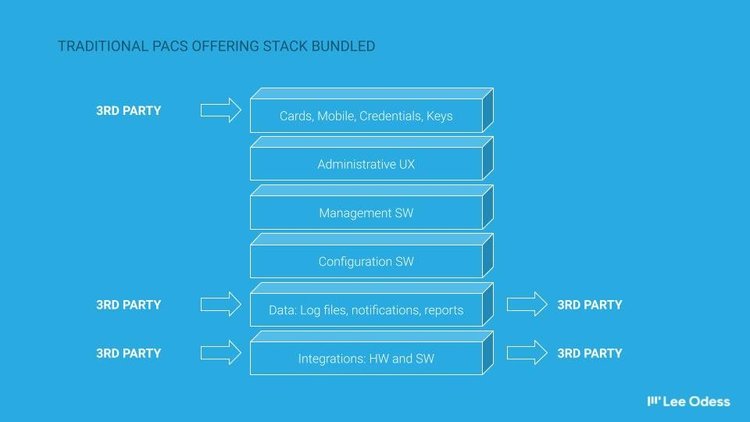
At a high level, the technology stack for physical access control systems is made up of the following parts:
And also, at a high level, the go-to-market value chain of physical access control systems looks a lot like this (the + signs are a rough scale of the value generated by that cog in the value chain):
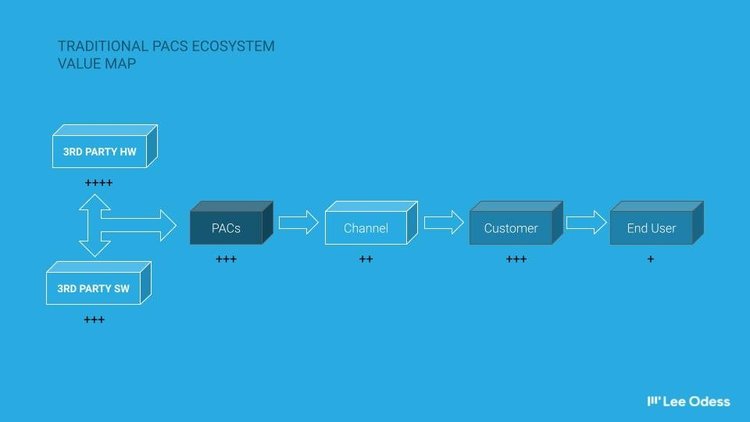
Sure there are nuances, but again, these two charts summarize the parts, how products flowed to market, and the rough value generated by that cog in the value chain.
This technology stack and value chain have been around since 1973. Unfortunately, there have been few breakthrough innovations within our industry over the years compared to innovations outside the industry. As a result, our industry has decided to take on the "this is how we do it" school of thought regarding innovation and go-to-market strategies. Please keep in mind that when I talk about innovation, it is not just technical. It is also around the business. Innovation happens in how we communicate and tell stories, how we price, how we partner, and how we go to market.
The good and bad news with that innovation strategy is, most of the time, that's when disruption occurs. The disruption that is happening right now is primarily due to two factors. First, is the introduction of software. Software as a disruptor, also known as a digital transformation, has been lurking and building for many years. We can look to technological breakthroughs and momentum that have come along over the years, such as personal computing, computing power, cloud computing, and mobile, to create the environment we are in now. The second is investment dollars. The external capital markets have seen the opportunity from our fragmented, slow-to-change, and cottage industry and have accelerated disruption by investing in and around our industry. As a result, it is having an impact.
So when you couple technical advancements with capital investments, people and companies from outside our industry start asking questions that begin with "why" and become laser-focused on soft tissue areas of our industry. That is where the unbundling starts to happen.
When it comes to the technology and application stack of access control, the unbundling looks like this:
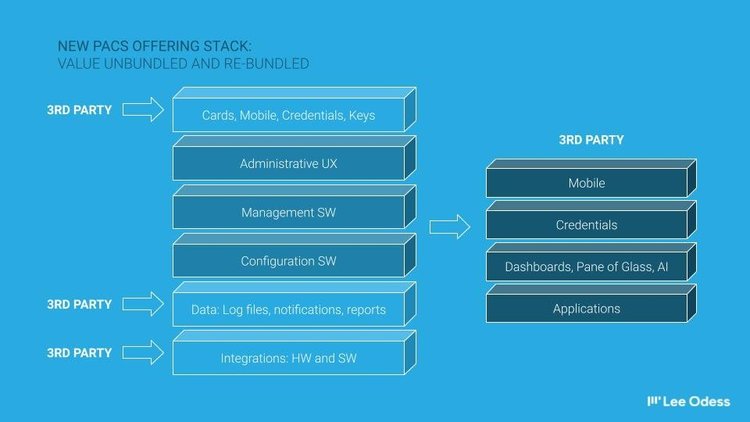
You will notice that the third-party companies start to focus on delivering mobile or wallet applications for end users, or credentialing and identity, or maybe they take access control data and create dashboards, couple it together with other data and deliver a "single pane of glass" view into building operations, or maybe they apply some machine learning and artificial intelligence to the data and automate or provide insights, or perhaps they create new applications that use our industry to "unlock" new value, like on-demand booking apps, that also focus on the end user. All areas we have ignored or not prioritized. Historically the areas listed above have been a low value to the market, but times have changed.
When it comes to how this unbundles the traditional go-to-market strategy, the unbundling looks like this:
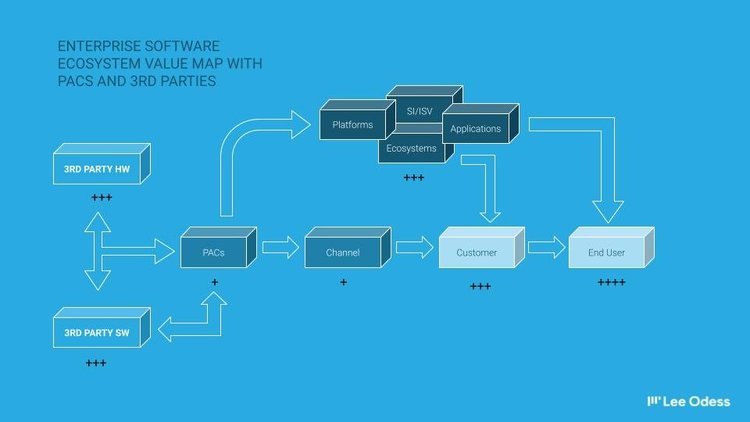
We see value staying more or less the same for the 3rd party hardware, 3rd party software vendors, and customers. We see a substantial decrease in value for traditional physical access control software companies and the traditional channel. On the other hand, there is an introduction of new and moved value to the Enterprise Software companies and substantially increased value to end users.
To believe that with all this newness entering the market, the economics and value would stay the same or pile on top of each other is insanity. Instead, the value will move to where the value is either perceived to be created or valued the most. We may not feel the pinch yet, but it will start to feel more like a strangle. For reference: see the multifamily vertical.
An impactful but less discussed area of disruption is the influence directly on the end user and customer. The plain fact is that end users and customers are discovering more online, leveraging online peer groups, but more disruptive to the status quo is that end users and customers are being sold to by many more new companies, with modern sales messages, new value creation stories, and at different levels within the organizations.
Typically unbundling becomes extremely appealing when a whole industry, like ours, has been built on the same logic. As I mentioned, we have had the same methods and messages since 1973. The aforementioned allows new players the ability to come in, identify the most valuable parts of the value chain and offer it at a more convenient price, re-bundled with other services and products of value, or use newer methods that make their offering seem more modern, flexible, or custom built for their needs.
Here are some examples of the unbundling and re-bundling happening:
-
AI companies like Hakimo, Ambient.ai, and Hivewatch
-
ISVs or SIs selling into the market like Soloinsight, RemoteLock, SwiftConnect, BraXos, StratorSoft, and Wavelynx
-
Data and Operational Efficiency companies like OpenVia, VTS(Rise) and Realpage (Straits)
-
Identity Management Systems bridging virtual to physical with Oloid
-
Traditional access control companies moving more to enterprise software like Brivo
-
Lock company going deeper into software such as Salto
-
Newer access control companies combining other utilities and enterprise software tools like Genea
-
Megatech and their wallets, like Apple
-
Megatech and their worktech offering like Microsoft
-
Large PE firms grouping many worktech and data offerings like Eptura
And on the horizon are potential Enterprise Software Megatechs getting into the game that would be massively disruptive (it is a case of when not if) like Salesforce and ServiceNow.
So what should you do if you are part of the existing access control ecosystem?
First, recognize it and put a strategy together. I know you are "busy," but you need to put the time and resources into this.
From there, you have many options. To name a few:
-
Go through the "we are an enterprise software company" thought exercise. What would you do differently? What should you start doing, and what should you stop doing?
-
Get in the unbundling and re-bundling game yourself. Where are the areas where you can invest in to offer? For instance, data. What is your plan? Log files and the ability to export files will not do it anymore. Unbundling your products or services has the potential to offer more choices by splitting your services into multiple offerings tailored to meet the needs of your customers. This structure will help your business reach different customers by providing just what they want versus trying to be everything to everyone. Unbundling can also increase revenue in some instances. But it won't happen unless you also…
-
Go vertical. Use software to get specific and dominate a vertical.
-
Don't look at this only as a technical exercise. Some of this comes down to how you package and market your offering. For example, how are you offering and packaging some of your software services? Too many offer everything as a license.
-
Look at your team. Do you have the right talent? Do you need to bring in new? Level up existing? Do you need to acquire talent? Many "feature" companies would be better off being part of legacy companies.
-
Take the ecosystem seriously as a channel. Create programs, charge for your services, set expectations, and resource them properly.
-
As an integrator, how do you morph your business into a service entity? Do you create your products? What product categories do you stop doing, continue and bring new on? How do you position yourself properly with the brands you partner with so they treat you properly with your strategy and vision? What certification and training do you need to be more relevant?
-
Get crisp on what is and is not your core business. For instance, you may have had a visitor management system for years. Is it up to snuff with what's needed today? Should you invest more in it? Kill it? Partner?
-
Get to the action: Is it time to merge with another company? Can you acquire someone? What about selling your company?
Undoubtedly, the next 2-5 years will shape the next 20-50. So the question is, what are you going to do about it?
Do you agree we are in the midst of unbundling and re-bundling or is this just an extension of the everyday business, and there is nothing to see here? Curious about your thoughts on all of this. Let me know by replying to this email.
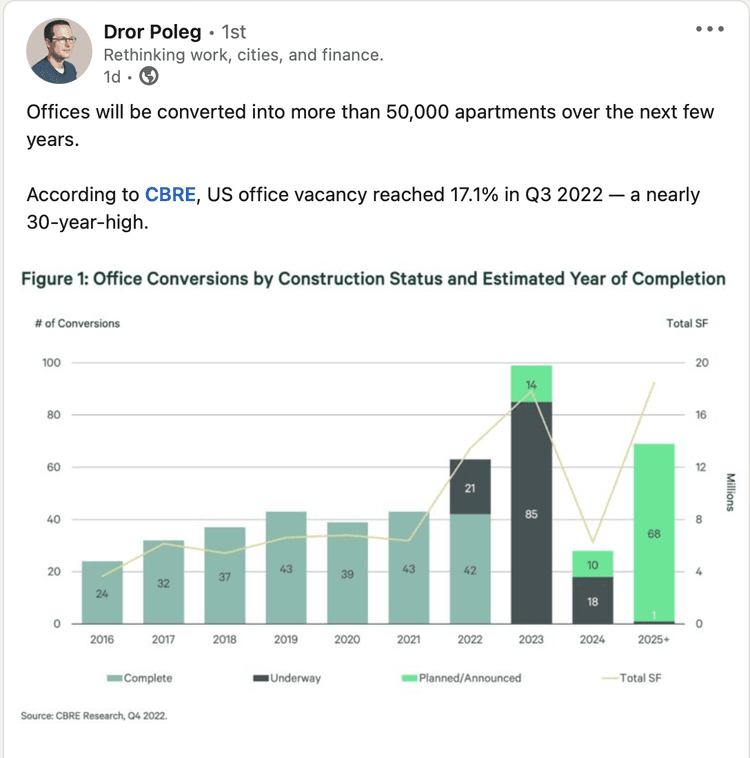
Chart of Interest