
Volume 40 | January 8, 2024
Welcome to the first Brief of 2024!
I hope you had a chance to relax and enjoy the New Year. This time of year is great for slowing down and preparing for January and the year ahead.
In this Brief, titled Standard Definitions and Nomenclatures for Today and Tomorrow Through the Topology Map + Hopes for the Access Control and Smart Lock Industry in 2024, I want to emphasize something meaningful that will shape 2024 and the next 3 to 5 years and beyond. I've mentioned before that 2023 marked the beginning of a digital transformation. It moved from being a topic of discussion to something we experienced, talked about, and participated in. It set the stage for the next 30 years in our industry. It also marked the start of something new for me, and I invite you to join me in what I'm about to share.
I spent most of 2023 defending the new against the old. I spent much time trying to convince people that the changes in our industry are fundamental and will have a more profound impact than in the past 30 years. I focused on highlighting the opportunities they presented and showcasing those globally well-positioned to take advantage of these new truths and opportunities.
Well, I'm done with that.
In 2024, I will spend my time discussing where things are happening, how they are happening, the stories behind these developments, and highlighting the opportunities ahead of us. I won't be comparing them to the past; instead, I'll focus on the facts of today.
However, our global community must align on standard definitions and nomenclatures for today and tomorrow to do that effectively.
To achieve standard definitions and nomenclatures for today and tomorrow, I will use the topology map as a representation.
That is the purpose of this Brief. It is about our global community coming together and establishing standard definitions and nomenclatures that support our industry as it becomes more mainstream.
I also want to share some of my "Hopes for the Access Control and Smart Lock Industry in 2024." Instead of making predictions, I have compiled a list of these hopes.
More on those later, but first, on how I want to drive standard definitions and nomenclatures for today and tomorrow.
Thank you for all the support in 2023, and here's to a fantastic 2024!
If attending the Intersec show in Dubai from 1/16 to 1/18, please visit the Thought Leadership Pavilion. We have lined up 8 global companies with 16 thought-provoking discussions from 11 am to 4 pm on the first two days:
As always…If, for any reason, I am not meeting your expectations, please feel free to let me know.
Thank you!

PS: I am sure some of you may forward this on but please do so sparingly and encourage others to sign up here. Thank you!
Standard Definitions and Nomenclatures for Today and Tomorrow Through the Topology Map
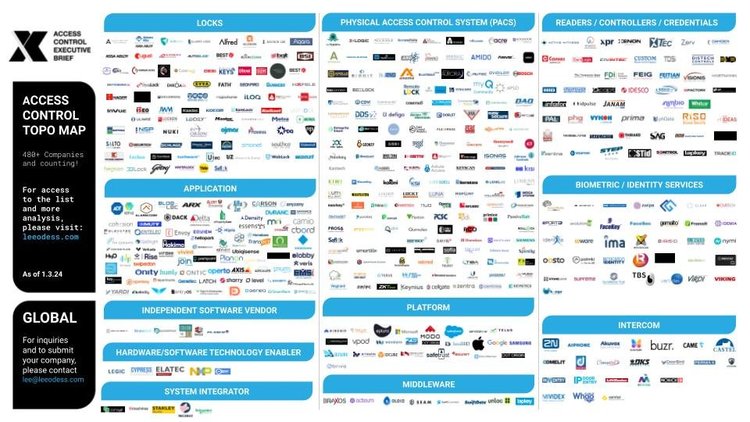
I launched the Topology map tool on 1/3/23 while sitting on my in-laws' couch in Portland, Oregon. I thought it was something needed (truthfully, because every other industry had one, so why not us?) and something that people wanted. I had no idea it would grow to include 480 companies or receive such high engagement. But in the end, it worked out and continues to work out great.
However, the definitions and nomenclatures felt outdated when I looked at the topology map over the holiday break and with a fresh perspective. There was a section called ISV/SI, but the companies grouped started to lose their coherence as that area grew.
The Access Control Software section also needed further refinement as its companies became incompatible and could not be effectively grouped.
So, I did what I always do - I made changes. I updated it.
[BTW - you can download yours as well as have access to the source file and the data viz tool created by StratorSoft under your account online. The map is also available in our Slack group}
Addressing Some Concerns
Before discussing the updates, I want to address a few concerns:
First, it is important to acknowledge that the map is intentionally imperfect. The market and the companies involved are complex and nuanced. By simplifying it into a one-dimensional representation, we can establish clear definitions and nomenclatures crucial for effective communication, decision-making, brand recognition, quality assurance, efficiency, and trust-building.
Second, the definitions and nomenclatures used in this map are not my own. They are community-driven. Your feedback and input are essential in refining this tool and making it a valuable resource.
Third, the information used to create this map was gathered from direct conversations with you, your company, or individuals in the market, as well as from your website, blog posts, articles, podcasts, and trade shows.
Now, let's dive into the updates made to the Topology Map.
Updated and New Categories
The following categories have been cleaned up and remain relevant:
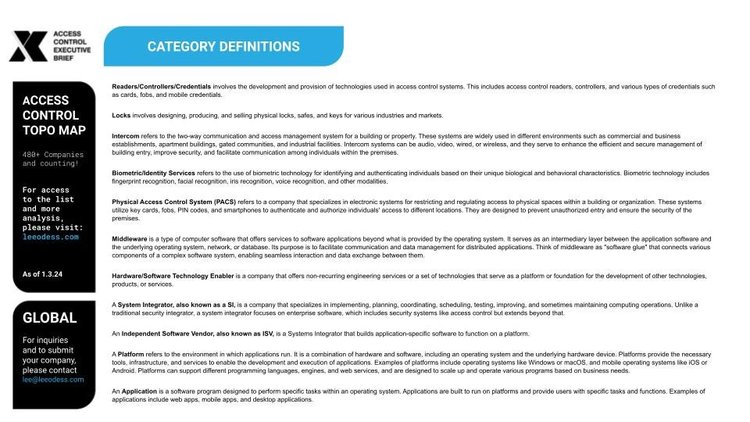
Readers/Controllers/Credentials: This category involves the development and provision of technologies used in access control systems, including access control readers, controllers, and various types of credentials such as cards, fobs, and mobile credentials. Example companies in this category are Active Witness Corp, Atlas360, and BridgePoint (IDFACTORS).
Locks: This category focuses on designing, producing, and selling physical locks, safes, and keys for various industries and markets. Example companies in this category are 33Lock, Access2, and Accurate lock.
Intercom: Intercom refers to the two-way communication and access management system used in buildings or properties. These systems are widely used in commercial and business establishments, apartment buildings, gated communities, and industrial facilities. They can be audio, video, wired, or wireless and serve to enhance efficient and secure building entry management, improve security, and facilitate communication among individuals within the premises. Example companies in this category are 2N, Aiphone, and Aukuvox.
Biometric/Identity Services: This category involves using biometric technology for identifying and authenticating individuals based on their unique biological and behavioral characteristics. It includes fingerprint recognition, facial recognition, iris recognition, voice recognition, and other modalities. Example companies in this category are Accessworks, Alcatraz, and Allthenticate.
The category Access Control Systems has been updated to Physical Access Control System (PACS).
Physical Access Control System (PACS) specializes in electronic systems that restrict and regulate access to physical spaces within a building or organization. These systems utilize key cards, fobs, PIN codes, and smartphones to authenticate and authorize individuals' access to different locations. They are designed to prevent unauthorized entry and ensure the security of the premises. Example companies in this category are 10Tacle, 3xlogic/Infinias and Access Specialties International.
The following new categories have been introduced:
Middleware: Middleware is computer software that offers services beyond what the operating system provides to software applications. It acts as an intermediary layer between the application software and the underlying operating system, network, or database. Its purpose is to facilitate communication and data management for distributed applications. Think of middleware as "software glue" that connects various components of a complex software system, enabling seamless interaction and data exchange between them. Example companies in this category are BraXos, Octeum, and OLOID.
Hardware/Software Technology Enabler: This category refers to companies that offer non-recurring engineering services or a set of technologies that serve as a platform or foundation for developing other technologies, products, or services. Example companies in this category are Elatec, EMSi, and LEGIC.
Platform: A platform is the environment in which applications run. It combines hardware and software, including an operating system and underlying hardware devices. Platforms provide the necessary tools, infrastructure, and services to enable the development and execution of applications. Examples include Windows or macOS and mobile operating systems like iOS or Android. Platforms can support different programming languages, engines, and web services and are designed to scale up and operate various programs based on business needs. Example companies in this category are 3MillID, Airship, and Apple.
Application: An application is a software program designed to perform specific tasks within an operating system. Applications are built to run on platforms and provide users with specific tasks and functions. Examples include web apps, mobile apps, and desktop applications. Example companies in this category are Alarm.com, Alert Enterprise, and Alfa-Zet Systems.
What am I missing? What looks right? Please let me know.
As a community focused on progress today and highly motivated by the prospects of tomorrow, if we come together and share a common language and nomenclature, we can make it easy for our customers and their customers to embrace the amazing products and services we offer.
Our offerings go beyond just keeping bad actors out; they also provide value in operational efficiencies and even revenue opportunities.
It all begins here, with this community.
Hopes for the Access Control and Smart Lock Industry in 2024

Instead of working on predictions for 2024, I wanted to share some hopes for the Access Control and Smart Lock industry. Here are a few of my hopes for 2024:
Another banner year: I hope 2024 will be another successful year for our industry. With the increasing need for safety and security, there is an opportunity to provide additional value beyond just locking and unlocking. Our industry is now in the enterprise software formation, and we can capture the $70-$100 billion market by offering innovative solutions that deliver on the customer needs of today and tomorrow.
The rise of middleware: I hope the fragmentation of our industry, the number of installed systems, and the convergence of IT and Security indicate that 2024 could be where the value shifts from legacy players to software middleware companies. While the value of horizontal Physical Access Control Systems is decreasing, the value of Middleware, Applications, and Platforms is increasing. The perceived and actual value these companies bring to customers will be the main driver. I believe this value will end up with the Platform, Applications, and Middleware players becoming prime acquisition targets.
Embracing unpredictability: I hope and expect 2024 to be a year of unpredictability, where rules and truths are redefined. The old guard will struggle to control content and communication. Still, those who embrace our industry's volatility, uncertainty, complexity, and ambiguity (also known as VUCA) will benefit in the long run.
CEO-driven AI innovation: I hope to see every CEO in our industry driving AI innovation. It shouldn't be solely the CTO or product manager's responsibility, as Dror Poleg said. AI is a significant opportunity, and 78% of CEOs have already invested in it. However, 1 in 4 CEOs believe they lack the right people to power their AI programs. This suggests a continuing battle for talent, and CEOs should take the lead in driving AI initiatives.
Reverse mentoring: I hope to see our industry engage in reverse mentoring, where new entrants mentor older veterans. Technology changes and disruption can be overwhelming for those in the industry for a long time. By seeking mentorship from younger and more experienced individuals in specific fields, older veterans can stay up-to-date and adapt to the changing landscape.
Legacy disruptors' second act: I hope to see a large group of legacy disruptors in our industry have a second act. Companies like Salto Systems, Genetec, Allegion, Suprema, Idemia, dormakaba, and the S2 portion of LenelS2 have successfully leveraged their legacy business but need to reinvent themselves. Examples of companies such as Brivo, Nedap, and bioconnect have done a great job in this regard. Out of that group listed, my money is on Salto Systems being the first to do it.
Authenticity over "open washing": I hope we stop our industry's "open washing" trend. It's not a genuine conversation, and it makes us look foolish. While closed systems may have less fragmentation and vulnerability, both closed and open systems are viable. Putting that aside, most companies that advertise they are “open” are actually just “more opener than someone else.” It is a pedestrian strawman.
Red in the Face Businesses: Which leads me to…I hope we stop seeing companies whose business plans are solely based on not being HID, Mercury, Genetec, or any other larger incumbent. In 2023, far too many companies presented their business plans as being "more supply chain friendly than HID," "more open than Mercury," or "more platformed than Genetec." This is not a winning strategy in the long term. Instead, the focus should be on solving customer problems.
Rise in M&A activity: With incumbents holding a significant amount of cash, cash-strapped growth companies, and a fragmented industry, I anticipate an increase in M&A activity. This presents a great opportunity for those who approach things differently to gain a larger market share and foster innovation in our industry.
Lastly, I want to express my hope to be continually inspired by all of you. Together, we can work towards capturing the $70-$100 billion new opportunities. Thank you for allowing me to be a part of the re-imagination of our industry.
