
Volume 43 | February 5, 2024
Welcome to Brief 43, titled Honeywell's Q4 2023 Earnings: A Deep Dive into Building and Safety Segments. This Brief is the first quarterly earning report by our special financial analyst guest, Tony Dong. The report also includes a comprehensive 10-year Discounted Cash Flow (DCF) analysis on Honeywell below. The level of detail and analysis is second to none.
As a reminder, here is Tony's bio:
Tony's ETF analysis and reviews have been featured in multiple North American financial and investing media platforms, including U.S. News & World Report, USA Today Blueprint, TheStreet, Benzinga and The Motley Fool. Currently, he is also the Lead ETF Analyst for ETF Central, a partnership between the NYSE and Trackinsight. Previously, he also contributed content for the ETF platforms of the CBOE Canada and Nasdaq exchanges.
Before becoming a financial writer, Tony worked in corporate security management and served in the Canadian Armed Forces as a reservist. Later, he transitioned into a senior risk analyst role with a Canadian public transportation infrastructure entity, before quitting in March 2022 to pursue freelancing full time.
Tony earned a Bachelor of Arts degree in criminology from Simon Fraser University in British Columbia, Canada, graduating in 2019. In 2023, Tony completed graduate studies at Columbia University in New York City, earning a Master of Science degree in enterprise risk management.
His main financial credentials include the Canadian Securities Course (FINRA Series 7 Equivalent) and the Certified ETF Advisor (CETF®) designation from The ETF Institute.
This report is the first of many financial analysis Briefs we plan to bring to you. If there are any questions, comments, or thoughts, please reply here or join the conversation in Slack, where Tony is also participating.
As a reminder, we published in partnership with StratorSoft and We the Dreamer a Position Paper titled "Enhancing Physical Security Through Data, A Guide for Beginners." It is an incredible guide to data as it pertains to access control. StratorSoft, founded by Adam Groom, is a data automation, business intelligence, and workflow company focused on the physical security industry. We the Dreamer, founded by Bert Hart, is who we partner with on all our graphics, artwork, look and feel.

We will continue to develop Position Papers and bring them free for download to the general public to help increase adoption of the technologies you are presenting to the market. Up next is a Position Paper on “Not all Clouds are the Same.” Please let me know if you want to partner on a position paper.
As always…If, for any reason, I am not meeting your expectations, please feel free to let me know.
Thank you!

PS: I am sure some of you may forward this on but please do so sparingly and encourage others to sign up here. Thank you!
Honeywell's Q4 2023 Earnings: A Deep Dive into Building and Safety Segments by Tony Dong

Honeywell International Inc. (NASDAQ: HON) just released its earnings report for the fourth quarter and the entirety of 2023, presenting a bit of a mixed bag.
While the company slightly surpassed expectations with an adjusted earnings per share (EPS) of $2.60, edging out the forecasted $2.59 by a mere 0.33%, this news didn't sway the market favorably, as the stock witnessed a 3% drop within the day.
In terms of sales, Honeywell saw a modest increase of 3% year-over-year for the quarter, with a 2% rise in organic sales, which adjust for certain factors like currency changes and acquisitions to give a clearer picture of growth.
Looking at the year as a whole, Honeywell's sales rose by 3%, or 4% on an organic basis. The company managed to increase its operating income by 10%, leading to a 1.2% improvement in operating margin. The full-year EPS was reported at $8.47, with an adjusted EPS of $9.16 after accounting for certain financial adjustments.
However, for a diversified giant like Honeywell, it's crucial to look beyond these surface-level figures. A broad overview can obscure specific areas of strength or weakness. Case in point, the operating margin—a key measure of profitability—actually saw a decrease of 2.9% to 16.8%. This should be a prompt to drill deeper.
This is especially true for executives in the access control industry, where understanding the nuanced performance of Honeywell's building and safety segments is essential. Let's delve into the details to uncover the real story behind these numbers.
Challenges and Opportunities in Access Control and Safety Segments
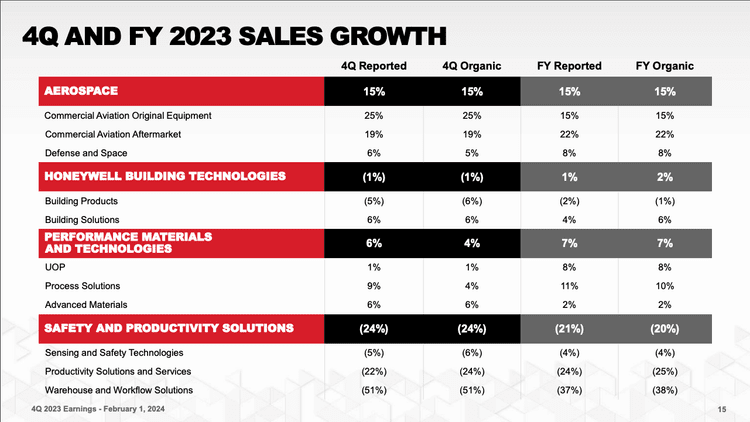
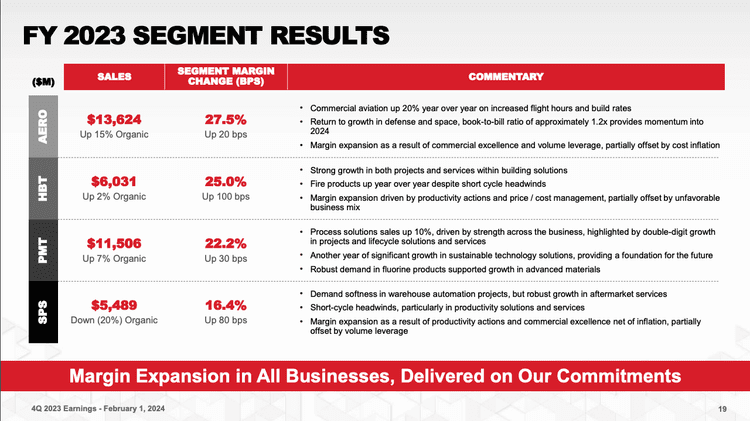
Honeywell's aerospace sector saw a notable increase, with sales rising 15% due to growing demand in both commercial aviation and defense sectors. However, for those of us focused on access control, the results were less positive.
In the building technologies sector, which includes access control systems, sales slightly decreased by 1% year-over-year. Despite a 6% growth in building solutions driven by service and project sales, this was offset by a decrease in fire and security product sales.
The profit margin for this segment decreased by 0.9% to 23.9%, influenced by higher costs and the sale of less profitable products, although Honeywell did take steps to mitigate these effects.
Digging deeper into Honeywell's building technologies segment, the -1% shrinkage reveals some disparities. Building solutions actually grew by 6%, but building products, which are more crucial to our interests, fell by 5%.
This decline in building products is particularly significant for subscribers as it includes key areas like electrical and wiring, access control, intrusion detection, sensors, voice and notification, and video systems.
The safety and productivity solutions segment, relevant for warehouse and workflow solutions within our industry, experienced a more significant sales decline of 24% year-over-year. However, there was a positive sign with orders growing by more than 30%, suggesting potential future improvements.
Despite this, the profit margin in this segment decreased by 2.9% to 17.3%, mainly due to the lower sales volume and increased costs, though efforts to improve productivity and sales effectiveness did provide some relief.
I'm more concerned about the substantial 24% reduction in sales for the safety and productivity solutions segment. Breaking down this segment, we find sensing and safety technologies down by 5%, productivity solutions and services down by 22%, and most notably, warehouse and workflow solutions plummeting by 51%.
This downturn could indicate a broader industry-wide challenge, potentially impacting investment and operational decisions across the sector. This trend should be alarming for executives in the property technology industry for several reasons.
First, if a diversified conglomerate like Honeywell, with its robust balance sheet and extensive support, is facing challenges in these areas, it's likely that specialized manufacturers, integrators, and end users might experience similar, if not more severe, demand downturns from industrial clients.
Furthermore, the steep decline in warehouse and workflow solutions, a critical component for efficient property management and logistics, suggests a significant slowdown in industrial activities. This slowdown could lead to a ripple effect, impacting everything from construction projects to technology upgrades in existing facilities.
In essence, Honeywell's struggles in these segments could be a bellwether for the wider industry, hinting at the need for strategic adjustments and possibly more cautious financial planning in the near term.
Macro Outlook Impact on Honeywell's 2024 Performance
Honeywell's outlook for 2024, with projected sales between $38.1 billion and $38.9 billion and an earnings per share increase to $9.80 - $10.10, appears optimistic.
However, it's important to consider how certain macroeconomic factors might impact this forecast, particularly for the building technologies and safety and productivity segments.
A key factor in my opinion is the national office vacancy rate, which recently hit a record 19.6%, according to Moody’s Analytics. This is the highest since early 2021 and a notable jump from previous years. This increasing commercial property vacancy rate could directly impact Honeywell's building technologies segment growth.
It's simple: lower occupancy rates in offices lead to financial strain on property owners, who may then be less inclined to invest in new security and property technology products and services. With fewer businesses and tenants populating these spaces, the demand for building upgrades, including advanced access control systems, could see a significant decline.
On the other hand, a potential positive driver for Honeywell's safety and productivity segment could be the escalating need for automation among industrial end users. According to Deloitte, this need is being driven by a persistent shortage of skilled labor, ongoing supply chain disruptions, and new challenges arising from companies striving to meet their net-zero emissions goals.
The positive outlook for Honeywell's safety and productivity segment is further bolstered by a recent Deloitte study, which found that 86% of surveyed manufacturing executives believe smart factory solutions will be primary competitiveness drivers in the next five years.
This trend could greatly benefit Honeywell, especially considering their range of products and services catering to the evolving needs of e-commerce and distribution centers. These include the Momentum warehouse execution system (WES), and various order picking and putting technologies such as mobility devices, scanners, and printers.
Key Takeaways
Earnings reports, while informative, inherently look backwards, painting a picture of what has already happened. Furthermore, companies' forward-looking guidance can often be notoriously unreliable. Here's what I think you should care about instead from a strategic standpoint, as an access control, security, or proptech executive.
For conglomerates like Honeywell, a segmented analysis of their earnings is essential. On the surface, Honeywell's performance might seem satisfactory, but the lackluster results in specific segments related to access control and security should raise red flags.
Considering Honeywell's significant market presence, their struggles in these areas could signal broader challenges for the industry, particularly for smaller, less capitalized companies and startups. In a high-interest-rate environment, the ability of these companies to sustain and grow becomes a critical concern.
Aligning sales strategy with current market trends is another key strategic approach. Rather than going against the grain of macroeconomic cycles, it's more pragmatic to tailor sales efforts to industries showing stability and growth potential.
For instance, with commercial property currently facing challenges like high vacancy rates and credit issues, focusing on more resilient sectors such as healthcare and critical infrastructure could prove more fruitful. These sectors tend to withstand economic fluctuations better and offer more sustainable opportunities for growth.
In summary, for more fruitful strategic planning, focus on two key aspects: deeply analyze the performance drivers of relevant segments and consistently factor in the macroeconomic context. This approach ensures your strategies are not only responsive to current market conditions but also aligned with long-term growth opportunities.
[Tony Dong currently holds a long position in HON]
A comprehensive 10-year Discounted Cash Flow (DCF) analysis on Honeywell
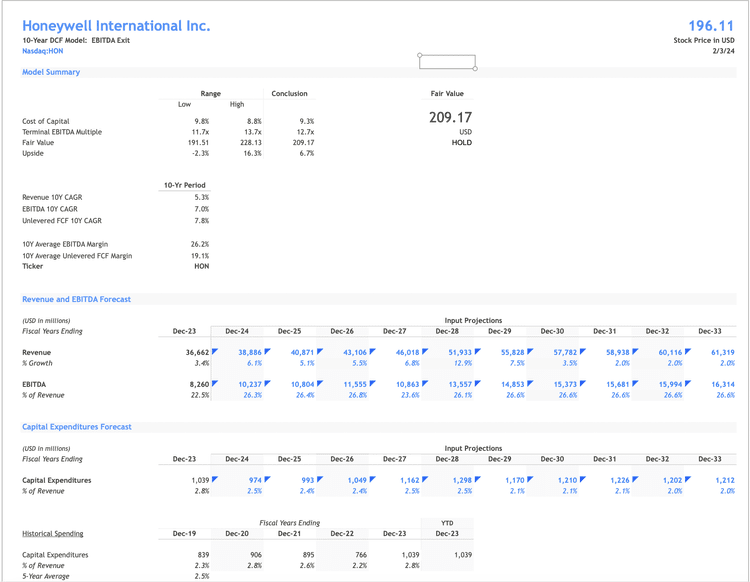
*Please note: below is a screen shot of the Excel spreadsheet. The source file of this analysis is in Slack for your download.
In light of Honeywell's recent earnings report, I've completed a comprehensive 10-year Discounted Cash Flow (DCF) analysis on Honeywell. This analysis aims to offer a clearer picture of Honeywell's financial health and future prospects, empowering you with information to make informed investment decisions.Understanding the DCF Analysis: A Simple OverviewAt its core, a DCF analysis helps us determine the fair value of a company by forecasting its cash flows over a certain period — in this case, 10 years — and then discounting them back to their present value using a specific rate (the discount rate). Think of it as calculating how much the company's future money is worth today. This approach gives us a way to decide if the stock price today is reasonable compared to how much money the company is expected to generate in the future.Key Inputs and Assumptions:
-
Stock Price: The current stock price is $196.11 USD.
-
Fair Value Estimate: My analysis indicates a fair value of $209.17 USD for Honeywell's stock, suggesting what I believe the stock should be worth today based on its future cash flow generation.
-
Discount Rate: I've used a range of 9.8% to 8.8%, with a conclusion at 9.3%. The discount rate is crucial as it reflects the risk and the time value of money — the principle that money available now is worth more than the same amount in the future due to its potential earning capacity.
-
Terminal EBITDA Multiple: Estimated between 11.7x and 13.7x, concluding at 12.7x. This metric helps me estimate the company's value at the end of our forecast period.
-
Revenue Growth and Profitability Metrics: I expect a 5.3% compound annual growth rate (CAGR) in revenue over the next 10 years, with an average EBITDA (Earnings Before Interest, Taxes, Depreciation, and Amortization) margin of 26.2%, indicating steady profitability. The unlevered Free Cash Flow (FCF) is also projected to grow significantly.
Valuation Conclusion and Recommendation:Based on my DCF analysis, Honeywell's stock has a calculated fair value range of $191.51 to $228.13, with a central value of $209.17. This valuation indicates a potential upside of -2.3% to 16.3%, with a more likely scenario of a 6.7% upside. Given the relatively modest potential for gain, my recommendation is to HOLD your investment in Honeywell. The current stock price appears to accurately reflect market consensus and valuation, suggesting that Honeywell is fairly valued at the moment.In simpler terms, my analysis shows that Honeywell's stock price is just about right, given its future money-making potential. There doesn't seem to be a significant opportunity for a price increase that would justify buying more shares right now. However, holding onto your shares if you have a position is advisable, as my projections suggest that the company is on solid financial footing.I understand that navigating financial analyses can be complex, especially with varied levels of expertise in finance. I hope this breakdown has made the insights from my DCF analysis on Honeywell accessible and useful for your investment strategy.
As always, I'm here to support your investment journey in the security industry. Please feel free to reach out if you have any questions or need further clarification on my analysis.
Warm regards,
Tony Dong
Let’s keep the conversation going and join us on Slack.
