
Volume 59 | June 13, 2024
Welcome to Brief 59, titled Access Control Executive Brief 2024 Mid-Year Market Update, by Tony Dong. It is a timely Brief given the US Federal Reserve news yesterday. More on that below, but first, let's share some exciting news:
It's been two weeks since ASC24 Europe, and we're happy to announce that the videos are now available online for members!
Here's how to access them:
As an Access Control Executive Brief Member, you can find the videos in your membership account on www.leeodess.com. They're also accessible on this password-protected page: www.leeodess.com/acs24-europe-videos with the password 053024acse.
Please note, two sessions, "Access Granted: The Untold Story of Google’s Security & Mobile Access" and "Workplace Experience: How Technology is Driving Value Beyond Locking and Unlocking," were not recorded due to permission restrictions. Just another reason to attend in person next time 🙃.
If you were a speaker, expect to receive the raw video of your session from Hilary by noon EST today.
I look forward to hearing what you think of the videos!
And back to the Brief...
In Brief 59, following the recent US Federal Reserve decision to maintain current interest rates and project only one rate cut this year, we thought it fitting to provide a mid-year market update. In this edition, Tony Dong provides a comprehensive overview of the access control industry and the ACEB Focus 10 Index's performance in the first half of 2024. He delves into the performance contributors and detractors, discusses potential strategy shifts for the index, and updates us on macroeconomic factors in manufacturing, labor, consumption, and central banks' activities. As always, Tony demystifies complex financial concepts. It is an awesome overview.
Lastly, we're excited to announce that we'll be using an AI voice generator, trained on my voice, to offer all Briefs in audio format moving forward. It is definitely not perfect yet but we are close. I will update you all when it is ready. It's been a fascinating process, and we're happy to discuss it further with you.
As always, your feedback is invaluable to us. Please let me know if there's any area where we can better meet your expectations.
Thank you!

PS: I am sure some of you may forward this, but please do so sparingly and encourage others to sign up here. Thank you!
Access Control Executive Brief 2024 Mid-Year Market Update
by Tony Dong

As we flip the calendar page in June, marking the halfway point of the year, Lee suggested it might be beneficial for me to provide subscribers with an update. Thus, this week's brief will cover how our industry has fared over the past six months, as well as the broader economic landscape.
Fair warning—this brief will involve a fair amount of financial jargon, data, and terminology. I understand these topics can be dense, especially if you're new to them, so I'll make every effort to break down the information in a way that's accessible and easy to understand.
However, should you find yourself puzzled by any part of this update or if you have questions about specific details, please don't hesitate to reach out on Slack.
ACEB Focus 10 Index Update
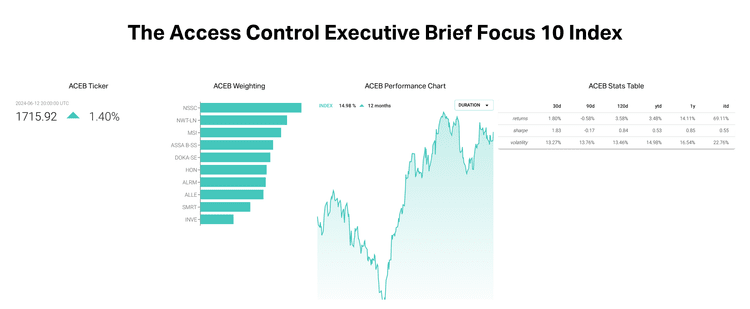
As of June 07, 2024, the ACEB Focus 10 Index recorded a year-to-date (YTD) price return of 2.81%, which lagged behind the broader S&P 500 Index's return of 13.23% and the Industrial Select Sector Index's return of 9.02%.
Contributors to performance YTD included:
-
Napco Security Technologies Inc. (NSSC) - up 51.08%
-
Newmark Security Technologies PLC (NWT) - up 34.23%
-
Motorola Solutions Inc. (MSI) - up 19.74%
-
Assa Abloy AB (ASSA-B) - up 7.32%
-
Dormakaba Holding AG (DOKA) - up 6.33%
-
Honeywell International Inc. (HON) - up 0.51%
Detractors from performance YTD included:
-
Alarm.com Holdings Inc. (ALRM) - down 1.36%
-
Allegion PLC (ALLE) - down 5.79%
-
SmartRent Inc. (SMRT) - down 22.64%
-
Identiv Inc. (INVE) - down 46.79%
Despite the strong performance of several key components, the equal-weighted methodology of the ACEB Focus 10, coupled with significant losses in small-cap holdings like SmartRent and Identiv, contributed to the overall underperformance of the index.
Looking ahead, Lee and I are considering shifting the index to a market-cap weighted strategy. This approach would weigh companies based on their market capitalization—calculated by multiplying the stock price by the total number of shares outstanding—giving larger companies a greater influence on the index's performance.
We are also contemplating replacing some of the current holdings with larger firms such as ADT or Johnson Controls to potentially lower volatility.
Macroeconomic Update(s)

Manufacturing
The latest factory orders report from the US Census Bureau, issued on June 4th, showed a consistent performance in manufacturing. April's factory orders increased by 0.7% month-over-month, mirroring the growth rate from March and slightly exceeding the expected 0.6%. This report aligns closely with the preliminary durable goods data released earlier, indicating steady manufacturing activity.
Labour
On June 7th, the U.S. labor market delivered a robust performance, with the economy adding 272,000 workers last month, significantly surpassing the anticipated 185,000 and marking a notable increase from April’s 165,000.
This surge in hiring wasn’t the only positive development; wage growth also accelerated. Employee paychecks rose by 0.4% month-over-month, exceeding expectations of a 0.3% increase and doubling the previous month’s gain of 0.2%. Year-over-year, average hourly earnings increased by 4.1%, which was above the projected 3.9% and higher than April’s 4.0%.
While the strong hiring and wage gains are positive indicators for household income, there was a concerning shift in the unemployment rate, which edged up from 3.9% to 4.0%. Historically, any 50-basis point rise in unemployment from its lowest point has preceded a recession.
In this cycle, the lowest unemployment rate was 3.4%, now 60 basis points below the current rate, which could signal potential economic headwinds. Additionally, a decline in the number of temporary workers to a new cycle low suggests a possible softening in labor conditions, adding a note of caution to an otherwise positive report.
Despite the positive hiring numbers, there was a concerning contraction in the labor supply last month, as more individuals became discouraged about their employment prospects.
The labor force participation rate—the percentage of working-age people who are either employed or actively looking for work—declined by 20 basis points to 62.5% month-over-month. This reflects a significant departure from the workforce, with 250,000 people choosing to leave, no longer actively seeking employment.
This withdrawal from the labor force is troubling, particularly from an inflationary standpoint. With fewer people in the labor market, there's less competition for jobs, which can lead to increased wage pressures as employers are forced to raise salaries to attract or retain workers.
Consumption
Households significantly increased their spending on services last month, as reported by the latest Services Purchasing Managers’ Index (PMI) from the Institute of Supply Management (ISM).
The PMI for May reached 53.8, substantially beating the forecasted 50.8 and marking a sharp increase from April’s 49.4, making it the strongest result since last August. Key drivers of this growth included exports, production, and domestic orders, with scores of 61.8, 61.2, and 54.1 respectively, all indicating expansion (a score above 50 indicates growth).
Despite the positive headline figures, there were still areas of concern. Prices continued to rise rapidly, with the price index segment climbing to 58.1, reflecting ongoing inflationary pressures. Additionally, the employment component of the index fell to 47.1, suggesting contraction in employment within the services sector.
Survey respondents noted that this decrease in workforce numbers was not due to a drop in demand but rather stemmed from challenges in filling positions left vacant by departing employees, coupled with efforts to cut costs.
International Central Banks

On June 5th, the Bank of Canada (BoC) made a move to lower its key interest rate by 0.25% to 4.75%, marking the first among the Group of Seven nations to ease monetary policy this cycle. Governor Tiff Macklem mentioned that this decision was based on consistent signs that inflation is becoming more manageable.
The bank might cut rates further if this trend continues. However, Macklem also warned that international tensions, unexpected spikes in home prices, and wages rising faster than productivity could hinder efforts to stabilize the economy.
The following day, the European Central Bank (ECB) also reduced its key interest rate by 0.25%, bringing it down to 3.75%. This decision came after observing that inflation pressures were decreasing and the economy wasn't performing as well as hoped.
Despite the rate cut, the ECB slightly increased its inflation forecasts for the coming years, indicating they expect prices to rise a bit more than previously thought.
U.S. Federal Reserve

Despite recent rate cuts by the BoC and ECB and a slight decrease in May's inflation to 3.3% year-over-year from April’s 3.4%, the Fed has chosen to maintain its current interest rate range of 5.25-5.5%. This decision marks a continuation of the rate steady since July 2023.
In their latest guidance, the Fed indicated that it expects to make just one rate cut this year. This conservative approach is underpinned by observations of robust economic growth, particularly highlighted by strong hiring patterns.
