
Volume 6 | January 11, 2023
I hope your January is off to a great start. I am looking forward to a strong Q1! I hope you are too.
Thank you to those that have accepted the invitation to the Slack group. Like anything, the more people we engage there, the better it will be. Please use it as a resource. And speaking of Slack, before we jump into Brief V6, I plan to write more about two things I am chewing on that I want to lead off with and will discuss on Slack as I build out my point of view:
🎥 Video is the future of access control.
😎 As an industry, we need a good discussion of what "good looks like" when it comes to the future of access control. Instead of conversations about incremental changes, what does it look like if we started today and were not worried about existing buildings or norms? What would we do? And not just technically. Would it look drastically different? I think it would.
And lastly, let me know if you need anything regarding the Global Access Control Topo Maps. I am working on breaking them down further and will dive into the nuances of our industry. I have had numerous conversations about why some companies are listed in multiple categories. I want to share here why. First, I had to draw some lines. One of the lines was that every company has one primary part of its business. It is also important to note that I view the world as today/tomorrow vs. yesterday/today (as most do in our industry). So as I looked at a business and worked to understand it. I looked at where their core business is today and where it will be as we move forward. Now, I recognize I will miss things, need help to understand the details, and am not in your meetings, so please reach out if you want to be categorized differently, and let's discuss it. Remember, some of this also comes down to how a company brands itself. On that, does your website match your desired brand identity?
I am thrilled about the engagement I have gotten from it so far, and I know that it has reached beyond our industry and is being used as a resource. Please let me know if you notice any of your partners needing to be added. I am happy to add them.
More to come on these in future Briefs, so back to your regularly scheduled programming: Brief V6.

PS: I am sure some of you may forward this on but please do so sparingly and encourage others to sign up here. Thank you!
"I Cloud Now. Brand it?"

There is a belief that with digital transformation comes commoditization. And if you believe the access control industry is in the midst of digital transformation, then it is fair to assume areas of our industry are being and will be commoditized. Examples of this are starting to appear all over:
-
The rapid embrace of software, in turn, is reducing our legacy hardware dependency
-
A deep focus on vertical markets reconfiguring our channel motions
-
An adoption, at scale, by mainstream markets pressuring traditional margin structures
-
And my favorite, our industry's value proposition moving from being only a high-security cottage industry solving for one value creation story (keeping bad people out), to one of value creation beyond that (such as revenue generation and operation efficiencies)
So, in a series of conversations, I plan to dig into "how does the access control industry continue to derive value as it becomes commoditized?” In this ongoing conversation, I plan to cover many topics such as branding, trust, insights, the concept of "surprising ideas," and much more.
As fate would have it, this Brief was sparked by a recent question Chris Wilson posted on LinkedIn about branding.
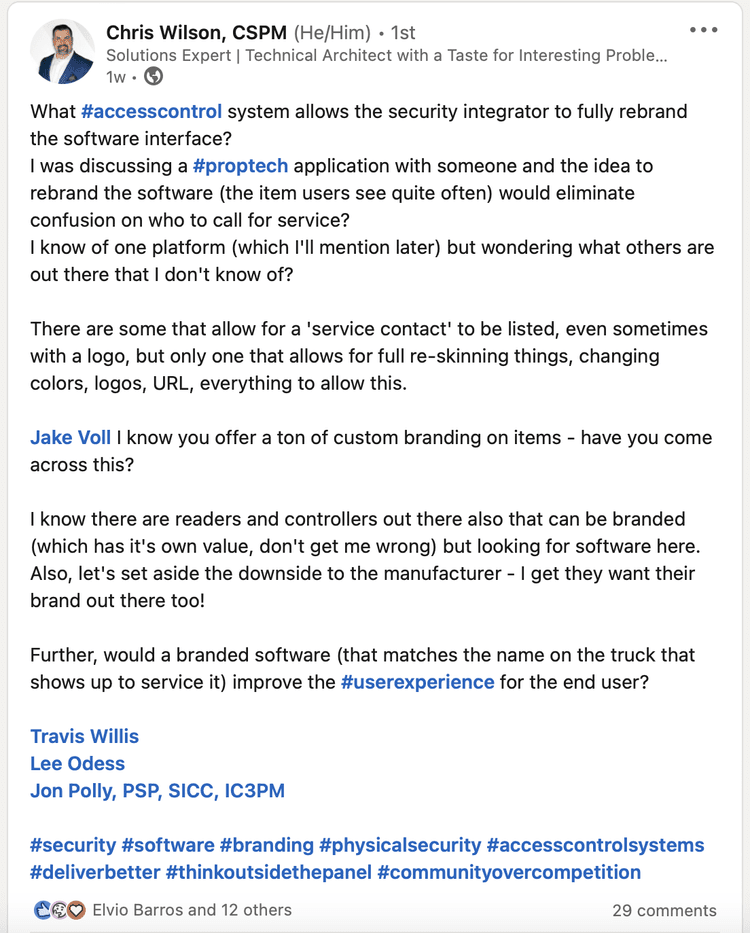
After engaging in the conversation, it became clear that this question needed much deeper thought as it is, like many things, nuanced.
The nuances when thinking about cobranding or white labeling include, amongst others: What is branding? How do you define branding? What is involved in branding? Who are you in the value chain, and how does that impact your decisions? How do you go to market, and does that matter when deciding? Positive and Negatives / Gives and Puts / Liabilities in doing so? And on.
So let's get into it. I bring you:
"I Cloud Now. Brand it?"
You should consider this deeply whether you are a manufacturer, dealer, or distributor (also as an end user, but I will focus this Brief on the prior three). As technological adoption increases and crosses with macroeconomic forces, there are real positive and negative implications of deciding to cobrand, white label, or not. It reminds me of something my father (or maybe an old boss, I can't remember) used to say,
"Just cause you can doesn't mean you should."
First, let's talk about why we are even asking this question and why many are considering it. The reason is typically twofold:
☁️ More companies are adopting cloud systems which inherently introduce an opportunity around branding. This branding opportunity includes the interface(s), such as the admin portals and end-user applications (more on this below), that did not exist in the past when the real interaction by most people with our systems was headend hardware and maybe a card/key. This opportunity is a classic example of what I mean when discussing "what does cloud architecture create?"
🤝 Along with the technical adoption of "cloud" architecture brings a new customer relationship centered around service and RMR engagements versus hardware and traditional project-based business of the past. This new opportunity looks a lot like the alarm and IT industry, which sparks the question of most manufacturers and integrators, "should we brand it?" This question brings us to the summarized reason we are talking about this and the main driver: it feels like there is a business opportunity or advantage in doing so.
I highlighted the word "feels" because, as a majority, we are an industry made up of technical specs driving our decisions. Minimal feeling. When it comes to new business ideas, we have a hard time wrapping our heads around them because, in many ways, they hit us in the area we have underappreciated and under-invested in. That area is called strategy and marketing. It is okay to have feelings, I promise.
Before we get to the strategy and marketing, let's do some background on branding.

How do you define brand?
A brand is a personality formulated to connect with audiences in a precise way.
Now let's compare brand to branding. Unlike your brand, which is the personality customers perceive your company to have, branding is the series of specific choices you make to communicate your brand externally. If your brand is people's perception of you, branding is how you paint that perception. Perception becomes a reality.
And then there's brand identity. Your brand identity is the design choices you make when branding something.
Typically "branded" comes in different flavors. Flavor one is cobranded. Flavor two is white labeled. For this Brief, I will treat OEM and ODM differently and won't include it in a branding conversation (even though that gets the label as branded by some).
Specifically to this conversation, we are deciding between keeping the status quo where, in general, the manufacturer is the hardware and software brand, and the integrator and distributor's brand is the services they provide. Some of you are invisible to the end CUSTOMER and even more invisible to the end USER, but with software, this is changing.
Let's look at the difference between cobranding and white labeling:
🎢 Cobranding: a marketing strategy that utilizes at least two brand names on a good or service as part of a strategic business collaboration.
🐇 White labeling: a product or service produced by one company that other companies rebrand to make it appear as if they had made it.
OK, so, what are we branding when we talk about branding access control?
Typically manufacturers, dealers, and distributors alike are looking to brand the software, hardware, and communication. Specifically:
👩💻 Software: the admin portal, end user application, and APIs.
👷🏾 Hardware: the readers, controllers, and head end panels.
📡 Communication: manuals, help, chatbots, emails, notifications, and alerts.
From experience and looking at the comments in the LinkedIn post, communication is typically the most significant afterthought but arguably the most impactful. You can make a strong argument; it's the most critical.
Why? The moments the access control system communicates with different stakeholders are outside the typical day-to-day interaction they have with our systems and are typically invisible. The moments of communication are outside the habitual workings of our system.Because they are outside the norm, they form a different relationship with the stakeholder, the end user, or the administrator. Think about it; there is an emotional attachment to an alarm or notification, especially if it's bad.
Or, take an end user nudge or insight as an example. Suppose that communication is given to an end user through the mobile app as a notification. In that case, there is different interaction from the ho-hum taping to unlock they usually do with our systems. Frankly, you form another relationship than we have in the past.
This different relationship with a new stakeholder is also why we leave money on the table by not focusing on notifications more, but that's for another time.
Communication also comes with the most complex questions to think through. Unlike the hardware that most people won't interact with and the lines of responsibility are well defined, who notifies to whom, when, and in what form is far more complex. The truth is that most manufacturers' product origin stories did not start with the user story or "epic" of branding, so most have not thought through the nuances when building their systems. Typically branding is an afterthought, and the effort to refactor all parts of the access control system to support cobranding and white labeling, along with the ongoing maintenance, make it too costly and, frankly, not worth the squeeze. Some, like Alarm.com, were designed with this in mind and did a great job of it from day 1. The fact that most system's design intent for branding is lacking is critical. It is important because what you may think is, say, white labeled with your name on the software or app, in the end, is just cobranded because you aren't on the communications that go out to customers and end users. Does it matter? You tell me. I believe it does. But that is a perfect business decision that needs to be thought through on your end (more on those later).
The good news is that most of these questions are (should be) covered in the agreements and SLAs between the manufacturer, integrator, and end customer. The expectations of how the product works should be clear(ed) there. They are also covered in the EULA and sometimes in the TCO for end users. But you will want to keep it simple. Specifically, as a manufacturer, you will typically have a few cobranding or white labeling agreements but just one program. It is impossible and wielding to have 700 different programs for 700 other dealers for 700,000 customers.
Because of the liability, the trickiest is in the distinct relationship between the manufacturer and dealer and the criticality of the reason for the emails, notifications, and alerts. For instance, say there is a critical patch to firmware needed. Does that communication come from the manufacturer or the dealer and can you communicate that directly to the end user? That question triggers a bunch of questions around liability. It is a well-known fact that it's an ongoing process to keep systems updated and patched. If the system is white-labeled or cobranded, who is liable? In speaking with a local corporate lawyer here in DC, it became very apparent that you 100% need to consider the liability and risks of choosing to white-label or cobrand. I am not a legal expert, so I will spare you my two-bit legal advisement and state: make sure you have it spelled out in the agreements. ("Yeah! Lawyers win again," says no one).
See, it's more complicated then, "I cloud now. Brand it?"

Switching gears a bit, let's get into the nuances depending on who you are in the value chain and how that impacts your answer. No matter who you are in the value chain, it goes beyond whether you can technically do it or because "they" offered. This decision is a business decision that needs the proper support to include marketing, customer support, training and certification, and much more. (Being repetitive on purpose).
As a manufacturer: It comes down to the following questions "Whom do you want to be short term and long term?" For most of you, it's just not feasible long term, and it makes for a wrong business decision as you look to grow organically, or raise capital, or expand into adjacent markets. That said, if your strategy is solely to be a white-labeled system, then by all means, have at it. That is your strategy. But from what I know about most of you, that's not your business. You are trying to be opportunistic or think you have a short-term differentiated offering by including cobranding or white labeling. But it is the wrong decision to make for your long-term viability. There are two, maybe three companies in our industry that can really do both (different story when you go deep into a vertical).
For instance, if you are a large high-security access control software company with traditional go-to-market practices that call on, say, airports, where you get specified and use the channel only, with a marketing strategy focused primarily on product marketing, and lean on trade shows, white labeling brings a minimal return, and it would be a mistake. But, cobranding might make sense with the right dealer (the key is "right dealer") going after a market or vertical you do not want to invest in. But do it with eyes wide open and full throat: product development, marketing support, pricing, SLAs, and more must match this market motion. Overall, most large access control software company’s in our industry will need a brand presence as the market continues to move to where customers want to have a relationship with the manufacturer. They will demand it, and a cobranded or white-labeled system, although seen as critical to some integrators, will add little to no value and a bunch of work for manufacturers.
The story is slightly different if you are a mid-market player (self-funded or a start-up without growth capital) or a start-up (funded with growth capital). At least it is a different story in the short term. As a mid-market player or a start-up that has yet to raise significant growth capital (coupled with market conditions), you have the opportunity and permission to do things differently. Realistically, you will want to spend your money on something other than extensive marketing campaigns. Your go-to-market strategy is focused on the channel (some end users but mainly through the channel), and branding is more or less for the industry. With this model offering a cobranded or white-labeled solution is an excellent way to differentiate yourself from "the others" and gain inroads with dealers that would not typically invest the time and resource in a newcomer. But my words of caution are not to sell your long-term strategy short for short-term opportunities unless those short-term gains are part of the long-term world domination plans. I get it. You need to do what you need to, but if you're not going to build with cobranding or white labeling as a core part of how you develop your product, I suggest not getting into it.
Other questions to consider as you think through your options:
🎯 What market do you target? High security, particular verticals, geography, etc.
🏪 How do you go to market? The channel, retail, direct business development, direct sales, etc.
🚣♀️ How do you market, brand, and do communications? Cut sheets, press releases, tradeshows, social media, in-person training, mass market, niche market, vertical-specific, etc.
🤝 Do you have the right partners and ecosystem?
🏷️ How do you price your products with this in mind?
🎿 How are you going to service clients if/when your channel changes?
As a dealer or integrator: Your options offer a wide range of advantages and disadvantages unique to your chosen path. Choose correctly and do it with clear intentions; your business could be on the fast track to success. Choose poorly, and you can quickly squander customer goodwill, take on more than you need to, and burn through much-needed resources for no reason. This decision is, like others, also related to your strategy and size. For most small local integrators, you benefit more from piggybacking on the manufacturers' brand recognition and marketing juice. But suppose your long-term plan is to go from being a local integrator to a regional, national, and possibly multinational player. In that case, there may be some benefits to getting on the branding train early.
For most national integrators or regional players, with the changes in the market, I would take a hard look at both having a white-labeled offering with your brand name and offering known manufacturer brand names. Most large integrators generate opportunities and benefit from specifications, end-user manufacturer brand recognition, and manufacturers' leads. For some, large integrators are in a position to integrate vertically. Do it properly and take more off the table. I am surprised more do not look like Kastle Systems or Datawatch Systems. Sure it comes with headaches, but will you tell me you don't already have headaches? At least these would be from your own doings. Once you decide whether you will or won't get into the branding business, what will it be? White-labeling or Co-branding? Here are some more pros and cons of both:
📈 White Label Pro: You can set your price.
📉 White Label Con: As the go-to resource for your customers, you are typically the tier 1, 2, and 3 for all their questions and issues.
📈 Cobrand Pro: Comes down to focus. You can sell and service to a point while the manufacturer handles supporting customers beyond tier 1 or 2.
📉 Cobrand Con: You limit your revenue capture for services by having the manufacturer involved.
📈 White Label Pro: By rebranding a manufacturer's products as your own, your branding and reputation are front and center, which can build long and deep relationships with your customers.
📉 White Label Con: As a smaller or new company, are you wasting time and resources positioning yourself as the manufacturer when you can put that elsewhere with a greater return on investment?
📈 Cobrand Pro: By blending the brands, you have the opportunity to highlight not only your story but your partners.
📉 Cobrand Con: You are sharing the spotlight and somehow losing some brand awareness by introducing another brand with yours.
📈 White Label Pro: Since you are everything to your end customer, you can bundle support and charge what you think is appropriate.
📉 White Label Con: But being in charge of end-customer support typically means you need more resources.
📈 Cobrand Pro: You can share the burden of creating everything needed to sell and support the cobranded system.
📉 Cobrand Con: You are typically not the only partner the manufacturer is cobranding with, and if that is the case, are you gaining anything?
📈 White Label Pro: By selling white-labeled 3rd party products, you can mix & match the offerings of different vendors and optimize your product line.
📉 White Label Con: The "soft" goods like building support documentation, FAQs, and creating training tools, etc., are expensive and a lot.
📈 Cobrand Pro: The cost to staff appropriately is reduced as you can leverage your manufacturing partner for specific responsibilities.
📉 Cobrand Con: You lose control in setting pricing, reducing your revenue share.
As a distributor: This is a fascinating thought experiment and an area where different models continue to merge and work themselves out. At a high level, I like the idea of a distributor having their own brands. The benefits are:
🎚️ More control and leverage: many manufacturers use distributors to gain market acceptance, only to leave them as they grow. Many distributors create their own problems, but that's a conversation for another time.
💰 More revenue potential: not sure if there's actually more margin, but in theory, there would be, with all things being equal.
🗓️ More opportunities from long-term planning and relevancy: training, strategy development, and market development.
The first reason is the most important: the ability to be more in control of your destiny. And because of this, we will see more vertically integrated distributors selling their own branded access control products to integrators and selling them to end users (or writing specs). Distributors will look to support their dealers and treat access control as another item in a large basket of goods and services offered. Some can reach an interesting economy of scale by taking this approach. But like the others, think deeply about this before you do it. Again, like the others, it comes down to resources and your strategy.
First, consider whether you have the right team to sell your products and market development. Distribution is heavy on teams that can do takeoffs, catch proposal requests, fill out bids, and handle product fulfillment work. That role in the market is okay, but it differs from selling your own line.

Again, there is no general perfect answer to whether or not you should or should not cobrand or white label. There is only one specific ideal answer for what makes sense for your business in the long run.
Long and short, here is my recommendation or where I fall on this:
-
For a mid-market or small incumbent access control manufacturer: This is an "or" decision. I would dump your brand and go all in on white labeling or focus on your brand. You need to pick a lane. You do not have the luxury of doing both.
-
For start-up access control manufacturers: It is easy. Focus on your brand building. The keyword is focus.
-
For large incumbent access control manufacturers: This is an "and" conversation. I would do both, but I would get specific to what markets and with whom you do it. Then invest in it.
-
For local integrators with the aspiration of massive national growth or a large integrator already growing: I would look to white label or cobrand while also sticking with manufacturer brands. You can afford to do both. You are already typically working with every brand, and it's served you fine till now. Now is the time to consider your long-term value as a company.
-
For local integrators with aspirations of having good solid local growth only: I would stick with the manufacturer brands and leverage them to support your growth. There is a ton of good in doing just that. Go be the best at it.
-
For distribution: I would offer a white-label version and support the manufacturer brands. Take control of your own destiny.
All in all, whatever decision you make, you need to look beyond whether you can and make sure you should. It is not a technical decision but a business one, and you need to resource it properly and think through the liability.
What are your thoughts? Good idea to cobrand or white label? Are you doing it now and open to sharing your experience? Please let me know.
Nexus Labs partnership and discount

As mentioned in V4 Brief, I partnered with James Dice of Nexus Labs on a blog series discussing the intersection of access control and smart buildings. Please check out the article by clicking here or on the fantastic image Bert Hart created showing the difference between our $10B, $70B, and possible $100B+ opportunity as an industry. As part of the partnership with Nexus Labs, they offer Access Control Executive Brief subscribers a 10% discount on their membership. I am part of this amazing community and highly recommend you join. Use this link to sign up https://www.nexuslabs.online/odess.
