
Volume 64 | July 22, 2024
Hello, I am in Amsterdam with a canceled flight to Munich (thank you, Lufthansa). I have been on hold for the past 180 minutes, so there is no better time than now to bring you Brief 64, titled What Is the Best Way Access Control Companies Can Return Value to Shareholders? where Tony Dong, MSc, CETF, delves into the intricacies of shareholder value in the access control industry.
Tony explores the various strategies companies can employ to return value to their shareholders, sparked by recent mergers and acquisitions in the industry. He examines four critical approaches: dividends, stock buybacks, mergers and acquisitions, and spin-offs, weighing the pros and cons of each method. Tony provides insights into how these strategies might apply to access control companies, considering factors like industry trends, company size, and market dynamics. He also offers a critical perspective on the effectiveness of these strategies, drawing on real-world examples and academic research. As we have come to expect from Tony, he brings sharp insights into the industry and finance. I encourage you to read more below.
My thoughts on Tony's analysis: His insights are invaluable, and his perspective is second to none. His exploration of the various strategies for returning value to shareholders in the access control industry, sparked by recent mergers and acquisitions, is timely and a must-read for anyone interested in our industry.
As I've stated, the industry is ripe for consolidation, with video and access control companies likely to merge due to the rich data opportunities in a much larger market than previously thought. While some leadership teams might be struggling, these mergers and acquisitions are not just strategic moves, but inevitable steps that are positioning companies for eventual sale to larger access control companies or private equity firms interested in our industry.
Again, there is no better time than now to be in the access control industry.
Up next Brief: “When will the alternative access control market become the mainstream market?”
As always, your feedback is invaluable to us. Please let me know if there's any area where we can better meet your expectations.
Thank you!

PS: I am sure some of you may forward this, but please do so sparingly and encourage others to sign up here. Thank you!
What Is the Best Way Access Control Companies Can Return Value to Shareholders?
Recent trends in the access control industry, including notable mergers and acquisitions like Milestone's merger with Arculesand ASSA ABLOY Americas' acquisition of Wesko, have sparked discussions about the real benefits of these moves for shareholders and end users.
On the Access Control Executive Brief Slack channel, debate has revolved around whether these M&As genuinely enhance shareholder value. Lee shared his insights on one such merger, suggesting that these moves might be strategic positioning before a sale. He speculated:
"IMO - this is what you would do before you sell ABs. I believe they are sold to an access control company or a PE firm that has interest in one. Everyone says behind closed doors that the current leadership team at Milestone is slowly killing the company. It’s also becoming harder, when you view the works as a $100+B opportunity vs a $10B one that a video and access control company should be separate. The data is too rich. Prediction: they sell and it goes to an access control company."
From previous discussions, you'll recall my support for the notion that executives in this industry should evolve from being purely operational experts to becoming strategic 'capital allocators'—leaders who make finance-focused decisions on how to best utilize the company's resources.
So, what is the best way to return value to shareholders if you were in charge of a company? Let’s explore the options.

Dividends
Dividends are payments made by a company to its shareholders from its profits. Here's a simple breakdown: when a company earns a profit, that money can be used in several ways—reinvested into the business, used to pay off debt, saved for future use, or distributed to shareholders as dividends.
When a company decides to issue a dividend, it announces a dividend payment per share; shareholders then receive money directly proportional to the number of shares they own.
The preference for dividends is widespread among investors, although, from a theoretical standpoint, it might seem irrational. According to the Miller-Modigliani theorem, in a perfect market, the value of a firm is unaffected by how profits are distributed (dividends or retained earnings).
They outline key assumptions for their model: no taxes, no transaction costs, and that investment decisions are not influenced by dividend decisions. Essentially, they argue that dividends and capital gains are equivalent in the eyes of investors, as the payout does not change the fundamental value of the company. In reality, the applicability of this theory varies across industries.
For example, in sectors like tobacco and energy which are cyclical and subject to regulatory risks, companies often offer high dividend yields. This strategy is used because the company might face troubles that could jeopardize future payouts, making immediate returns in the form of dividends more appealing to shareholders.
Conversely, in technology or growth-oriented industries, companies often retain earnings to reinvest in research and development (R&D). This reinvestment is crucial for innovation and maintaining a competitive edge, particularly in fields evolving with technological advancements and the integration of the Internet of Things (IoT).
For access control companies, particularly those increasingly focusing on tech convergence and IoT, adopting a tech-like mindset for dividends could be beneficial. By focusing on R&D rather than high dividend payouts, these companies can reinvest in product development and innovation. This approach not only fosters growth but also saves shareholders from the tax burden that dividends can incur.
Despite this, many established "blue-chip" access control companies tend to pay above-average dividend yields compared to the market, for example:
-
Johnson Controls: 2.13%,
-
ADT: 2.86%,
-
dormakaba: 1.82%.
Exceptions are more common among smaller caps like Identiv and Evolve. Due to their balance sheets and lack of profitability, these companies are unable to pay dividends, reflecting a different financial strategy driven by their current fiscal health rather than a strategic reinvestment plan.
Buybacks
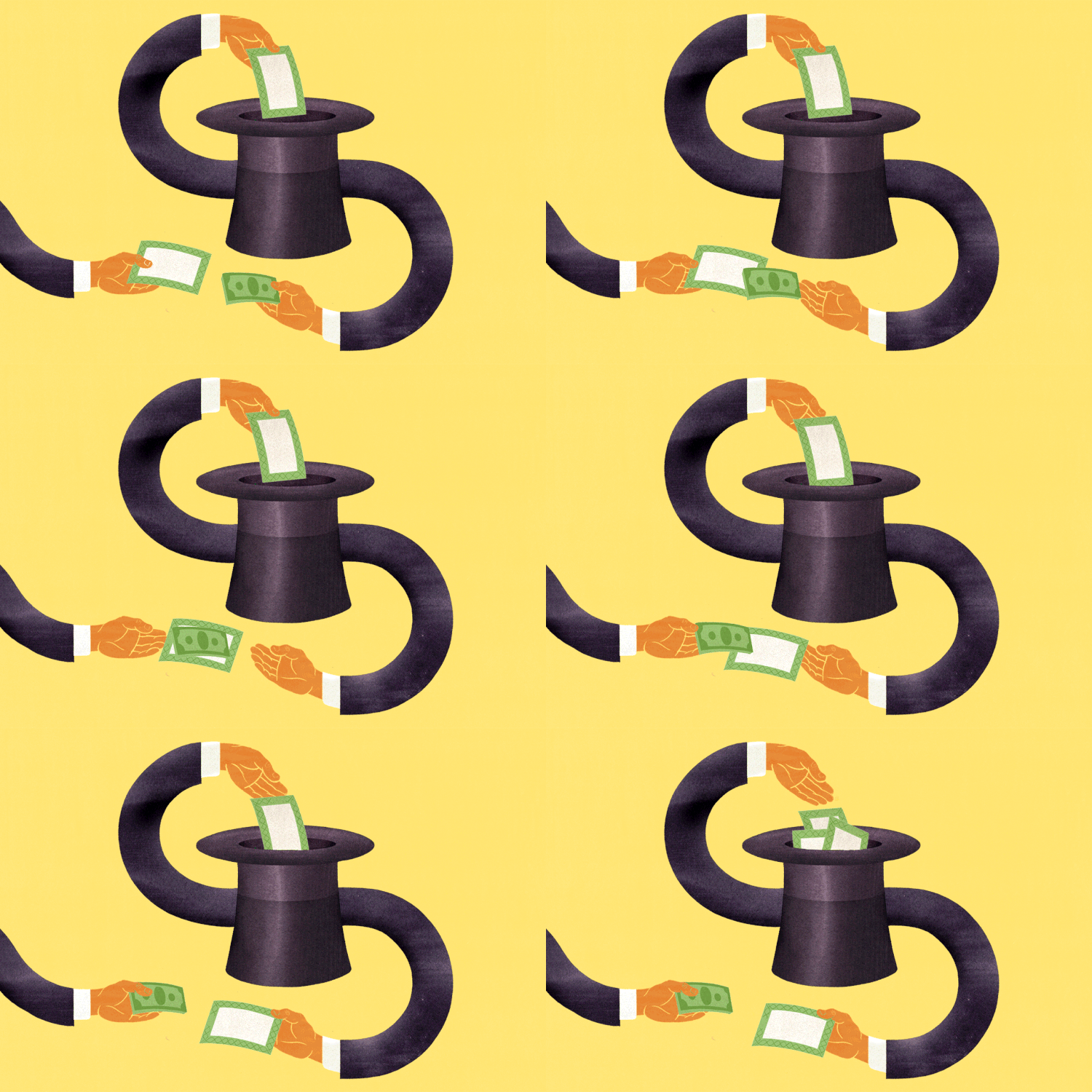
Stock buybacks, or share repurchases, are a strategy companies use to buy back their own shares from the marketplace. By reducing the number of shares available, each remaining share represents a larger ownership stake in the company, potentially increasing the value of these shares.
One of the primary benefits of buybacks over dividends is tax efficiency. When a company opts for buybacks, shareholders who do not sell their shares do not incur immediate tax liabilities. This contrasts with dividends, where all recipients must pay taxes on the distributions they receive.
However, the effectiveness of buybacks can vary widely depending on how they are executed. For instance, the energy supermajor companies often have a good track record of buying back shares when valuations are low due to the cyclical nature of oil prices. This can be a wise use of excess cash when operations are profitable and still generating substantial free cash flow.
Conversely, there are cautionary tales like Bed Bath & Beyond, where poor timing and judgment led to buybacks at historically high valuations. Such decisions have strained finances and contributed to the company's eventual bankruptcy, highlighting how critical good management and timing are in the execution of buybacks.
Therefore, the success of a buyback often hinges on management's understanding of the company's true valuation. Ideally, insiders are best positioned to judge when shares are undervalued, making buybacks at these times a strategic move to enhance shareholder value. However, if management misjudges the timing or the company’s financial status, buybacks can become a costly error.
It’s important to recognize that buybacks are a form of financial engineering. The funds used for buybacks are not invested in new product development, employee benefits, or strengthening the company’s financial foundation. Instead, they are used to artificially inflate earnings per share by reducing the number of shares outstanding.
If a company is not growing organically—meaning it’s not seeing sustained year-over-year earnings growth without shrinking margins—then a buyback might merely be a short-term boost rather than a generator of long-term value. Just look at Apple's latest earnings report for an example of this.

Mergers & Acquisitions
I have a generally unfavorable view of mergers and acquisitions (M&A)—and for good reason: The track record of M&As across various industries often falls short of expectations.
Consider the econometrics study "Winning by Losing: Evidence on the Long-Run Effects of Mergers," which sheds light on the complex dynamics of these corporate maneuvers. This study reveals that in the two years following a merger, companies that were outbid (losers) actually outperformed the acquiring companies (winners) by a significant margin.
A primary reason for this underperformance is the high acquisition premiums that acquiring companies often pay. Essentially, this means that a company pays more for an acquisition than the actual value of the target's future earnings, betting on synergies and growth that may not materialize. This is a risky move that can lead to financial strain if the expected benefits do not pan out.
Another critical issue is that not all M&As are accretive. An accretive merger is supposed to increase the acquiring company's earnings per share post-transaction, but achieving this is challenging. It requires not only seamless integration but also the actual realization of projected efficiencies and synergies, which is often much harder than anticipated.
Sometimes, especially for larger conglomerates, M&As seem to be the only way to achieve growth, often reflecting a lack of vision for organic development. These companies may continue to swallow competitors, mimicking the Jack Welch era at General Electric, which was marked by a relentless pursuit of growth through acquisitions. However, this approach can lead to inefficiencies and, eventually, necessitates spin-offs as the conglomerate unwinds its complicated structure.

Spin-Offs
The focus on mergers and acquisitions can sometimes lead to inefficiencies, necessitating corrective measures like spin-offs and divestments as conglomerates seek to simplify their structures and unlock shareholder value. These strategic decisions are often executed on a tax-free basis, making them particularly beneficial for shareholders.
We have seen this trend in sectors such as healthcare and industrials, where companies divest parts of their operations to free up cash to address regulatory risks. For example, 3M's recent spin-off of Solventum and Johnson & Johnson's separation from Kenvue allowed each company to raise funds to manage costly litigation related to PFAS/hearing loss and talc issues, respectively.
In the context of access control, it wouldn't be surprising if a conglomerate like Honeywell decided to spin off its building automation segment in the future. Honeywell's Q1 earnings report in April 2024 highlighted that lower volumes in building products led to sales declines across fire, security, and building management systems, with segment margins contracting by 1.2% to 24.0%.
Generally, the decision to divest can follow a barbell approach: a segment contributing less revenue and facing a shrinking market might be a candidate for divestment. Conversely, a segment experiencing faster-than-average growth in a rapidly expanding market might also be considered for divestment, allowing the company to capitalize on its high value while focusing resources on core areas.
For now, as Lee mentioned, spin-offs in the access control industry might not be imminent given the current size of these companies. However, as these businesses grow into conglomerates comparable to Honeywell, we can expect some to begin shedding non-core segments to sharpen their strategic focus and enhance shareholder value.
