
Volume 73 | October 9, 2024
Welcome to Brief 73, and welcome to Q4!
Today's Brief is another written by Tony Dong, titled "How the Heck Do You Invest When Markets Are at All-Time Highs?" As his subtitle suggests: "Here's my survival guide for figuring out how to allocate your capital when we're in the middle of a strong bull market."
In today's unpredictable market landscape with unprecedented opportunities, understanding how to invest your resources wisely is more crucial than ever. I'm thrilled to have Tony share some invaluable insights on navigating investments during peak market conditions. Tony's expertise shines through as he breaks down three key strategies: staying the course, diversifying internationally, and targeting undervalued sectors. Read below to dive deeper into Tony's expert analysis and practical tips that will empower you in your investment decisions!
A few updates on our end: Things aren't slowing down, but our vision for the remainder of the year is clear, and 2025 is crystallizing. We have a ton of content from the "Conversations with Lee" series. Thanks to Honeywell and LenelS2 for the opportunity to chat with their leadership teams (those videos drop this week). Also, a BIG thank you to Any2Any and TANlock by FATH for the invite to BERGFEST, where I moderated a discussion about the future of access control with six leading companies shaping the industry (those videos should start dropping next week).
Plus, for the remainder of 2024:
-
Securing New Ground in New York (keynote and coverage)
-
San Francisco to record a three-part webinar with Envoy
-
AMAG's SES24 in Tewksbury, UK (keynote and coverage)
-
Brivo's Cloud Security Summit in Austin, Texas (coverage)
-
Executive Meeting at DMP in Missouri with an industry dinner in Kansas City (coverage)
-
Stop in Chicago to meet with Liftmaster/Chamberlain (coverage)
-
Back to NY for ISC East, where we're activating the Critical Infrastructure Pavilion in partnership with the show. Helping host a VIP breakfast with CoreWillSoft and an industry night with ZKTECO USA (activation and coverage)
-
Another trip to New York for the Security Investor Conference by Imperial Capital (speaking and coverage)
-
Then to Groenlo, NL (outside Amsterdam) to meet with the leadership team at NEDAP (coverage)
After that, I'm off for two weeks to spend time with Jen and the kids before diving into 2025, where we have a ton planned.
For instance, ACS25 is locked in for May 20–21 in San Sebastian, Spain. I'm grateful that Salto Systems will be our city host, showcasing their beautiful city, fantastic culture, and, most importantly... the food and wine. This year's theme is Exponential. "Exponential" typically refers to something that increases rapidly, and I can't think of anything more fitting given our industry, the changes happening, and the current opportunities. We're in the process of organizing speakers, so if you or your C-suite would be interested in participating and can tell an exponential story, please let me know. More details will come later, but please mark the date.
Also, keep an eye out for the following:
-
Intersec Dubai and the Thought Leadership Pavilion
-
ISC West in Las Vegas with the AI Zone and much more
-
The Security Event in Birmingham, UK, with the XForum and the Night of Access industry night happy hour (RSVP now as we only have 100 spots for what will be a great night of fun and networking)

We're in the process of setting up our calendar for the rest of the year. If you're hosting your annual sales kickoffs or partner events, looking to do something different in a trade show booth, or would like me to visit your headquarters for a write-up and strategy session, please reach out.
As always, your feedback is invaluable to us. Please let me know if there's any area where we can better meet your expectations.
Thank you!

PS: I am sure some of you may forward this, but please do so sparingly and encourage others to sign up here. Thank you!
How the Heck Do You Invest When Markets Are at All-Time Highs?

Written by Tony Dong, MSc, CETF®
Here's my survival guide for figuring out how to allocate your capital when we're in the middle of a strong bull market.
Investing during a period when major U.S. market indices like the S&P 500, Nasdaq-100, and the Dow Jones Industrial Average are hitting all-time highs can feel like a bittersweet moment for many investors.
On one hand, the value of your existing investments is likely up, which is always welcome news. On the other hand, deciding where to allocate new capital can seem intimidating because every asset appears overly expensive
For those of you who are active investors, not just passively automating contributions into a 401(k)-target date fund, this scenario poses a particular challenge. How do you continue to grow your portfolio effectively when the market seems to be at its peak?
Here’s a practical survival guide to help you navigate these high-altitude financial waters and make informed decisions about allocating your capital in what may seem like an overvalued market.
Is the U.S. market actually overvalued?
Objectively speaking, the U.S. market does appear to be overvalued, especially when focusing on a basket of 500 of the largest and most prominent companies as represented by the S&P 500.
One of the key metrics supporting this view is the Cyclically Adjusted Price-to-Earnings Ratio (CAPE Ratio), also known as the Shiller PE Ratio.
This ratio is calculated by dividing the current market price of the index by the average inflation-adjusted earnings from the previous 10 years. It's an important measure because it helps smooth out short-term earnings fluctuations and provides a clearer long-term view of market valuation.
Currently, the CAPE Ratio stands at 36.65, significantly above the historical mean of 17.16 and median of 15.99. To put this in perspective, the minimum CAPE value recorded was 4.78 in December 1920, and the maximum was 44.19 during the dot-com bubble in December 1999.
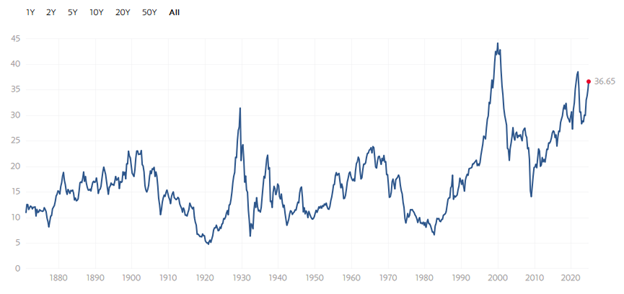
Although today's valuations are not as extreme as during the dot-com era or the height of the COVID-19 market in 2020, they are still notably high. High CAPE values generally suggest that future expected returns might be lower, as investors are currently paying a premium for earnings.
Another critical measure is the earnings yield, which reflects the sum of the underlying S&P 500 companies' earnings for the previous year, divided by the index level at the end of the year.
Presently, this yield hovers around 3.64%. Essentially, this means that for every dollar invested in the index, investors are earning approximately 3.64 cents.
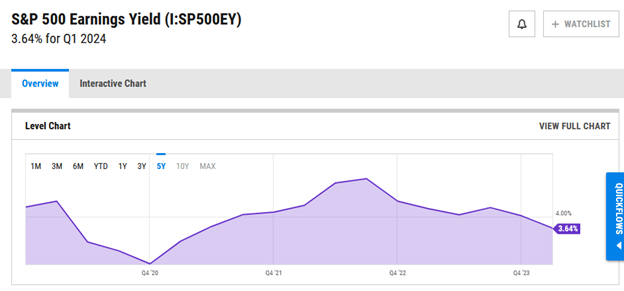
This comparison becomes particularly poignant when you consider the current yield on the on-the-run U.S. 10-year Treasury bond, which stands at about 3.785%.
This poses a dilemma for investors: the broad market's earnings yield is lower than what can be obtained from a relatively risk-free 10-year Treasury bond. This situation often makes Treasuries an attractive alternative to stocks, especially if the market is perceived as overvalued and thus carries higher risk with potentially lower future returns.
Strategy #1: do nothing
Staying the course is often the best strategy if you already own a broadly diversified portfolio of equities. This approach involves systematic purchases—methodically buying or selling through regularly scheduled transactions regardless of market conditions and reinvesting dividends when received.
Essentially, you set up a diversified portfolio that you consistently add to over the years, through both booms and busts, especially if you lack the time, interest, or expertise to manage it actively.
A quintessential example of this strategy is participating in a 401(k) plan at work, selecting a low-cost index fund, and maintaining steady contributions regardless of fluctuations in the stock market.
While this method might lead you to overpay during market peaks, like in 1999, it also allows you to buy valuable assets at a bargain during market crashes, like in 2009, with the hope that these extremes balance each other out over time – as long as you maintain consistency.
To illustrate the effectiveness of this approach, consider a study by Charles Schwab involving two hypothetical investors: Peter Perfect, who could time the market perfectly, and Ashley Action, who invested $2,000 annually at the beginning of each year without trying to time the market.
Over multiple 20-year periods, Peter accumulated the most wealth due to his perfect timing, ending one period with $138,044. However, Ashley, who consistently invested without timing, ended with $127,506—just $10,537 less than Peter.
Strategy #2: diversify internationally
Diversifying internationally is a strategic move that can enhance portfolio returns, especially when U.S. equities are highly valued. Often, U.S. stocks are assigned a "valuation premium" compared to similar-sized international counterparts.
For instance, U.K. oil majors like Shell and BP trade at forward price to earnings (P/E) ratios of 8.24 and 6.99, respectively, while comparable U.S. counterparts like ExxonMobil and Chevron have higher P/E ratios of 13.04 and 11.35.
This trend extends beyond the oil industry—global giants like Unilever and Nestle often trade at lower valuation multiples compared to U.S. peers like Procter & Gamble and Coca-Cola.
Historical performance supports the case for international diversification. During the "lost decade" from 1998 to 2008, for example, stocks tracking the MSCI EAFE (Europe, Australasia, and Far East) index outperformed the S&P 500, delivering an annualized compound annual growth rate (CAGR) of 12.33% compared to just 5.43% for the S&P 500. This period coincided with the peak of the dot-com bubble when U.S. equities were notably overvalued.
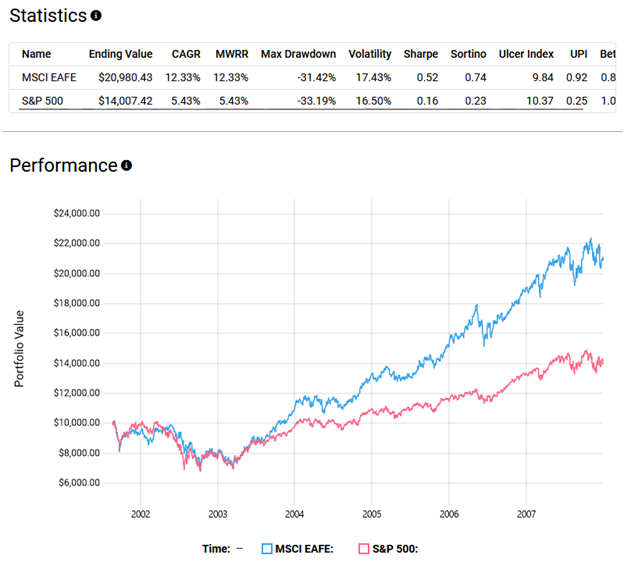
Today, with the availability of low-cost ETFs like the Vanguard FTSE All-World ex-US ETF, which holds over 3,800 international equities for a minimal expense ratio of 0.07% ($7 per $10,000 invested annually), diversifying globally is more accessible and cost-effective than ever.
Strategy #3: buy undervalued sectors
Originally, I considered advising on "buying undervalued stocks," but quickly realized that explaining how to be a value investor could extend beyond the scope of this brief. Instead, we'll explore a "stock picking lite" strategy by focusing on purchasing individual sectors.
Sectors are collections of companies involved in similar industries, activities, services, and products. The market is typically divided into 11 major sectors: communication services, consumer discretionary, consumer staples, energy, financials, health care, industrials, information technology, materials, real estate, and utilities.
Choosing to overweight certain sectors can be strategic, as their performance is cyclical and somewhat predictable through different phases of the economic cycle.
Currently, from a valuation perspective using metrics like forward P/E (price to earnings), PEG (price to earnings growth), P/S (price to sales), P/B (price to book), and P/FCF (price to free cash flow), the energy and financial sectors appear to be the most undervalued.
Conversely, technology and real estate are the most expensive—the former due to a decade of strong performance and the latter buoyed by expectations of falling interest rates.
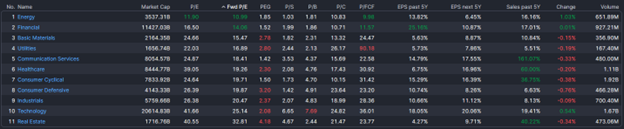
How can you invest in sectors easily? Via low-cost ETFs. State Street offers 11 "Select Sector" ETFs, each corresponding to one of the major sectors, each with an expense ratio of only 0.09%.
To implement this strategy in a straightforward and safe manner, simply go long on the undervalued sectors. It’s crucial to size your positions properly and implement a stop-loss for risk management in case your investment thesis proves incorrect.
But for those more experienced and willing to take on greater risk, consider a pairs trade: short the two most expensive sectors and use the proceeds from the short sale to go long on the two cheapest sectors.
This is a form of arbitrage. It involves simultaneously buying (going long) and selling (going short) two correlated securities with the expectation that the price relationship between them will converge to their historical norm.
In the context of sector investing, it involves shorting sectors that are currently overvalued (trading at prices higher than their historical norms or fundamentals would justify) and using the proceeds to buy undervalued sectors (trading at prices lower than what their fundamentals suggest). In this case, I could go long energy and short technology.
The goal here is to profit from the relative movements of these sectors against each other. If the overvalued sectors decline in price and/or the undervalued sectors increase in price, the trade will yield a profit. This approach leverages the notion that over time, market anomalies will correct and the sectors will return to their typical valuation relative to each other.
It's a sophisticated strategy that requires a thorough understanding of the sectors involved, their historical performance correlations, and the ability to manage risk effectively, particularly because it involves leveraging potential gains through the use of short sales.
