
Volume 85 | December 11, 2024
Welcome to Brief 84! I am happy to report that I've completed my 2025 themes and inevitable trends, which I'll share in a Brief soon. I believe you'll find these five fundamental shifts reshaping our industry to be thought-provoking and actionable—at least, that is my desire.
In the meantime, I'm excited to share an insightful article by Tony Dong Founder & Owner @ ETF Portfolio Blueprint | Lead ETF Analyst @ ETF Central | Freelance Writer, Bylines: US News & World Report, Moneysense, The Motley Fool, TheStreet, who brings his unique perspective on financial markets. While M&A in access control continues to generate buzz (I'm certainly excited about it), Tony highlights an equally important trend: spin-offs. These strategic moves—where companies break off parts of their business—help streamline operations and raise capital without shareholder dilution. Whether optimistic or skeptical about spin-offs, the full analysis below offers crucial insights into their implications for our industry. Thank you, Tony, for bringing it as you always do.
This week (today, December 11th and tomorrow the 12th), I’m attending the Security Investor Conference in New York, hosted by Imperial Capital—one of my must-attend annual events. This unique conference gathers select companies to present their strategic growth plans to key investors and business leaders. The event brings together 70 public and private companies and over 600 leading executives, institutional investors, and private equity investors. It's an excellent opportunity to network with leaders who deliver cutting-edge security solutions across global consumer, enterprise, and government markets. I'm honored to moderate the lunch keynote panel on "Changing Paradigms for Secure Identity: Building (Physical) and Network (Digital) Access," featuring executives from Samsung, SwiftConnect, Wavelnyx, and Safetrust. I plan to ask the following questions:
Looking beyond today's obvious opportunities, I'd like you to share your deeper vision. What meaningful but less visible, and even new, mid-term and long-term threats and opportunities should we consider regarding mobile access control?
How will big tech influence our industry's future via mobile, and what strategies can companies use to maintain or strengthen their market position? Samsung, given your role in big tech, I'm particularly interested in your perspective, along with the panel's insights.
What internal industry changes and external factors need to happen to realize your vision of enterprise mobility's future?
How should we structure and communicate our value proposition and messaging as an industry for both large-scale ("big ball") and smaller-scale ("small ball") opportunities?
It should be an engaging conversation, and I'm looking forward to steering it in a new direction regarding mobile technology. I'm thankful to John Mack for inviting me to participate. If you're attending, please reach out—I'd love to connect.
Have a great week!

PS: I am sure some of you may forward this, but please do so sparingly and encourage others to sign up here. Thank you!
Forget Mergers & Acquisitions, the Dark Horse Trend to Watch in Access Control: Spin-Offs
by Tony Dong

In past ACEB newsletters and Slack discussions, we've tackled the topic of mergers and acquisitions (M&A)—a process fundamentally about paying a fair multiple in the present day for a company's future expected cash flows and realizing operational strategic synergies (I hate that word, but it applies here).
However, as some of you astute observers have correctly noted, the same companies engaged in M&A are often simultaneously slimming down their portfolios through divestitures or spin-offs. But why this shift towards splitting up a company, especially an industrial conglomerate?
It ties back to a trend I've highlighted before: today's executives in product-driven industries, like yours, are often more focused on managing capital than on pioneering innovation. It’s not a bad or good thing per se, just an observation that’s becoming more and more evident.
Personally I think it’s because they view it as a safer bet for their careers—why venture into the uncertainties of capital expenditures and long product development cycles (arguably one of the riskiest strategy in business and hardest to justify if it goes wrong), when you can just acquire a company that aligns with yours and later sell it at a profit (or cut losses easily)?
This approach to corporate restructuring—engaging in both acquisitions and spin-offs—is essentially large companies buying and selling others much like retail investors do, but on a grander scale and with (typically) greater sophistication. Here’s a deeper dive into how this plays out in the access control industry, with examples and insights on what might lie ahead.
Why spin-offs? An example with Honeywell
Recently ignited an insightful discussion on our Slack channel, hinting at the potential future of Honeywell. It was asked: In all seriousness, I would not fully bank on Honeywell still being around in 10 years. Their brand is rather all over the place, I could see them fracturing into 30 pieces and the legacy Honeywell brand staying with HVAC, with the other bits getting new odd-sounding names.
As of October 2024, Honeywell operates across four major segments: Aerospace Technologies, Industrial Automation, Building Automation, and Energy and Sustainability Solutions. The performance of these segments varies significantly.
For instance, Aerospace Technologies saw a robust 10% organic growth year-over-year, marking its ninth consecutive quarter of double-digit growth.
Contrastingly, Industrial Automation witnessed a 5% decline in the same period. Such disparities prompt executives to reevaluate and streamline operations, focusing capital on more profitable areas.
An enduring principle in corporate strategy is divesting segments that fail to generate a return above the cost of capital, especially if they are not core to the company's long-term strategy. It’s the same mechanic as you cutting a losing stock.
But it isn’t the only consideration. Long term, alignment with overall strategy matters more (if your executive team has a long-term mindset versus just pumping quarterly earnings).
For instance, despite the underperformance in Industrial Automation, Honeywell's management has not earmarked this segment for a spin-off. Instead, they have identified their Advanced Materials business within the Energy and Sustainability Solutions segment as the divestiture candidate.
This unit, expected to generate around $3.8 billion in revenue with an EBITDA margin exceeding 25% for FY24, is being spun off due to its misalignment with Honeywell’s strategic focus on megatrends like automation, the future of aviation, and energy transition.
The decision for a spin-off aligns with Honeywell’s broader "accelerator" strategy, which involves reallocating at least $25 billion (over 10% of its market capitalization) to dividends, capital expenditures, and accretive acquisitions (those that increase earnings per share).
Case in point, just over the last year Honeywell has acquired Carrier Access Solutions, Civitanavi, CAES and Air Products' liquified natural gas (LNG) business, for over $9 billion in acquisitions.
That money has to come from somewhere – ideally, a spin-off does the trick by shedding dead weight and generating capital without needing to dilute shareholders or issue debt. Bonus for shareholders – it’s tax free too.
Remember, this isn't Honeywell's first foray into spin-offs; in October 2017, it successfully spun off its Transportation Systems and Homes and low-voltage security businesses into two separate public companies, Garrett and Resideo.
You received a spin-off. What should you do
As an investor in the access control industry, or any sector prone to corporate restructuring, encountering a spin-off is almost inevitable. When that moment arrives, deciding what to do with the new shares can significantly impact your portfolio.
The performance of spin-offs varies widely and skews towards the bad, a fact highlighted by a study conducted by Jeff Haxer, Dustin Rohrer, and Sam Rovit in the Harvard Business Review. Their research analyzed 350 public spin-offs, each valued at over $1 billion, from 2000 to 2020.
The findings were mixed: while 50% of these separations failed to generate any new shareholder value two years post-spin-off, 25% significantly destroyed shareholder value. On the flip side, the most successful quartile saw a 75% increase in combined market cap two years after the separation, pointing to a bimodal distribution of outcomes – not odds stacked in your favor.
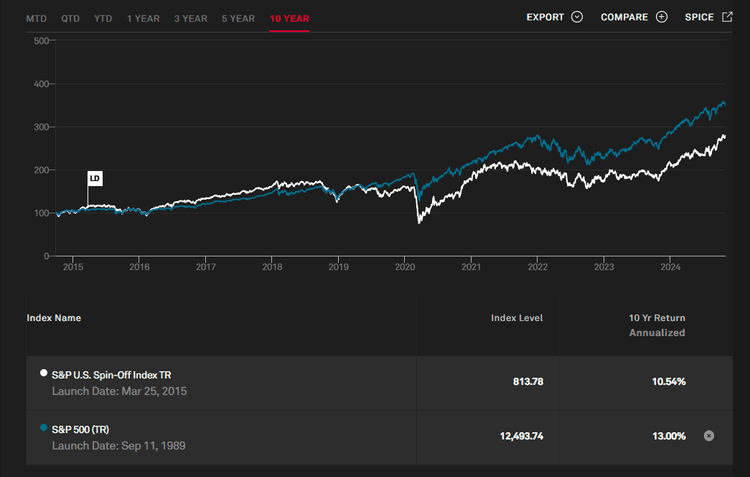
Furthermore, when considering a broader systematic approach, the S&P U.S. Spin-Off Index—which tracks spin-offs from companies in the S&P U.S. BMI for up to 48 months post-separation—offers additional insight.
The index returned an annualized total return of 10.54% over the past decade. This performance trails behind the more passive S&P 500's 13% total return in the same period. This data suggests that while some spin-offs can unlock significant value, the average outcome tends to underperform compared to sticking with broader market indices.
My personal strategy, based on these insights, is typically to sell the spin-off shares and reinvest the proceeds into the parent company. This approach aligns with my investment thesis that if I’m invested in the parent company for its core business and strategic direction, I should continue supporting it rather than betting on the uncertain potential of the new entity.
Spin-offs are a mixed bag, treat them as such
It’s important to clarify that my perspective isn’t a blanket judgment against spin-offs. In fact, under the right circumstances, spin-offs can be a strategic move for a company.
Again, If the segment being spun off is non-core to the main business, operates in a strong industry with secular tailwinds, and if the company is seeking non-dilutive capital without increasing its debt load, especially in a manner that’s tax-free for shareholders, then a spin-off can be a sound management decision that benefits the company in the long run.
However, while the data isn't entirely encouraging, with only the top quartile of spin-offs significantly outperforming, it's still preferable to the kind of value destruction seen in some poorly executed mergers and acquisitions. Notable historical M&A failures like AOL-Time Warner and the Daimler-Chrysler merger serve as reminders of how shareholder value can be eroded through ill-considered integrations.
Yet, what's beneficial for a parent company doesn't automatically translate to benefits for the shareholders of the spin-off. If the spin-off does not meet the above criteria or if you’re focused on maximizing value, consider selling the spin-off shares and reinvesting into the parent company.
This strategy aligns with the parent company’s intention of divesting to refocus its resources and capital—effectively, they are 'selling' part of their business, and you might consider doing the same.
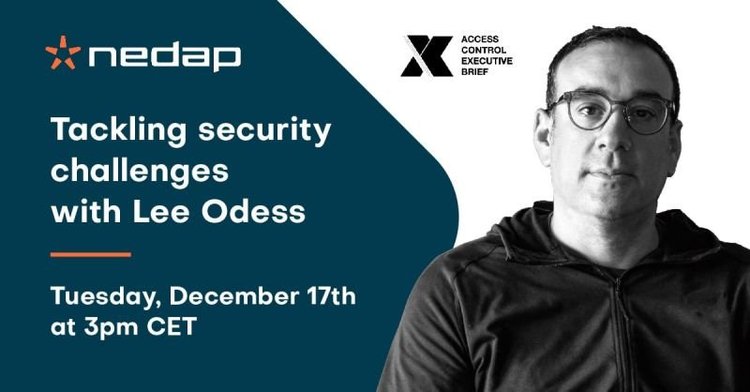
Seats are filling up for a live webinar I am participating in on Tuesday, December 17th with Nedap Security. I will be in Groenlo, Netherlands for my last trip of 2024!
Whether you're just starting out your career in security, or a security manager with decades of experience, you won't want to miss this one. Sign up and you’ll get a chance to submit your own security challenges and questions.
We've already got questions coming in from the 🇬🇧 UK, 🇧🇪 Belgium, 🇬🇷 Greece, and 🇳🇱 the Netherlands.
Register here.
