
Volume 93 | March 6, 2025
Welcome to Brief 93!
Think of this Brief as a "special edition" Brief. Given the news about tariffs in the United States, I would like some insights.
A simple text message asking, "How are you feeling about these tariffs?" evolved into a comprehensive industry survey. After numerous follow-up conversations spanning emails and Slack messages, I surveyed ~50 global executives across the access control, smart lock, software, and adjacent sectors.
I'm writing this brief at 4:30 PM EST on Thursday, March 6th. The survey was distributed Wednesday, March 5th, at 8:30 AM EST. While much has changed in the last 24 hours, the industry feedback remains valuable—providing crucial insights during these turbulent and unpredictable times.
To maximize response rates, I kept the survey simple with just two anonymous questions:
-
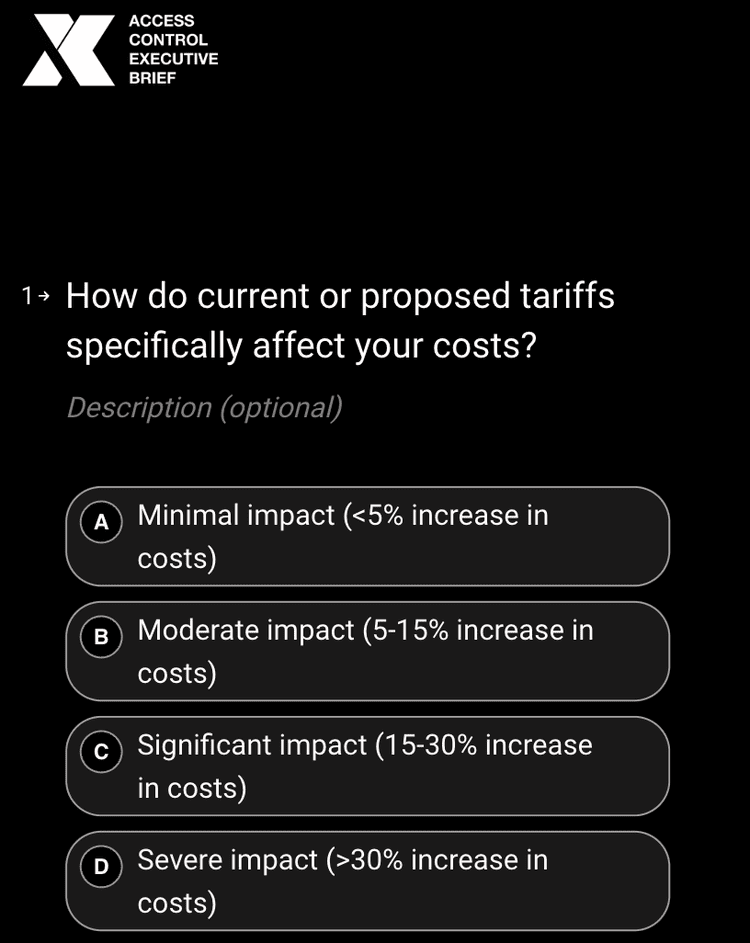
How much have tariffs increased your costs?
-
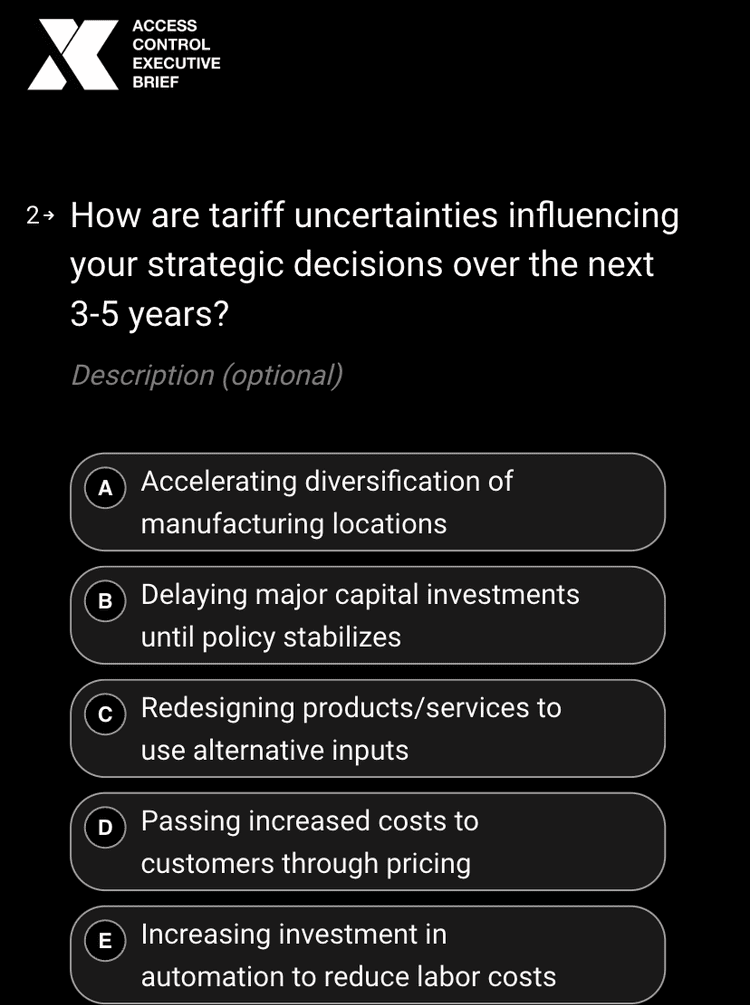
Which strategic approach are you taking to address tariff uncertainties over the next 3-5 years?
For the second question, I deliberately limited respondents to a single choice despite multiple viable options. This forced prioritization helped reveal their primary strategic focus rather than collecting a list of all potential approaches.
Below are the results. Please join us in Slack for a real-time and community-driven discussion on these results and first-hand insights and opinions.
Also - please excuse the lack of graphics and formatting. I went with “get the info out” over “make the info pretty” and given the time of day, I banged through this. I will work on the audio and video portion of this tomorrow.
Thank you for all your support, partnership, and friendship.

PS: I am sure some of you may forward this, but please do so sparingly and encourage others to sign up here. Thank you!
Industry Tariff Impact Survey: Executive Insights
Key Findings
The survey responses indicate that most are experiencing minimal to moderate cost increases due to tariffs. While no one reported severe impacts (>30% cost increase), nearly 40% are seeing a 5-15% rise in costs—not insignificant in an industry already facing margin pressures from competition and supply chain constraints.
Cost Impact Overview
-
Minimal Impact (<5% increase) – 61.5%
-
Moderate Impact (5-15% increase) – 30.8%
-
Significant Impact (15-30% increase) – 7.7%
-
Severe Impact (>30% increase) – 0%
With 38.5% reporting cost increases exceeding 5%, tariffs represent a concern, though not an existential threat (at least not yet). This suggests that most companies have successfully mitigated severe cost escalations through diversified supply chains, alternative suppliers, or contractual protections.
Strategic Adaptations
When asked how tariff uncertainties are influencing their long-term strategies (3-5 years), respondents indicated:
-
Passing costs to customers (46.2%) – Nearly half will increase prices, suggesting that integrators, distributors, end-users, corporate security teams, property managers, and government agencies will likely face higher security hardware and services costs.
-
Diversifying manufacturing locations (23.1%) – A significant portion actively shifts supply chains to reduce tariff exposure, aligning with broader industry trends of moving production from China toward Vietnam, Mexico, or domestic U.S. facilities.
-
Investing in automation (23.1%) – Many companies want to offset rising costs through automation, potentially translating into more robotics, AI-based monitoring solutions, and streamlined manufacturing processes.
-
Redesigning products/services (7.7%) – A smaller segment works around tariffs by modifying materials or designs, potentially switching to alternative materials, different electronic components, or software-driven solutions to replace certain hardware elements.
-
Delaying significant capital investments (0%) – Notably, no respondents are pausing investments, indicating that despite tariff pressures, the sector remains forward-looking rather than defensive.
Industry Implications
-
Price Sensitivity & Customer Impact – With nearly half planning to pass costs onto customers, budgets for enterprises, institutions, and government agencies will likely face upward pressure.
-
Supply Chain Shifts & Localization – The move toward diversified manufacturing could drive further investment in North America or non-tariff-impacted regions. Expect increased discussions around "Made in USA" products for security hardware at upcoming industry events like ISC West.
-
Automation & Efficiency Focus – The industry's continued interest in automation suggests a push toward AI-enhanced security systems, autonomous drones, and robotic surveillance solutions, which may also hedge against rising labor costs.
Conclusion
As of today, while the industry isn't facing a tariff crisis, these trade policies are creating enough pressure to drive noticeable cost adjustments. The industry is responding primarily with price increases, supply chain shifts, and automation investments rather than cutting back on growth initiatives.
In the coming years, expect more of what was already in motion - continued emphasis on cost efficiency, regional manufacturing diversification, and technology-driven adaptations across the security industry.
Also, the world has the largest excuse for price increases, and our industry, especially hardware manufacturers, has shown an appetite in the past for using them to increase margins and revenues. I'd expect the same here.
I'll continue to monitor these trends and provide updated survey results in future reports.
