Volume 95 | March 30, 2025
Click icon above for audio or video versions.
Welcome to Brief 95!
In a "remarkable" alignment of industry events, security professionals have a pretty cool opportunity to witness the global security landscape unfold across two continents simultaneously. ISC West in Las Vegas and The Security Event in Birmingham create what I'm calling a "security show lunar eclipse"—a rare moment when North American and European security showcases converge within two weeks. (It will also cause enormous stress on many people's personal lives, but that's for another Brief).
I have a ton of thoughts and questions, such as: What trends will emerge on both sides of the Atlantic? Where will priorities diverge? Which technologies will dominate conversations in Las Vegas versus Birmingham?
I'll share my thoughts now in this Brief on my most burning thoughts and follow up with an analysis highlighting where my predictions proved accurate, what I got wrong, where surprises emerged, and what these parallel events reveal about the evolving security industry worldwide. I aim to go beyond the obvious and offer fresh insights.
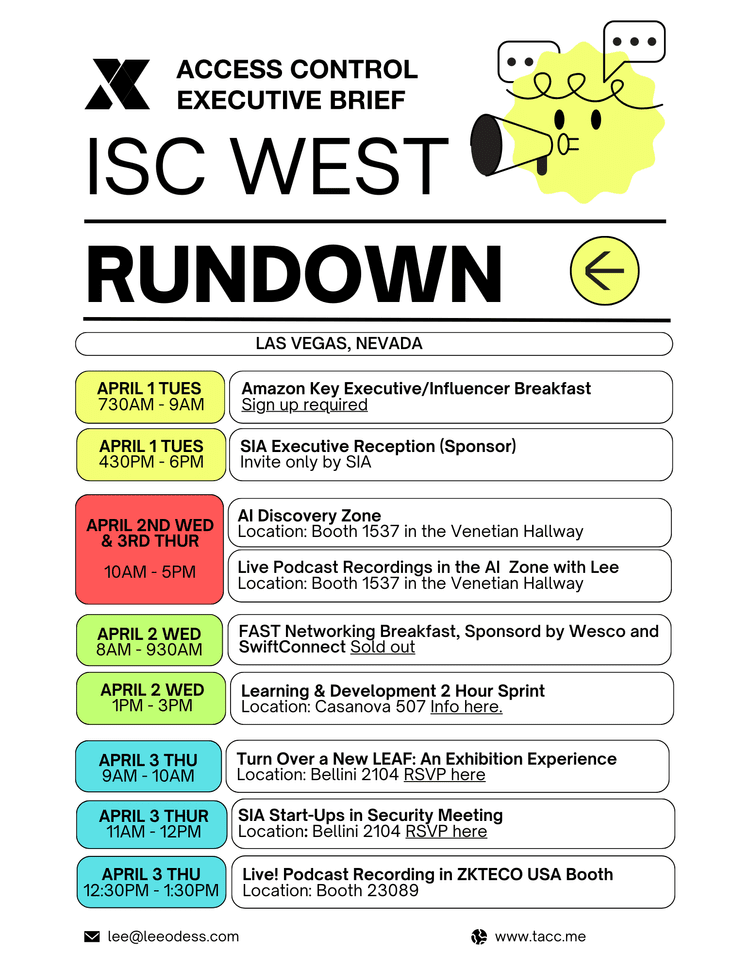
Like many of you, we have a ton going on at both shows. There are countless activations at ISC West, The Security Event with the XForum, and the Night of Access. The energy is fantastic, and I want to extend a heartfelt thank you—all of our events and activations are oversold, a testament to this amazing community. Please stop and say hello if you see me running at the show. I want to make sure we connect.
Safe travels.
BTW: ACS25 agenda and speaker list are online and live!
Thank you for all your support, partnership, and friendship.

PS: I am sure some of you may forward this, but please do so sparingly and encourage others to sign up here. Thank you!

They are LinkedIn Shows Now. I will start with a personal one that is still relevant. You may have noticed that Pelco has officially rolled out a company influencer alongside HID and Mercury. So, what does this mean for these two shows? This is the year when online presence becomes very clear as the more important driver than physical presence at shows. Historically, online was just a side hustle—a booth photo here, a group shot there—but it never truly connected with driving business, capturing the show's essence, or driving narrative on the show floor. The power of influence remained firmly offline.
Countless people and companies are building their brands online, particularly on LinkedIn. It's starting to drive more business than traditional channels, and without a doubt, it's driving a share of voice. It's also reshaping how trust and relationships form in our industry. We don't just meet locally or wait until the next show to catch up anymore. We're building relationships year-round and globally—and these digital connections, the content being created, and the new forms of discovery are challenging long-held industry assumptions.
Consider this: Would I have been invited to join the Security Industry Association board if not for the work that Hilary, our team, and I have done primarily on LinkedIn? I doubt it. I can promise it wasn't due to my offline presence. It was both, but if I had to choose, which drove the awareness of who we are and what we do? It was our online presence that led.
We're witnessing the dawn of a new era of influence in our industry, and these two shows will demonstrate something unprecedented—those who've been consistently building their presence online, especially on LinkedIn, will wield significantly more influence at these shows than ever before.
Geopolitical Juxtaposition: Parroting what is happening in "real life," ISC West will demonstrate the US market's opportunity dominance, while The Security Event will showcase Europe's growing desire for self-reliance. I suspect companies will adapt their narratives based on location—European firms will emphasize their US connections at ISC West, highlighting their need for American scale, investment, innovation, and credibility. Yet just 48 hours later, at The Security Event, these same European companies will proudly assert their non-US identity. The reality? Both positions are authentic and accurate. I hope companies and people at the shows don't overshoot here by being obnoxious. I think there is an interesting discussion to be had on how geopolitical changes are impacting our industry, and we collectively should work together to maneuver through it.
Real Concern about the Economy: I suspect this is a massive topic at both shows, but most likely, we will be discussed very differently. The two topics underpinning the economic concerns are (1) the US use of tariffs and (2) ongoing wars in Europe and the Middle East. It will be interesting to capture the tone, sentiment, and thoughts around this based on the show's location. What will be discussed? Here are some thoughts on the topic. This uncertainty will significantly impact large organizations' investment in innovation as they reduce spending. These organizations now have the perfect excuse to focus on "operational efficiencies," which is code for "cost-cutting and holding pattern."
However, this climate will boost M&A activity as many incumbents have substantial cash reserves while underperforming independent companies struggle to raise additional capital. This doesn't mean private investing will decrease. It will continue to grow in thriving segments of the security sector, particularly in access control, virtual guarding, and smaller companies showcasing AI capabilities. That is just a taste of the uncertainty's impacts on the industry. All of that aside, I am sure plenty of conversations will be centered around feelings and opinions. It would be a lie if I said I didn't care. I really do. These are some uncertain times, and as a community, I believe it is ok for us to come together, talk, listen, share our thoughts, opinions, and experiences, and work things out. I have gotten used to this part of "my job" now. With all the travel, there is a certain level of mutual intrigue, in my and your opinion, on manners like this (I don't profess to be an expert on geopolitics, by the way, but I do live in Washington DC, so there is a certain level of curiosity on the subject that comes with living here) along with my appetite to hear different interpretations, thoughts, and impressions from people all over the globe. All in all, I suspect this to be a major topic at both shows.

Click on image above.
New Stakeholder Walking the Halls: You'll see many more investors walking the halls of ISC West (I'm not sure if this will be true at The Security Event, but I'm interested in finding out). This will be noticeably different from what we've seen before. The number of investors I've spoken with who will be at ISC West is encouraging. This is excellent news because it will drive more investment into our industry. It will also distinguish between companies with investable businesses and those without. Historically, our industry has been top-heavy with non-investable entities for the mainstream financial markets, but as recurring revenue models grow, so does the number of investable businesses. Note: Not every company with a recurring model is investable, so I'm not suggesting that. As the number of businesses with recurring models increases (think of it as a growing lake), we'll see more investment flowing into that lake. I suspect we are just at the beginning of a lot of financial news, and ISC West will be the starting block.
New Faces, New Places Speaking of new, we will see an influx of people entering the industry—vendors, end users, integrators, specifiers, and others—due to our industry's opportunities. I suspect attendance will be way up at both shows, along with records of the number of booths and companies. The industry is steady, and where there's a steady opportunity, there's growth. And where there's growth, people follow. With recent layoffs in the US (including 10,000 cuts in Health and Human Services just this week), we'll likely see former end-users transition to integrator, consultants, and vendor roles. As our industry evolves from cottage to mainstream, I expect this workforce expansion to continue.
On That, What I Hope to See (But Probably Won't), I'm particularly interested in how companies address training and certification needs as we enter this new era of physical security that merges cybersecurity and enterprise software with our traditional systems - also known as converged security. I haven't seen our vendors step up yet (we do see training offered at both shows, but not as programs like the ones I am talking about). Still, I hope manufacturers and service providers will develop new channel programs that meet current market demands. I wish they'd give these programs the same attention they give to flashy new features with blinking lights (which rarely matter or have a lasting impact). Despite all this "new" stuff, we still rely on outdated programs.
Old Faces, New Places We're seeing significant movement of people between companies lately. It reminds me of a sports league's off-season, where players switch teams and don new uniforms. The pace of people transitions has notably increased this year compared to previous years, particularly at executive levels. This shift raises interesting questions about loyalty, the intersection of new and old ideas, and how organizations invest in talent acquisition. Are companies making the investments in their people needed to drive exponential rather than incremental growth (Gallup awards aside)? The race for talent continues unabated, and people remain the most valuable asset in our industry. However, and not often discussed is that sometimes there's addition by subtraction when someone leaves an organization to go to another—the impact of these moves may be felt more strongly at the companies people leave rather than where they land. I've seen a few cases where I believe this is true.
End-user Dominance is evident at ISC West, while The Security Event remains primarily integrator-focused. This mirrors ISC West's earlier years, with The Security Event—like IFSEC before it—typically trailing ISC West's trends by a year or two. This year might mark a significant shift in attendance demographics, as seen plainly by more end users attending ISC West.
Click on image above.
Mobile is a Sidecar to Platform and AI. Mobile will be everywhere—that's precisely the point. Everyone has it, and no one is differentiating their offering from others (web provisioning, although cool - eh...not really and not really a value creation story). I've been blaming Apple for how they slow-rolled things, but at this point, the blame is on us. Sure, putting a card in the phone is again...cool (I am being nice), but what can you do with it and those stories? That's epic. Let's be epic. It'll be far more interesting—and hey, you might bring home hundreds of millions of dollars along the way, too. There will be a couple booths telling the epic story.
And on AI. I expect we'll see plenty of AI messaging, just as we've seen with cloud, mobile, and other trending terms. Sure, we're activating the AI Discovery Zone and have presentations planned on the topic at The Security Event XForum so you can blame us for that, too. Some products at the shows will be labeled as AI without truly being AI, while others will be genuine. I have a question that I plan to be on the lookout for: what about AI that you are showing will drive real value today, which has potential for value tomorrow, and which is bullshit? That remains to be seen. What fascinates me most going into the shows are the smaller shops leveraging AI to maximize their efforts or AI's impact behind the curtain—quietly doing work that historically would have required millions of dollars and extensive human capital. AI has profoundly impacted my business; I don't think we're unique. Yes, we're small, scrappy, and eager to embrace new tools. Much of what you see isn't AI itself but rather the results of us using AI. So, if that's true for us, why wouldn't it be happening for many of you or other companies in our industry? I believe it is, and that's what you'll see most at the show: blatant AI advertising alongside subtle AI impacts that aren't marketed as AI. Which will have a more significant impact? The understated AI implementations aren't advertised as such.
But what I'm really looking forward to is seeing who positions themselves as a "platform." I love what's happening around the platform play—it's the perfect example of software eating our industry. The platform play will further separate the old from the new. Change will accelerate. New opportunities will emerge. It will spark System Integrators as the leading channel and create new economies. Overnight? No. But long term? Absolutely. Bring on the platforms!
First come the Platforms, then come the Apps. Get ready for the introduction of apps built on all these new platforms everyone's talking about. While we'll mostly hear talk at first (it's still early), the real story is more profound. The platform strategy isn't just about integration or being "best in class." It's about making it easier—and profitable—for third parties to build on your platform. Here's the clever part: it's also a way to get others to build features that are either deep in your roadmap or weren't even considered due to limited time, resources, or imagination. You can empower an external development team to create it for you, and boom—they have a business. I've seen that customers (both installers and end users) love these early apps. It's a win-win-win situation, making our industry look fast, nimble, and cutting-edge.
I'm particularly excited about this opportunity globally. It creates economic opportunities for people with fewer resources, offering the same vitality we've seen in traditional consumer and professional app stores. Just look at Salesforce's Exchange as an example. We'll see one or two companies in our space dominate the app marketplace. Still, we'll also see more individuals launch one—or two-person shops, leveraging AI and outsourced development resources to build potentially game-changing solutions that gain wide adoption.

Click on image above.
Open Products: Expect to hear this word at both shows. Try this with me: squint your eyes and say, "We are open." That's exactly how it's often presented. Usually, you should follow up by asking, "More open than what?"
I'm looking forward to seeing true "open systems" one day—not just "more integrated" or "more open than [insert company]." While there are many ways to define "open," here's my definition:
An open system in technology is defined by several core tenets that promote flexibility, collaboration, and user control. At its foundation is interoperability, which ensures the system can communicate and function with other platforms and devices through standard protocols and APIs. Open systems are typically modular, allowing components to be easily added, removed, or replaced without disrupting the whole. They are built on open standards, often governed by independent bodies rather than proprietary formats, fostering greater vendor consistency and compatibility. Transparency is another key element—interfaces, specifications, and sometimes even source code are openly available and well-documented, enabling developers and users to understand how the system works. This also supports portability, where data and functionality can move between systems without restriction, reducing vendor lock-in. Additionally, open systems are extensible, encouraging innovation through third-party integrations and customization. Lastly, they embrace the idea of security through openness, where public scrutiny of code and architecture often leads to more robust and trustworthy systems.
So, at either show, when we hear "we are open," my response will be, "Please define your 'open.'" I will ask them to call it something else if it doesn't include interoperability, modularity, open standards, transparency, portability, and extensibility with security through openness.
Biometrics: This topic will be similarly interesting in both shows. We'll see compelling discussions and showcases of biometric technology with promising stories. However, it won't make a huge splash in either market regarding productivity outside of a few companies that can scale and have a handful of odds-and-ends traction in a case-by-case scenario. While there will be notable examples— I remain bullish on its long-term adoption in North America and Europe—shows like Intersec and The Security Event Asia will demonstrate true adoption. What's particularly intriguing are three key developments: (1) meaningful discussions will emerge around biometrics with the integration of access control and video (see below); (2) standalone readers will become features within larger offerings—meaning what appears as a company today is a product better suited as part of a larger hardware manufacturer such as HID, Salto, dormakaba, or Allegion. It is time to do this; (3) we'll see deep use-case adoption in government, stadiums, and payment integration; and (4) OEM technology players will flood the market with their products and services. I believe the best thing that's happened to biometrics is mobile, but I don't think it's enough to move the meter for biometrics in the security industry. Maybe the problem is that it's in the security industry. Would biometrics be better off around solutions that include pay, HR, finance, retail, and others where it's also a feature of a larger value proposition, and security is a by-product versus the core value?
Access + Video: This upcoming show season is the last time we see a clear separation between access control and video as separate competencies. Sure, some will exist, but by next year, most access and video companies won't stand alone; they will be integrated systems (again, sure, they will also integrate one or the other to 3rd party systems, but they will lead with their own). This transition raises important questions about the future of specialized players like Milestone, who have built their reputation on focused offerings. Again, I'm not saying they won't exist, and we won't see single-player offerings. I am saying they won't be the predominant path forward, as the past no longer dictates the future.
This convergence is directly connected to our industry's transformation from cottage to mainstream enterprise technology, with customer expectations shifting toward streamlined, unified solutions. And not often discussed but equally as important, growth demands of companies by investors, boards, and Wall Street (plus, it's a hell of a lot easier to sell an existing customer than a new one, and it's also less expensive). The driving factors are clear: product differentiation has become increasingly difficult for end-users to discern and will only worsen, value arbitrage gravitates toward comprehensive platforms, and margin stacking across multiple systems has become a significant pain point in budget discussions. Results: a platform with knobs.
For security leaders and technology decision-makers, this means rethinking procurement strategies - evaluating individual components and how well they function within a cohesive security framework - see "platform" above. The winners in this new landscape will be those who embrace this convergence and build their value propositions around solving customer problems holistically rather than selling standalone products that force customers to piece together disparate systems from multiple vendors - of course, unless the customer wants it but that will become an outlier.
The Old on Defense Get ready. All this change will challenge the old school—particularly those who haven't adapted or feel their past contributions haven't received proper recognition or see all this new as "hogwash." This resistance is a natural part of change. I expect to see at the shows a vocal (though steadily shrinking) group become increasingly outspoken about the "overhype, nonsense, and illegitimate nature" of all these developments. I suspect they will get far more vocal directly at me and many of you spearheading the changes. My stance is firm: "I'm done defending the obvious and inevitable changes around us. It's time for the status quo defenders to explain why these changes aren't valid rather than me defending why they are. Simply saying 'it didn't work before' or 'the industry has always been slow' isn't enough." This doesn't invalidate past experiences—they're real and significant. But those experiences don't dictate what's possible now and in the future.
That's it! Well, not really, but that's all I have for this Brief. I look forward to sharing what I learn after two weeks at these two important events. Good luck, safe travels, and say hello if you are there!