Volume 96 | April 7, 2025
Welcome to Brief 96!
I'm heading straight to The Security Event in Birmingham fresh from ISC West (I’ll keep this intro short as I am boarding in a few minutes). In next week's edition, I'll share my observations and key insights from both events (as detailed in Brief 95), along with the latest industry news.
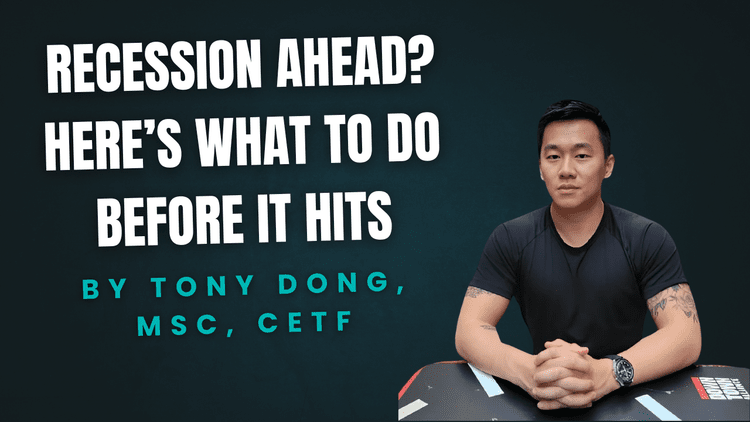
In Brief 96 below, given the recent tariff news last week and weekend global economic responses, I've asked Tony Dong to share his thoughts and insights on recession preparedness. Please join the conversation in our Slack channel, as the economic situation remains highly fluid.
If you're attending The Security Event, please stop by our booth—I'd love to connect in person!
BTW: ACS25 agenda and speaker list are online and live!
Thank you for all your support, partnership, and friendship.
FYI: No audio or version of this Brief as I am on the road for the week.

PS: I am sure some of you may forward this, but please do so sparingly and encourage others to sign up here. Thank you!
Trump’s global trade war is bad for business.
The latest round of blanket tariffs, starting at 10% and spiking to 34% on certain countries, injects a new layer of cost, confusion, and geopolitical instability into an already fragile economy.
Trump wants to reshore manufacturing and “bring jobs back.” But here’s the problem: the U.S. economy no longer competes on low-margin, high-volume manufacturing. Our strength is in high-margin exports—think software, cloud infrastructure, patented hardware, and integrated technology services.
As access control executives, you know this firsthand. Your business model probably depends less on building physical keypads and more on licensing proprietary software, integrating cloud-based platforms, and selling data-rich services to institutional clients.
Tariffs on components and sub-assemblies from countries like China, Vietnam, or Taiwan don't just raise input costs—they can break just-in-time supply chains, force emergency vendor shifts, and disrupt everything from cost forecasting to client delivery timelines.
Consider a regional integrator who builds out enterprise security systems. If they were importing surveillance cameras from Taiwan or NVRs from Vietnam, those parts are now 20–30% more expensive overnight. That hits margins, creates billing disputes, delays deployment, and erodes customer confidence—all while clients themselves are slashing budgets.
I’m not diving into the full impact on the access control industry today. I’m not qualified to do that and I’m assuming most of you are mapping that out internally in strategy meetings—scenario planning, budgeting, and thinking about long-term positioning.
This piece is about you personally. Because if Powell fails to land the economy softly—if inflation sticks, credit dries up, or business confidence collapses—we could be looking at a full-blown recession.
So, the question is: What can you do now to position yourself—and your portfolio—to come out ahead?
What Do the Numbers Say?
The media loves terms like meltdown, crisis, and crash—but those aren't economic indicators. The official definition of a recession is generally “a significant decline in economic activity spread across the economy, lasting more than a few months.”
The most common shorthand people cite is two consecutive quarters of negative GDP growth. Gross Domestic Product (GDP) measures the total value of all goods and services produced, and it’s calculated based on consumption, investment, government spending, and net exports.
But reality isn’t that tidy. The National Bureau of Economic Research (NBER)—which is the official U.S. recession arbiter—looks at a broader mix of metrics:
-
Real personal income
-
Employment trends
-
Industrial production
-
Real retail sales
They also weigh the depth and duration of any decline. In other words, it’s not just about how much the economy contracts, but how broadly and for how long. That’s why the NBER often doesn’t declare a recession until months after it begins or ends.
Now, based on the most recent data available, I don’t believe we’re in a recession—nor do we appear to be entering one just in the immediate future. Looking at the latest numbers in the chart, key signals remain mixed but not catastrophic:
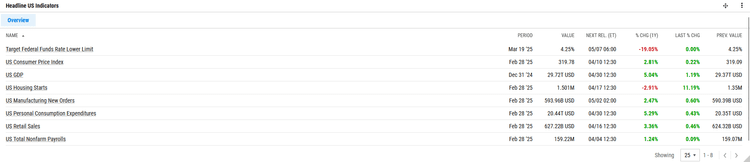
Unemployment remains below 4%, which suggests the labor market is still tight.
-
Retail sales are flat but haven’t cratered.
-
PMI (Purchasing Managers’ Index) is hovering just under 50, which indicates sluggish growth in manufacturing but not collapse.
On the other hand, consumer sentiment (a fairly reliable bellwether for middle-class America) is getting shaky. As shown below, the Consumer Sentiment Index has fallen 16.42% since July 2024. The sharp drop in sentiment suggests that average folks are feeling deeply uncertain about the future, likely due to tariff fears, price stickiness (go look at egg prices), and political instability.
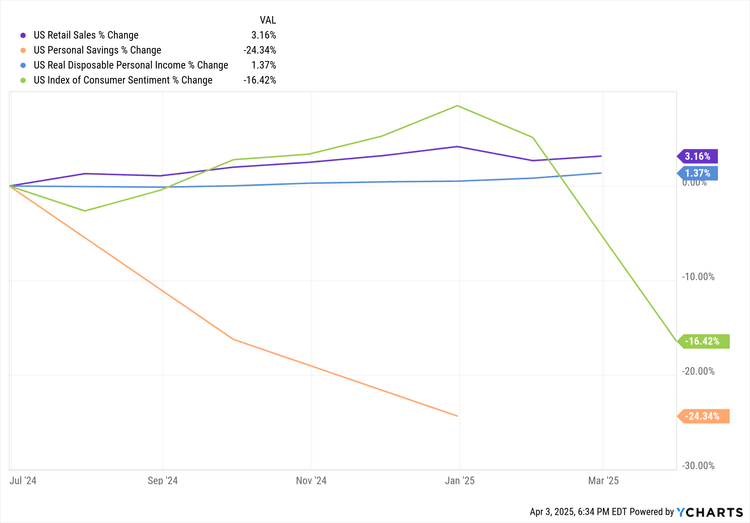
At the same time, the U.S. personal savings rate has collapsed down 24.34%, which implies that consumers are increasingly dipping into reserves to maintain spending levels. That’s not sustainable.
If this trend continues, it could set up a nasty feedback loop where spending finally cracks, which then hits corporate earnings and triggers layoffs—classic recession mechanics.
The worst-case scenario from here, in my view, is stagflation—that’s slow or negative growth plus persistent inflation. And Trump’s tariffs could be the exact kind of external shock to trigger it.
Remember, the Federal Reserve only cares about two things:
-
Stable prices
-
Full employment
If the Fed has paused its rate-hiking cycle to assess whether inflation is sustainably cooling—and Trump barges in with tariffs—you’re setting up a direct policy clash.
Trump, whether intentionally or not, is now undermining both part of the Fed mandate with tariffs that could increase input costs (inflation) and disrupt global supply chains (slowing output).
As seen below, the Fed hasn’t come remotely close to achieving the second half of its mandate—price stability. While headline inflation has edged down to 2.82%, core inflation—which strips out food and energy—is still sitting at 3.12%, well above the Fed’s 2% target.
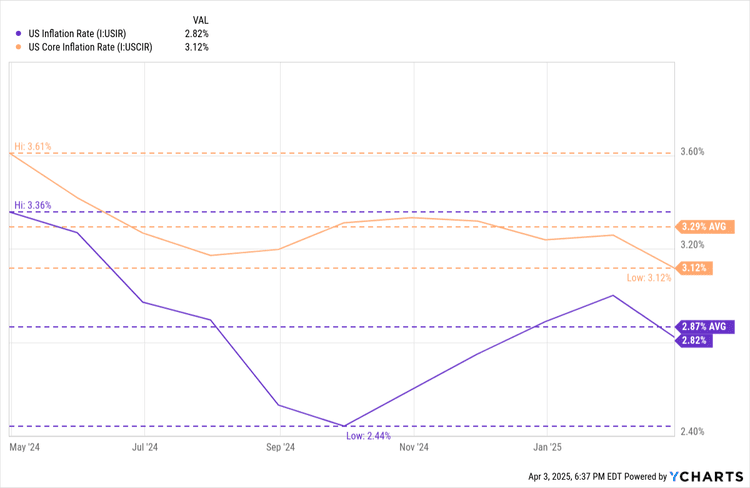
Even with years of rate hikes and policy tightening, the data shows that inflationary pressures remain sticky, especially in core categories. This gives the Fed limited room to maneuver, and tariffs that push input costs higher could easily reignite inflation just as it appeared to be cooling.
That’s the macro picture in a nutshell. We’re not in a recession yet—but if one shows up, my bet is this is how it’ll happen and probably before 2025 ends.
How to Recession-Proof Your Life
These aren’t knee-jerk moves. They’re things you probably should’ve already done, but now that recession risk is real, their urgency just clicked.
In short, stockpile cash. Warren Buffett is sitting on $340 billion in Treasury bills for a reason—and Berkshire Hathaway is coincidently up 18% this year.
There are very few problems in life that can’t be made better by throwing money at them. And the kind of problems that come with a recession—job loss, medical expenses, broken cars, rent spikes—are definitely not on the exemption list.
You need to increase your savings rate, and you need to calculate it the right way. That means looking at it as a percentage of you’re your monthly net income after taxes, 401(k) deductions, etc.
If you’re not saving at least 25% of that accessible cash flow—and yes, I know that’s hard for many people given how expensive life has become—you need to be honest with yourself. Because if a recession hits, you might be one of the people struggling to make ends meet. I’m asking you to make some hard cuts now, while you still have the luxury of choice.
Start trimming discretionary spending. Do you really need Netflix, Disney+, Hulu, and Amazon Prime? Make your lunch. Brew your own coffee. Maybe don’t buy that trip, new phone, or night out you think you “deserve.” As harsh as it sounds, the economy doesn’t care what you deserve—and if you spend beyond what your future self can afford, you’ll regret it.
Once you’re saving enough cash, don’t just sit on it—be strategic.
-
Keep some in a high-yield savings account for quick access.
-
Put some into short-term CDs, laddered with 6-month maturities, to smooth out interest rate risk and keep you from spending it on a whim.
-
And yes, keep some physical cash on hand—because if things really go sideways and your bank goes under like a few did during 2008, liquidity is king.
How to Recession-Proof Your Investment Portfolio
My investment approach is built around a simple principle: antifragility. I want a portfolio where different parts behave differently depending on the economic environment. That way, when something breaks, something else usually holds up.
Ray Dalio calls his version of this the All-Weather Portfolio. I call mine The Cockroach Portfolio. It’s designed to survive just about anything. It allocates 20 percent each to five very different asset classes.
First, there’s healthcare stocks within the S&P 500. These companies benefit from structural tailwinds like aging demographics, global demand for treatment, and often have pricing power. People don’t stop buying medication during a recession.
Second is utility stocks—power, water, and energy distribution. These are highly regulated businesses with predictable cash flows. They usually pay steady dividends and hold up well during downturns.
Third is consumer staples stocks. These are companies that sell everyday essentials—household goods, food, and beverages. Think toilet paper, toothpaste, and soft drinks. People buy them whether the economy is good or bad.
Fourth is intermediate-term U.S. Treasury bonds, typically those maturing in five to ten years. These tend to rally when the economy slows down or when panic sets in. They offer portfolio ballast and help smooth out the ride.
Last is gold, which acts as a hedge against inflation, currency debasement, and geopolitical shocks. It tends to shine when fiat currencies and central bank credibility start to wobble.
Now, let’s look at what this strategy delivers:
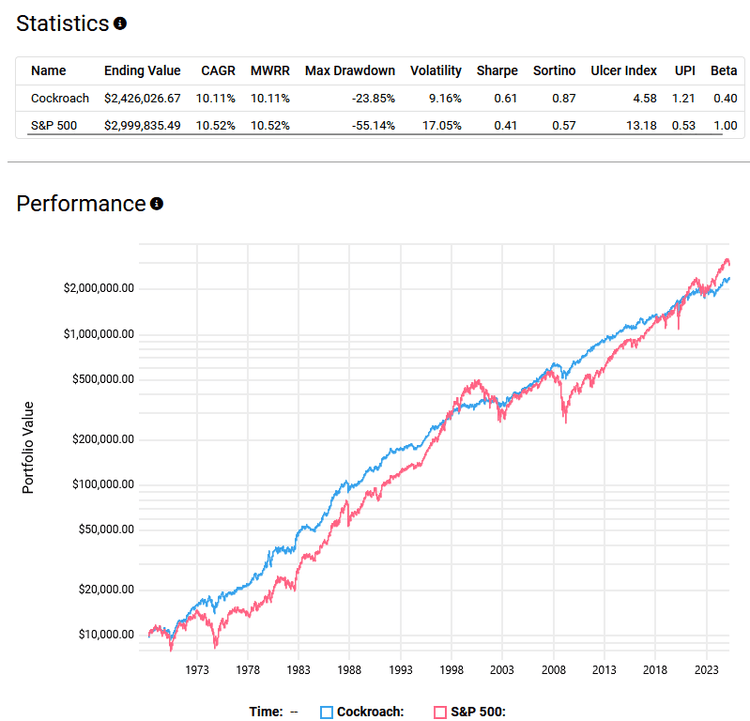
The CAGR, or compound annual growth rate, is 10.11% for the Cockroach versus 10.52% for the S&P 500. Considering some 89% of funds fail to outperform this index over a 15-year period, pretty good! But now look at the other numbers.
The maximum drawdown—which measures the deepest peak-to-trough loss—was 23.85% for the Cockroach. For the S&P 500, it was a brutal 55.14%. That’s a deep psychological and financial hole it takes years to climb out of.
Volatility, which captures the magnitude of average annual ups and downs, was just 9.16% for the Cockroach portfolio. The S&P 500? Nearly double that at 17.05%. That’s far less stress watching your portfolio swing back and forth over the years.
Diversification is the only free lunch in investing. Don’t pass on it.
Brand New Content!
We're proud to unveil three conversations we've co-created with industry-leading partners. These discussions are intended to spark a conversation about the future of the security industry. Click on the images above to join the convos that are defining tomorrow's security landscape today.

Click on image above.
Click on image above.

Click on image above.
