
Volume 99 | May 3, 2025


Welcome to Brief 99!
In Brief 63, I shared findings and thoughts regarding the Gallup 2024 Workplace Report. With the release of their 2025 report, I thought it would be worthwhile to share an analysis comparing both years and discuss ideas around how it relates to the access control industry. This report is one of my favorite annual publications, which seems to hit the market's pulse. Since we have no data in our industry, we need to use external data, and this report is a good one to start with.
The message is clear: due to workplace changes, access control must shift to a platform and add value beyond its core value proposition to serve this market properly. Access control is uniquely positioned as a source of record focused on identity, and this data is used for increased operational efficiencies, awareness, and even revenue generation opportunities. We are also one of a few sticky utilities already installed used by all personas, known and unknown, interacting with physical spaces. Name another. Other utilities would kill for this opportunity.
Why would you give up that position?
I take away from this report another validator that our industry's future demands are here now. Our industry, integrators, specifiers, manufacturers, distributors, software providers, associations, marketers—everyone—must choose where they want to play. Some of you are, and I applaud you. But not enough of you are, so let's get moving.
All right, to the Brief. First, we will recap 2024, discuss 2025, discuss similarities and disparities, and apply an access control lens.
Thank you,

PS: I am sure some of you may forward this, but please do so sparingly and encourage others to sign up here. Thank you!
First up, a refresher on the 2024 report's essential findings.
The 2024 report delivered comprehensive insights based on data from 183,000 business units across 53 industries and 90 countries. Here were the key takeaways:
-
41% of workers reported experiencing significant stress levels, highlighting a critical mental health challenge.
-
Manager influence emerged as a decisive factor, driving 70% of team engagement variations.
-
Remote work presented unique challenges, with increased isolation and disconnection reported
-
High-engagement organizations demonstrated superior performance metrics and reduced turnover rates
-
Strong workplace protections showed a direct correlation with enhanced employee well-being.
This sentiment played out in the market throughout 2024 in discussions of the access control industry, particularly regarding how workplace security contributes to employee well-being and engagement.
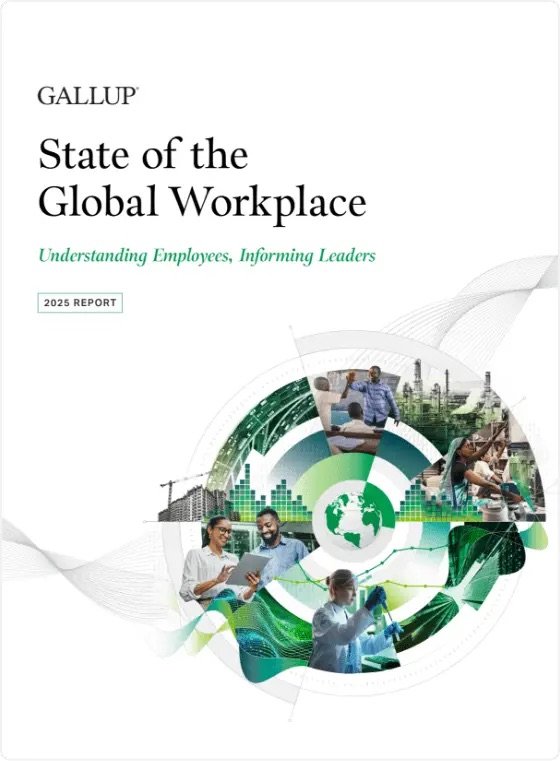
You can find the complete 2025 report here.
The global workplace is at a critical inflection point. As the 2025 Gallup State of the Global Workplace Report highlights, the time has come for a fundamental reimagining of work—a crucial wake-up call for leaders at every level.
Global engagement has declined to 21%, matching the dramatic drop observed during COVID-19 lockdowns. However, today's challenge is compounded by the rapid advancement of AI across industries, creating unprecedented pressure on organizations to adapt their workforce strategies.
The Critical Pressure Point? Management.
The core issue extends beyond general employee satisfaction—it's a management crisis. Manager engagement has plummeted to 27%, with younger and female managers experiencing the steepest declines (5 and 7 points, respectively). This troubling trend highlights a fundamental breakdown in organizational leadership structures.
The root cause is the impossible balancing act managers face between traditional executive expectations, evolving employee needs, and accelerating technological change. This three-way pressure creates unsustainable demands on those in leadership positions who lack adequate support, training, and resources to navigate these complex challenges.
This management crisis has far-reaching implications, as manager engagement directly influences 70% of team engagement levels. When managers struggle, entire teams suffer, creating a cascading effect that ultimately impacts organizational performance, innovation, and employee retention.
A Systemic Challenge in Well-being
Gallup's life evaluation metrics have dropped to 33%, with managers showing the most significant decline, particularly among older and female leaders. This alarming statistic reflects a broader deterioration in workplace well-being that extends beyond professional satisfaction into personal health and quality of life.
Stress, sadness, and isolation are increasing across all demographics, indicating that the problem is not isolated to specific employee groups but represents a systemic organizational challenge. These emotional and psychological strains manifest deeper structural issues within workplace cultures and expectations.
The business impact is clear and quantifiable: Disengaged managers create disengaged teams, directly reducing innovation, customer satisfaction, and revenue. This creates a destructive cycle in which declining well-being leads to lower performance, which increases pressure and further erodes well-being. Breaking this cycle requires fundamental changes to how organizations approach leadership development, work-life integration, and employee support systems.
The Path Forward is Data-Driven Solutions
The research identifies three actionable strategies that can transform workplace engagement and productivity. Management training is a critical first intervention, as basic role preparation can reduce disengagement by 50%, providing managers with the fundamental skills needed to navigate complex workplace dynamics.
Leadership development focused on coach-style approaches increases engagement by 28%, shifting management paradigms from traditional command-and-control models to more collaborative, supportive relationships with team members. Additionally, creating robust manager support systems is essential, as well-supported managers are 32% more likely to thrive, enabling them to withstand organizational pressures better and lead effectively.
The potential economic impact of these interventions is staggering: proper manager engagement could unlock $9.6 trillion in global productivity, equivalent to 9% of the world's GDP. This data underscores that investing in management effectiveness isn't merely a human resources concern but a strategic economic imperative with far-reaching implications for global prosperity and organizational success.
Now, let's look at the similarities and disparities between 2024 and 2025 using an access control lens:
Overall Landscape: From Uncertainty to Urgency
2024 Report: Despite high stress levels (41% globally), optimism about post-pandemic recovery remained. The prevailing sentiment was "Challenging but manageable."
2025 Report: Conditions have deteriorated significantly. Global engagement dropped to 21% (from 23%), well-being metrics declined, and manager burnout has reached critical levels. The new reality is "Immediate action required."
The industry must evolve into a strategic partner driving organizational resilience and talent retention. This transformation requires access control providers to reposition their solutions as critical infrastructure supporting employee well-being, organizational flexibility, and data-driven decision-making. The industry must articulate how access technologies directly contribute to addressing the urgent workplace challenges identified in Gallup's research.
The Manager Crisis: From Challenge to Emergency
2024 Report: Managers were recognized as key influencers, controlling 70% of team engagement outcomes.
2025 Report: Manager well-being has hit unprecedented lows, with younger and female managers showing particularly concerning disengagement rates (declines of 5 and 7 percentage points, respectively).
Access control solutions must transform (or be purposefully built) from security tools into management enablement platforms that provide actionable insights and reduce administrative burdens. This requires fundamentally reimagining access control's role in the management ecosystem, shifting from passive barrier systems to active enablers of leadership effectiveness.
Other examples include:
-
Real-time space utilization and engagement analytics allow managers to understand team dynamics without intrusive monitoring.
-
Predictive burnout indicators through access pattern analysis help identify concerning trends before they result in a turnover.
-
Intelligent hybrid team management tools that promote trust without micromanagement by providing visibility into distributed team presence and activity without creating privacy concerns.
Employee Well-being: An Integrated Approach
2024 Report: Well-being was viewed primarily through mental health and work-life balance lenses.
2025 Report: Physical workplace experience is now recognized as fundamental to employee thriving, with safety, belonging, and flexibility emerging as critical factors.
The industry must shift from "security-first" to "experience-first" thinking without compromising safety. This represents a paradigm shift requiring access control providers to collaborate with workplace experience teams, human resources, and facilities management to design holistic solutions.
Other examples include:
-
Frictionless access systems that reduce daily stress through technologies that minimize cognitive load and physical inconvenience.
-
Intelligent authentication that adapts to user behavior and preferences, providing personalized experiences that respect individual needs while maintaining security standards.
-
Access solutions are positioned as workplace experience enhancers that contribute to feelings of belonging and recognition.
Remote Work Evolution
2024 Report: Remote work challenges centered on isolation and connectivity.
2025 Report: Hybrid work is now standard, but exclusive remote workers are concerned about stress levels and disconnection.
Remote workforce enablement is now a core business requirement rather than an edge case or exception. Access control providers must recognize that supporting occasional in-office presence for primarily remote workers represents a critical use case demanding specific design considerations.
Other examples include:
-
Streamlined digital credentialing systems that eliminate friction for infrequent office visitors while maintaining security standards.
-
Seamless headquarters access for remote team visits that creates positive connection experiences rather than highlighting outsider status.
-
Unified physical-digital identity management that connects disparate security systems into coherent experiences spanning work locations.
AI Integration: The Game-Changer
2024 Report: AI remained peripheral to workplace discussions.
2025 Report: AI has emerged as a transformative force with the potential to empower or disrupt.
Access systems must evolve into intelligent workplace platforms that balance advanced capabilities, ethical considerations, and user control. This evolution requires substantial investment in technological development and ethical frameworks to ensure AI-enhanced systems build rather than erode trust.
Other examples include:
-
Behavior-based predictive security that identifies anomalous patterns while respecting privacy boundaries.
-
Customized access experiences that adapt to individual preferences, work patterns, and accessibility needs.
-
Advanced workforce analytics integration that provides organizational insights while maintaining individual privacy.
Final Reflection: Time to Command
2024's warning signs have evolved into 2025's imperative for change. The access control industry stands at a crossroads. We must transition from passive security provider to active enabler of organizational success, employee trust, and business continuity. We must be Utility+.
The industry's future, or the future of those who will take the lion's share of the mainstream upside, depends on our ability to align solutions with employee well-being, manager empowerment, and AI-driven workplace innovation - built off of security as the bedrock. If we don't seize this opportunity, others will. The choice is clear: evolve or become irrelevant.
The access control industry can lead this transformation - if we act now.
