🎙 Secured Podcast
Episode 36 | ACS26 in New Zealand and the MCP Moment
What did ACS26 reveal about the future of access control? Lee Odess and Hilary Gallagher recap the conversations, industry shifts, and big bets separating the companies moving forward from those standing still. Plus, why MCP could change how we interact with access control systems. Listen here.
📰 The Access Control Executive Brief by Lee Odess
Brief 157 | The MCP Moment and the Great Sorting of Access Control
Genea’s new MCP server could signal a bigger shift in access control than it first appears. Lee Odess explores how AI agents could reshape the way we interact with security systems, what this means for integrators, and why the industry may be heading toward a major divide between those embracing the Intelligence Era and those holding on to the old model.
✍🏻 Articles
Hilary Pogarch Gallagher | Nobody Knows The Rules Here
From a 5 p.m. dinner in Spain to a possible 3 p.m. drink in New Zealand, Hilary Gallagher reflects on what happens when we stop assuming our way is the only way. At ACS26, the best moments came from embracing the unfamiliar, sharing stories, and getting to know the people behind the titles.
Jon Lunetta, Stefano Pedemonte, Alberto Pedemonte | We Can Have Nice Things: A button was never the answer
We put access control in our phones and called it progress. But what if the next leap forward isn't another app or another button, but a door that understands the situation and responds accordingly? This piece rethinks what a truly smart access experience could look like.
Billy Paton | Would You Tape Your New Smartphone to the Back of Your Old Phone?
A door entry system can work perfectly and still leave a lot to be desired. Billy Paton challenges the industry's approach to retrofits and makes the case for treating the finished installation with the same care as the technology itself.
Mike Gillespie | Surveillance Finds a Way: The Real Privacy Risk Is What Comes Next
The biggest privacy risk may not be what a single surveillance system can do, but what happens when multiple systems start talking to each other. Mike Gillespie explores the growing connections between camera networks, AI analytics, and law enforcement, and why the consequences could reach far beyond facial recognition.
🚨 Breaking News
- Badlands Security Company acquires Cosmic Fischer Locks, a 58-year-old New York City commercial security integrator.
- Rhombus launches Rhombus MIND, a free AI agent for every customer
- ADRM names Brian Karas Chief Revenue Officer
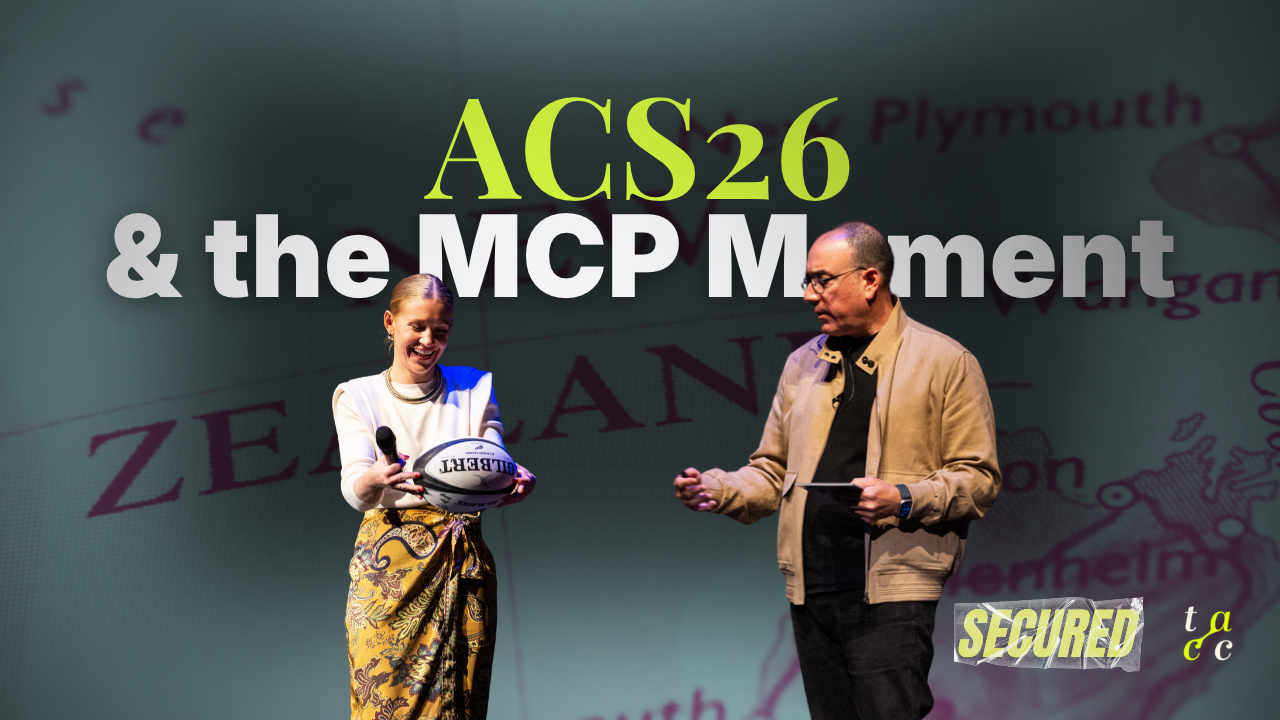
Secured: Episode 36
Lee Odess and Hilary Gallagher are back from ACS26 in New Zealand with a look at the conversations and industry shifts that stood out. They share highlights from a week built around community and local culture, then explore the growing gap between companies adapting to change and those holding on to familiar models. Plus, Lee breaks down why the security industry needs to rethink what “smart” really means, the latest moves from Ring, Apple, Rhombus, and Secure Passage, and why Genea’s new MCP server could signal a much bigger shift in access control. Listen here.
On September 29, Genea announced Genea MCP, a Model Context Protocol server that connects AI agents directly to its access control platform. On my flight home from ACS26 in New Zealand, I had the time to think about what it is, what it means, and what we should do about it. On the surface, it reads like a feature release. You can now say "give John access to the third floor" to the AI assistant you already use, and the system finds the location, finds the access group, asks only for what it can't look up, does the work, and tells you what changed. One sentence instead of a dozen clicks. I think it is much bigger than a feature release… I’m calling it a starting gun. Over the next 12 months, we are going to watch two things happen at the same time. On one side, a wave of MCP servers will come from access control, video, visitor management, and building systems companies, and a hockey stick of adoption and awareness will come from adjacent and mainstream markets. The "Already Theres" and the "Yeses" will move fast because their IT teams already live inside Claude, ChatGPT, Copilot, and Gemini every day (and they are tired of logging into 14 portals to do 14 small things). On the other side, you will hear an incumbent set of PACS defiantly telling you why you shouldn't trust AI, why you should question everything about it, and why "real security," you know, "enterprise security," requires a human clicking through their software. That message will find a very receptive audience in the large group of "Nevers" and "Maybes" in our industry. Both groups will be partially right. Only one of them will be playing in the right market. This is the clearest example yet of the difference between companies with a $100 billion mindset and companies optimizing for the $10 billion high-security market. So what is an MCP server, and why does it matter so much? The simplest way I can explain it is this. An API lets one piece of software talk to another, but a developer has to write the code to connect them. An MCP server lets an AI agent talk directly to your software. It publishes a menu of what the system can do (add a person, create a temporary credential, unlock a door, pull an audit report) in a way any AI assistant can read, understand, and act on in plain language. Think of it like a universal adapter. Before MCP, every AI tool needed a custom integration with every system. Now a company builds one MCP server, and it works with every major AI assistant on the market. That is why it is spreading so fast across enterprise software. Note: Google Cloud now turns its MCP servers on automatically when a customer enables a supported service, and governs them through the same IAM policies as everything else. That is what "default" looks like in the mainstream room. So what value does it create? I see four layers.
- Time. The obvious one. Onboarding, contractor access, schedule changes, and the endless list of tickets go from minutes of clicking to one sentence. Genea's own framing is that access control software has always made administrators learn the system, and MCP flips that.
- Reach. The person who manages access no longer has to be the person who knows the PACS. The IT admin, the HR coordinator, and the facilities manager all work from the tool they already live in.
- Orchestration. This is where it gets super interesting. An agent can work across systems in a single request. Offboard John in Okta, revoke his badge, cancel his visitor invites, and flag any door events from his credential in the last 30 days. That is four systems and one sentence.
- Questions. Most of the value sitting inside an access control system has never been asked for because asking was too hard. Who has access to the data center but hasn't badged in for 90 days? Which contractors still have active credentials after their project ended? The data was always there… the interface wasn't.
That last point matters more than people realize, and it raises the bigger question of where this is all going.
So, what does this mean in the Intelligence Era? For 40 years, access control's value proposition has been some version of lock, unlock, and keep the bad people out. Video records. Intrusion alarms. Each one sold as its own category, with its own vendor, portal, and buyer. We built an entire industry structure around those silos, and our trade shows still organize aisles around them. MCP quietly breaks that structure. When the primary interface becomes a conversation with an agent, the customer stops caring which silo the answer came from. They ask a question about their building, their people, or their risk, and they expect an answer and an action. The agent doesn't know (or care) that access control, video, and intrusion are "different categories." It just sees data and capabilities it can reach, and capabilities it can't. That is why I believe Security Intelligence platforms will treat MCP as a centerpiece of how customers interact with them, not as a bolt-on integration. The value of the system moves from "does it lock and unlock reliably" (table stakes) to "how much useful work can it do, how much does it know, and how well does it play with everything else the customer runs." Access control becomes infrastructure, and the intelligence layer becomes the product. This is also going to be a piercing point for a lot of marketing. I hear it every show… our video is the best, our analytics are the smartest, our camera has the most pixels. That conversation is going to matter less and less. If an agent can't reach your system, ask it a question, and act on the answer, then your beautiful video is a very well-lit silo. The new competitive question isn't "how good is your video?" It is "how good are you at intelligence and automation, and how far beyond the traditional value props can you take me?" Features are becoming bugs, and the interface is becoming the agent. (And yes, I see the irony that the companies with the most proprietary, closed, "you must use our client" architectures are the ones with the most to lose here.) So, what happens to the integrator? Configuration and setup are about to change immensely. Today, a huge share of integrator labor is programming: building access levels, schedules, and door groups; importing cardholders; mapping inputs and outputs; and then handling adds, moves, and changes for years after. In an MCP world, much of that becomes a conversation. The customer describes what they want, and the agent builds it, checks it against permissions, and confirms it. Commissioning starts to look less like keystrokes and more like review.That forces a sorting I think is already underway. On one side are the installers, companies whose real value is pulling wire, hanging hardware, and programming the panel. On the other side are true systems integrators, the ones who integrate systems beyond security (identity, HR, IT service management, building automation, the network) and sell the outcome. The installer's billable hours shrink. The systems integrator's opportunity grows, because someone has to design the agent workflows, set the guardrails, decide which actions need a human yes, and own the audit trail. (That is a managed service, and it recurs.) Note, and I repeat: this doesn't make the installer obsolete. Doors still need hardware, and hardware still needs hands. It does mean the installer competes on labor, and the systems integrator competes on intelligence, and those are very different businesses with very different multiples. Now, we should talk about the downside, because there are some and the "Nevers" aren't wrong about everything. They are wrong about the conclusion, not about the risks.
- The blast radius is physical. When an agent makes a mistake in a CRM, you get a bad record. When an agent makes a mistake in access control, a door is unlocked, or the wrong person keeps a credential. Natural language is ambiguous. "Give the contractor access to the building" can mean three different things, and the agent has to pick one.
- Prompt injection is real. Hidden instructions can trick an agent that reads email, tickets, or documents. If that same agent can unlock a door, the attack surface just walked out of the IT department and into the lobby.
- Credential sprawl moves to a new place. People connect MCP servers carelessly. GitGuardian found more than 24,000 secrets sitting in MCP configuration files on public GitHub this year. Our industry already has a Shadow Database problem with badges that never get deprovisioned. We could easily create a shadow agent problem on top of it.
- Audit gets harder before it gets easier. "Who unlocked the loading dock?" now has a two-part answer: which human asked, and which agent acted. Many systems aren't built to log that cleanly, and insurers, auditors, and regulators will ask.
- Skills atrophy. If nobody on the team knows how the system actually works because the agent does it all, you have a resilience problem the day the agent is down or wrong.
- Not every environment should do this. Federal, critical infrastructure, and parts of the high security market have legitimate reasons to say no, or not yet, and that is ok.
The credit I give Genea is that they built the controls first. Off by default, enabled per account and per role, inheriting the user's existing permissions on every request, and requiring a confirmation before high-impact actions like deleting a user or revoking access. That is the right pattern, and it should become the industry baseline. The answer to these risks is design, governance, and audit… not fear. The next question I usually get is, "Who wins and who loses as this accelerates?" I don't think it breaks down by company size or by hardware versus software. It breaks down by mindset, incentives, and demographics (sound familiar?).The likely winners:
- Built for the $100B Era platforms. Cloud-native, API-first companies that treat MCP as a front door, not a science project. Genea is early here, and others will follow quickly.
- Identity and IAM-adjacent players. If the agent is the new interface, the identity layer that decides what the agent can do becomes even more valuable. This is the Identity Ownership Thesis playing out in real time.
- Integrators of the Future. The ones who sell outcomes, workflows, and managed intelligence rather than door counts. They will build agent workflows for customers and charge for it.
- Companies with clean, open data. The more an agent can read and act on, the more useful the system becomes. Data quality turns into a competitive advantage.
- The IT buyer. They finally get a security system that works like the rest of their stack.
The likely losers:
- Legacy Incremental vendors with closed, on-prem architectures (even if you use a VPN) who will spend the next two years explaining why AI is dangerous instead of building the guardrails that make it safe. That is Sailing Ship Syndrome, and it will sound very convincing at trade shows, on industry stages, and in interviews.
- Companies whose value prop is the interface. If your differentiation is a better screen, the screen is going away.
- Single-silo point solutions in video, intrusion, or visitor management that an agent can't reach or that can't contribute to an answer.
- Integrators whose margin depends on administrative services (adds, moves, changes, and service tickets). An agent just took a lot of that work.
Another sorting is happening underneath all of this, at the hardware layer. Truly open controller platforms (not just most integrated), locks, and cameras already let software companies show up without building their own hardware. I expect we will see more hardware manufacturers working directly with new software companies that don't look anything like a PACS by the definition we have used for the past 30 years. Some will be identity companies, some workplace platforms, and some AI-native startups whose "access control" is an MCP server and a controller partnership. That is the Platform Squeeze in action. That means the traditional PACS category splits three ways. Some move up the stack and become platforms, with intelligence, automation, and agent access as the product. Some go out of business or get acquired for their dealer channel and install base. And many will live off their install base for a long time, collecting service and license revenue from customers who aren't moving. That last group will look healthy for years… right up until it doesn't. To be fair, the $10 billion high-security market isn't going away. Some customers will never want an agent near their doors, and companies will build good businesses serving them. Not every company needs to chase the $100 billion conversation. The mistake is pretending the high-security room is the whole house, and telling adjacent and mainstream buyers they are wrong for wanting what every other part of their business already has. Genea's announcement won't be the last one. By ISC West, I expect we will see a wave of them, followed by a wave of panels warning us about them. Watch who builds the guardrails and who builds the fear. The "Already Theres" are already there. The question is whether you will be.

As I sit at the Auckland airport waiting to board my flight back to the States, I have a lot of feelings. One is tiredness, with a side of anxiety about the very long flight ahead of me.
The other, and the one I’d rather sit with, is gratitude.
There are plenty of things I love about putting on ACS, but the thing that takes the cake is watching people genuinely enjoy themselves wherever we’ve landed. They bring their families. They show up for extracurricular activities. They go home with stories that have very little to do with the agenda.
Every year, one theme comes through louder than the rest: leaning into the local culture. I think I like it so much because I’m learning right alongside everyone else.
Is a light breakfast normal here? Is lunch something you grab on the go, or do you sit down and enjoy it for an hour or two? Is a drink at 3pm acceptable?
I still remember telling the SALTO team, our city hosts in Spain last year, that we were planning to start dinner at 5pm. “Five?! That’s so early!” Looking back, I probably should have allowed more time for lunch, too. Turns out, you can’t squeeze everything into an American schedule.
When Gallagher asked if we wanted to serve drinks during the afternoon break, our response was basically, “I don’t know. Is that what you’d normally do here?”
That’s the point. We want to learn how they do things, rather than bring our usual routines with us.
Think about how many conferences you’ve attended where you barely remember what city you were in. Airport, hotel, conference room, repeat. You could be anywhere.
I don’t want ACS to be that.
This year, Gallagher Security was our host in New Zealand. Our welcome reception was held at the home of Sir William and Lady Judi Gallagher. We put everyone on a coach from Auckland to Hamilton instead of sending them off in separate cars. And we ended the week with a boat ride to Waiheke Island and an evening at a vineyard.
None of those things needed to happen that way. But each gave people an opportunity to experience something together and have conversations they probably wouldn’t have had in a conference room.
It's funny, because the three takeaways I shared on stage at the end of our main day were really about the same thing.
The first was culture.
One of my favorite parts of ACS is learning about a company’s culture. Where they’re from, who their people are, and what makes them who they are. Gallagher opened our main day with kapa haka, and I think it told us something about who they are before they ever had to say a word.
The second was storytelling.
I found myself paying the most attention to the people who told stories. And when I think back on the sessions, those are the ones I remember.
Everyone in that room has stories. Every company has stories. But how often do we actually tell them? We spend so much time talking about what we do that sometimes we forget to share how we got there or why.
The third was trust.
Trust came up in almost every session. And I don’t think that’s a coincidence.
When someone shares a real story, especially one that requires a little vulnerability, you learn something about them. You start to understand the person, not just the company they represent.
And maybe that's why I care so much about getting people out of their usual environments. Nobody knows all the local rules. People ask questions, laugh at themselves, try something new. The titles matter a little less, and the conversations become more personal.
Six months from now, you might not remember every discussion from the main day. But you’ll remember who you sat next to on the bus, who you shared a meal with, or who you spent an afternoon talking to on a boat. Those are the people you feel comfortable picking up the phone and calling.
They're calling my row now, so I'll wrap this up.
I still have a lot to learn about how things are done in different parts of the world. But I think that's part of why this works.
And I'm still curious about that 3pm drink.
Somewhere in the early 2010s, “there’s an app for that” became the answer to almost every product problem.
Access control followed the trend. We took something physical and translated it into a smartphone interface: instead of a key, you could open an app, find the right door and press a button. It was a logical first step, but it was also a little strange.
A mechanical key is a remarkably elegant interface. It is tactile, immediate and requires no visual attention; you know where it is, you know what it does, and the physical action of using it is directly connected to the result. The smartphone introduced something very different: authentication, screens, navigation and software sitting between the person and the door.
We didn't necessarily make access smarter. We made it connected. And those are not the same thing.
The real opportunity is to ask a different question: rather than giving people more ways to tell a door what to do, what if the door could understand what is happening around it?
The better question isn’t how to give people more ways to command a door. It’s whether the door should need commanding at all. With intelligence built into the doorway itself, it can read the situation: someone approaching, someone just passing by, someone who means to come in, and respond instead of waiting to be told.
This isn’t about making every door touchless, or removing deliberate choice; sometimes a credential or a button is exactly right. It’s about making the interaction fit the moment: technology that steps in when it should and disappears when it shouldn’t.
Perhaps the best interface for a physical object is one you don't have to operate at all.
We spent the first generation of smart access putting the door into our phones. The next generation should make the door intelligent enough to understand us.
Why door entry retrofits deserve more thought than simply covering up what's already there.
Would you tape your new smartphone to the back of your old phone and call it an upgrade?
Probably not. So why do we accept the equivalent when it comes to the front doors of people's homes?
Having worked in the door entry industry for more than 37 years, I still see installations where new panels are fitted over existing ones, or large metal plates are used to cover the original openings before a smaller, one size fits all panel is fitted. The result can be exposed frames, uneven finishes and awkward proportions, leaving the entrance looking more like an afterthought than a properly considered upgrade.
What makes this more noticeable is that I regularly see examples of these installations being shared on social media, particularly LinkedIn, by both installers and manufacturers. I often find myself wondering whether we have become so focused on getting new technology fitted and operational that we have lost sight of the importance of the finished result.
If we're proud enough of an installation to share it publicly, shouldn't we also be confident that the quality of the finish reflects the standards our industry wants to represent?
Technically, the system might work. But is that really enough?
The entrance sets the tone
A door entry panel is often a visitor's first point of contact with a building. Before they enter the lobby or meet a resident, the entrance has already made an impression.
For residents, it is more than a piece of equipment. It is part of their home, something they use every day. The way it looks and functions contributes to their experience of the building and the pride they feel in where they live.
Shouldn't that deserve a little more consideration?
Retrofit shouldn't mean compromise
I understand the pressures facing housing providers, installers and building owners. Budgets are tight, existing infrastructure can be complicated, and replacing a door entry system often means working around cabling, apertures and architectural features that were never designed for today's technology.
Retaining existing infrastructure can make excellent financial and environmental sense. A well-planned retrofit can reduce waste, avoid unnecessary building work and extend the useful life of equipment that is still fit for purpose.
But there is a difference between working with an existing building and simply covering up its limitations.
A good retrofit starts with understanding the property and designing a solution around its existing opening, materials and requirements. Depending on the project, that might mean adapting the design or producing a bespoke panel or surround rather than relying on a standard panel and a cover plate to fill the gap.
This isn't about making every installation expensive. It's about planning properly so that cost savings don't come at the expense of the finished result.
Pride in the finished result
At Videx UK, we take pride in our solutions and the name associated with them. For me, that pride extends beyond the technology itself to the quality of the installation and how it looks when the job is complete.
Achieving that takes collaboration. Manufacturers, specifiers, installers and the organisations commissioning the work all have a part to play. The decisions made along the way determine whether the final installation is simply functional or something everyone can be proud of.
And we shouldn't forget the residents. They are the people who live with the outcome long after the installation team has left.
Ask a better question
This isn't about replacing perfectly serviceable infrastructure for the sake of appearances. It's about recognising that functionality, cost and appearance can work together when a retrofit is properly considered.
The next time a door entry upgrade is being planned, ask yourself one simple question:
Would you be happy with that installation on the front door of your own home?
If the answer is no, perhaps it's time to rethink the approach.
A retrofit should be an improvement, not simply a new panel bolted onto an old problem.
Don't settle for bolt-on. Demand bespoke.
The latest debate surrounding Flock Safety is not really about licence plate readers or even facial recognition. It is about the steady construction of a surveillance ecosystem that is becoming more connected, more intelligent, and increasingly difficult to regulate.
Recent reporting by 404 Media revealed that while Flock Safety continues to state publicly that it does not and will not add facial recognition to its camera network, another surveillance technology company, VIDIZMO, has been promoting integrations that combine facial recognition, behavioural analysis, and other AI capabilities with data collected from Flock cameras. The story highlights a familiar reality of technological development: when one company draws a line, another often sees a commercial opportunity beyond it.
VIDIZMO reportedly told law enforcement agencies it could create a searchable platform integrating Flock data, body-worn camera footage, and other evidence sources, allowing searches by face, vehicle, or object. Its chief executive described facial recognition as “the way the world is going.” Whether such integrations are widespread today is almost irrelevant. The technology is feasible, and experience suggests capabilities that can be deployed eventually will be.
The significance of this development becomes clearer when viewed alongside earlier revelations about the scale of the Flock network. A joint investigation by WIRED and 404 Media into data recovered from a compromised Flock camera found that a single device captured approximately 1.6 million images and recorded around 50,000 vehicle observations in just twenty-one days. The system could also identify people, bicycles, vehicles, and licence plates, demonstrating that these platforms already collect far more information than many members of the public realise.
The real privacy issue, therefore, is not facial recognition alone. It is data aggregation.
Historically, surveillance systems were limited because information existed in separate silos. CCTV footage, vehicle records, body-camera video, and investigative databases rarely interacted. Artificial intelligence changes that equation. Modern analytics platforms are designed to merge datasets, identify relationships, and automate searches across enormous volumes of information. Individually, each dataset may appear manageable. Combined, they become remarkably powerful.
This raises an important question: would these developments be advancing so rapidly if the United States had comprehensive federal privacy legislation? Compared with Europe and many other democracies, the answer is likely no. The United States lacks a single national privacy framework governing the collection, retention, sharing, and secondary use of personal data. Instead, it relies on a patchwork of state laws and sector-specific regulations. That fragmented approach leaves considerable room for surveillance capabilities to expand before policymakers catch up.
In jurisdictions with stronger privacy protections, organisations deploying surveillance technologies are often required to demonstrate necessity, proportionality, transparency, and oversight. They must justify why data collection is required and show that less intrusive alternatives would not achieve the same objective. In much of the United States, those questions are frequently considered only after the technologies have become embedded in policing and public life. The result is a regulatory environment where innovation often outpaces accountability. The future risks extend far beyond facial recognition.
The first is pervasive location intelligence. As camera networks become denser and increasingly interconnected, it becomes possible to reconstruct an individual's movements across cities, states, or even an entire nation. Vehicle location data can reveal where people live, work, seek healthcare, practise religion, attend political meetings, or spend time with family and friends. At that point, the distinction between tracking a vehicle and tracking a person becomes largely meaningless.
The second risk is predictive surveillance. Technology vendors are already marketing behavioural-analysis capabilities to law enforcement agencies. As AI systems become more sophisticated, surveillance technologies may move beyond identifying what happened and begin predicting what might happen next. Such capabilities raise concerns about bias, false positives, due process, and the possibility that statistical predictions become substitutes for evidence.
The third, and perhaps most consequential, risk is comprehensive identity correlation. Licence plate readers, facial recognition systems, mobile-phone location data, body-camera footage, commercial data brokers, and social media platforms all generate information about individual behaviour. When those datasets are interconnected, they can create an extraordinarily detailed portrait of a person's life, relationships, habits, and movements. No single technology creates a surveillance society. The integration of many technologies does.
That is the broader lesson from the latest Flock story. Modern surveillance systems no longer need to contain every capability themselves. As long as data exists, another company can develop the missing layer of analysis, correlation, or identification. The boundaries established by one provider mean little when a wider ecosystem stands ready to combine and extend available data.
The United States now stands at a crossroads. It can continue allowing technology vendors and law enforcement agencies to define the limits of surveillance through innovation and market demand, or establish legal, ethical, and democratic boundaries before the technology matures beyond meaningful control. If policymakers fail to act, future generations may view this period not as the beginning of the facial-recognition debate, but as the moment society quietly accepted continuous monitoring. The technology is coming regardless. The real question is whether governance, accountability, and privacy protections arrive in time
👀 As Seen In the Secured Community 👀
👨🏻💻 Product & Solution Questions
Michael Stuer asked whether a single programming device could issue physical credentials across multiple access control systems, eliminating the need for separate encoders. Reply here.
Rodney Thayer asked what responses vendors give when questioned about post-quantum cryptography support on their product roadmaps. Reply here.
Scott Napier is exploring a 16-location NX Witness deployment using Milesight NVRs and asked the community for feedback on the hardware. Reply here.
📰 Industry News & Insights
Lee Odess shared his take on Genea’s MCP server launch and what it could mean for access control platforms, integrators, and the future of AI-driven security. He’s expanding on the topic in this week’s TSB.
Lee Odess also pointed to Kisi’s apparent move toward fitness operations, raising an interesting question about how companies evolve beyond their original markets.
🗯️ Interesting Topics
Lee Odess shared a recent Department of Justice case involving an alleged covert recording device at OpenAI, asking whether more proactive security systems could help identify insider threats, not just keep unauthorized people out. Read the announcement.
📅 Events
Lee Odess shared a preview of upcoming industry events, including SNG, Brivo Cloud Summit, ISC East, Honeywell Accelerate, and more ACS26 content.
Ellie Baldwin asked if anyone was attending MercTech next month in London? Reply here if yes!
📣 General
Lee Odess announced that a limited number of spots have opened up for MercTech 2026, with community members getting first access through James Coulson.
The October 19–21 summit in San Diego will cover AI and cybersecurity, Mercury’s roadmap, system modernization, and end-user priorities. Accommodation and meals are covered, with up to six CE credits available.
Interested? Contact James at [email protected] or +1 612 406 6175. Spots are limited.
Lee Odess congratulated Brian Karas on his appointment as CRO of ADRM. Brian will lead revenue across ADRM’s security consulting, managed services, and DEFENDER platform businesses, building on the growth strategy he helped develop as a consultant.
📲 Aliro
Jason hart congratulated the Aliro working teams, the Connectivity Standards Alliance, and the vendors and customers who helped bring the standard to life after Aliro was named one of TIME’s Best Inventions of 2026. A big milestone for the industry and a step toward more interoperable access experiences. Read more in TIME.

ACS26 was last week!
What an event. ACS26 would not have been the same without a Collective. This industry deserves once-in-a-lifetime experiences to connect, learn, and grow, and we fully intend to keep creating and facilitating experiences like these.
There is a lot to take away from this one. The people of this industry are ready to build together, get ahead of this new era of intelligence, and figure out what comes next. We can’t wait to share the recaps, full-length conversations, and highlights from the event with you!
A huge thank you to Gallagher for being our City Host and welcoming us to your beautiful home, New Zealand. Thank you to SafeTrust for co-hosting the Warm-up Happy Hour, and to ColorID for co-hosting the Waiheke Sunset Evening and helping us close out ACS26 in style.
And yes, we are already thinking about ACS27. Stay tuned.
🗣️ Your Voice Matters.
Share your feedback, suggest topics, and tell us what questions we should be answering. Help us shape future issues and contribute to the conversations that move the industry forward.
PS: I am sure some of you may forward this, but please do so sparingly and encourage others to sign up here: https://www.tacc.me/secured Thank you!