
Volume 13 | April 18, 2025
This Weeks Featured Articles & Media
Brian Karas | Off Grid Security
Have you ever considered the possibility of security equipment being battery-powered? Brian has, and he is here to tell you all about it.
Angie Barnes | The Superfan Effect: Transforming Loyalty into Sales Success
Would there be any success in business without the Superfan? See Angie’s insights on how the Superfan does not only exist in sports.
Clairvest | Clairvest ISC West Conference Takeaways
Read all about Clairvest as they dive into their insights and what they will be focusing on after ISC West in Las Vegas.
Find them all below!

A while back I wrote about how you can make pretty much any security device with an Ethernet port into a wirelessly connected unit with various Wifi or cellular/LTE/5G routers. In that article I mentioned that even when you are communicating wirelessly, you still need to consider the power side of the equation, which frequently means a wired power source. But of course, just about anything can be run from a battery bank, if you know how to configure and size that battery bank correctly. So let’s dive into some considerations around making security equipment battery powered for a predictable amount of time.
If you’ve looked at battery specifications at all you probably noticed a minimum of 2 specifications, the voltage of the battery, and a specification of mAh (milli-Amphours, for small batteries) or AH (Amphours, for larger batteries). Most people understand the Voltage rating pretty well, but the Amp Hours (AH) rating can be confusing at first.
There are many good tutorials on the internet for understanding things like volts, amps, resistance, etc. Many of them often use plumbing analogies. If you want to understand the basic concepts of electrical circuits better I’d suggest a simple tutorial like this one to start.
If we think of a battery like a bucket of water, AH would be the equivalent of the amount of water in the bucket. Bigger buckets hold more water, and if we have a drain on the bucket, where the drain is the equivalent of an electrical circuit, then you can see how larger capacities equate to longer run times. But that capacity is not free in terms of cost of physical size. We can’t just buy an insanely large battery, and even if we had the budget, it probably wouldn’t fit in the space allotted for most battery-powered systems.
All this means that we need to do some calculations to spec a battery array that can meet our needs and have a predictable run time.
Let’s expand the meaning of AH a little more, just in case you don’t have an EE background and didn’t read the suggested tutorial. Everything comes down to power, batteries store power, cameras and routers use power. In electricity power is expressed in terms of Watts. Watts are Volts x Amps. 12Volts at 2Amps equates to 24Watts. Cumulative power draw is measured in Watt-Hours (or, for larger applications like your monthly electric bill, Kilowatt Hours).
An AH rating for a battery gives us data on how long the battery is rated to supply power for. A rating of 100AH (100 Amp-Hours) essentially means that the battery could supply 100 Amps for 1 hour. Or 1 Amp for 100 hours. Or 20 Amps for 5 hours, or any combination of Amps and Hours that factor to 100. Well, mostly. While there is no hard and fast standard that forces AH ratings to be calculated a certain way, the most common method for deep cycle batteries is a 20 hour rating, meaning the number is derived from something the battery can sustain over a 20 hour period. There are 5 hour and 10 hour standards as well, and in some cases, regularly discharging batteries to the rated amount can shorten their lifespan. All this means that if we take our 100AH battery and pull 100Amps from it, it will probably last less than a full hour, and it will most likely be damaged to the point that it would lose a good amount of its capacity.
Choosing the right battery for an application comes down to picking the right voltage and Amp Hour specs. The voltage is almost always going to be 12V at the battery, so I’m going to use that for the examples here. You can get 24V, 36V, or 48V batteries, but if you already know that you are most likely beyond this simple tutorial.
How do we know how many amp hours we need? First, we need to know how much power our connected devices require. For this example, I’m going to use Vicon’s NEXT camera as the main example. You might think that this is a case where spec sheets will come in handy and give you the required detail, for example here is the relevant portion of Vicon’s spec sheet for the camera:
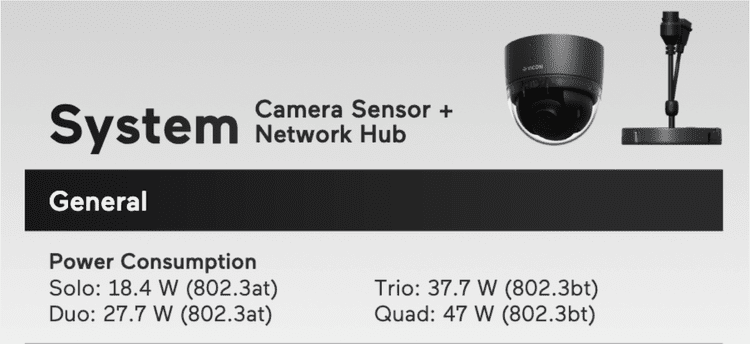
We see that a Solo camera config is rated at 18.4 Watts of power draw. If Watts is Voltage x Amps, we can also get to figure out how many amps 18.4 Watts at 12V equates to by rearranging the equation to be: Amps = Watts / Volts, or Amps = 18.4/12, which is 1.53.
Assuming a 1.53Amp draw, we could divide 100Amp Hours by 1.53Amps and get 65.36 Hours. This means our 100AH 12V battery could theoretically power this camera for 65 hours, not bad.
There is a slight problem though, in that we typically cannot trust spec sheets for these kinds of calculations. Vicon’s spec sheet, like most, lists a maximum wattage, not an average. In reality the camera uses much less power most of the time. In the below image, I have the camera and a small PoE switch hooked to a 12V power supply, with a power meter that shows me real time power draw, in this case 6.34 Watts. This meter also shows accumulated power usage in Watt hours (Wh) in the bottom right. Here I reset the meter roughly 24 hours ago, and I see over a 24 hour cycle the camera has used 156 watt-hours, which shows the camera and PoE switch together averaged about 6.5Watts continuously.
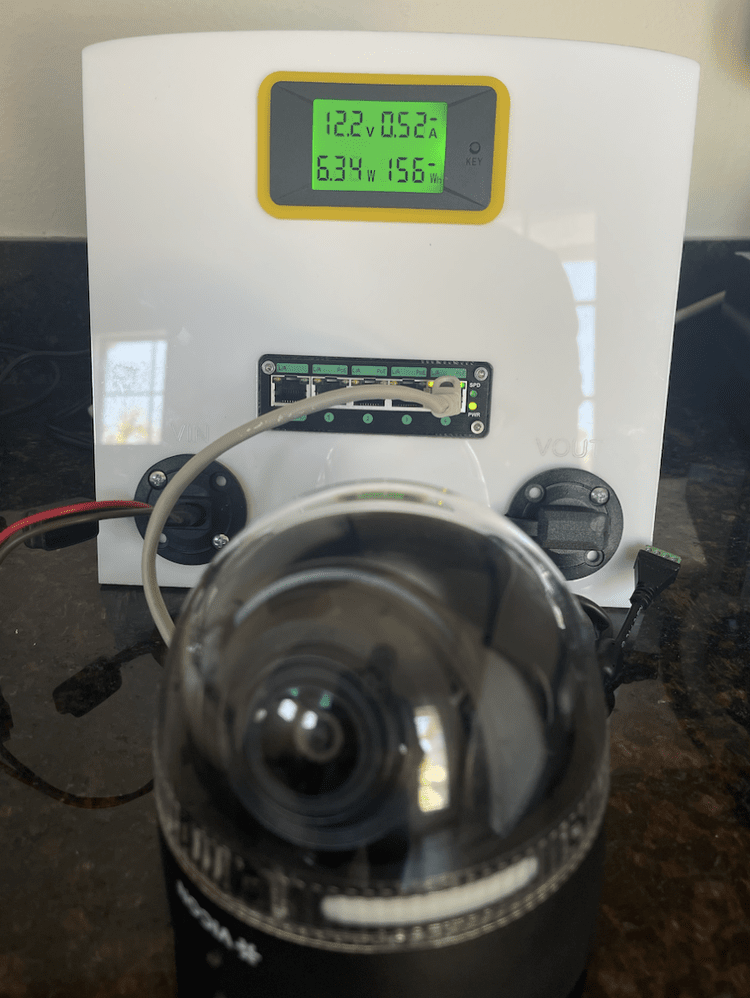
6.5 Watts at 12V is .54 Amps. 100 Amp Hours / .54 Amps = 185 hours. Now, my 100AH battery would power this setup for about 185 hours, or about 7.7 days, roughly a week. Much better than 65 hours, or 2.7 days.
All of these numbers only get more complex as you add routers, and speakers, and flashy lights, and other things to your battery powered setup. Trying to calculate battery needs from spec sheet data can cause you to wildly over, or under, estimate your true needs.
I use this power meter setup to get real-world data from equipment I plan to battery power, usually over a minimum sample time of 24 hours. It is important that you get your data in a representative scenario. If your camera has IR LEDs that come on at night, those will use more power, so you should place the camera in a location where it will get dark. Similarly, for LTE/5G routers, single strength (or lack of) can affect power draw.
Over time, I have built up a spreadsheet of stats for my go-to devices regarding power calcs. I’ll test this Vicon camera with it’s various features on and off, and then I’ll have a good baseline for future calculations.
Lastly, it is usually recommended to not discharge batteries too far. For lead-acid batteries, I usually derate the specifications by about 35%, so for a 100AH battery I’ll build out a system based around 65AH of actual use. For lithium/LiFePo4 batteries, I derate by about 20%.
Once you have accurate power draw data it becomes pretty easy to size your battery needs. If I have a camera, PoE switch, and router that collectively draw an average of 14 Watts (1.16 Amps @ 12V), and I want to provide enough battery capacity to run the kit for 48 hours, then I know I need 1.16Amps * 48Hours, or 55.68AH of usable battery capacity. If I’m using lithium batteries, then I upsize that to 55.68 / .8, or 69.6AH of actual battery capacity. Since batteries don’t come in granular AH sizing options, I’d look for anything rated at 70AH or higher, which happens to be a common size. Or, I might upsize to an 80AH battery to give me a little more margin of runtime.
A 48 hour runtime rapid deployment surveillance camera kit is great for monitoring a site for a weekend, but after the weekend the system is going to be dead. We can recharge the batteries with a generator, or a solar array, and we will get into those calculations next time to figure out how much power input we need to replenish a battery bank in a given amount of time.

We talk a lot about sports and momentum as we have just finished March Madness and are driving right into my favorite weekend of the year, The Masters.... My question to you would be, does any of them really exist without the Superfan? These are the fiercely loyal and dedicated fans that show up for games, events, with the painted faces, in freezing temperatures and rain delays, who travel city to city, because of their belief and deep loyalty exists for their teams and players. What does a stadium, course or arena look like without the fans? We got a taste of this during Covid, when they tried to continue to play but without allowing fans to participate. It was so sad, and it really changed the entire dynamic and the energy that we have all come to love when watching any sporting event. The superfan brings that not just to sporting events but also to the sales process.
At my new company, Evolon, we are working from a ground-up approach to building the brand, the product and the partnerships. As we build the excitement of what we are doing, we are looking to build a base of Superfan’s, who will be the ones that say “Hey, this is the best new product on the market, I need to show every one of my clients!” They can single-handedly change the course of your business, by being the super promoter of your product. Now, they must honestly believe it will benefit the customer and their company, but once they do, it’s magic.
Just remember, behind any successful sale, you will find there is a Superfan, who drives it through an organization and their book of business. You just start with one, because the Superfanin sales always wants to know what the other guy is doing to be successful. Once they see the energy and the success, they soon will want to get in line and follow. Momentum breeds momentum you see. Remember, a Superfan can also be a customer or prospect as well, the one that says, we need to use this company and product. They are your internal PR team that bring the value from the inside of the organization back through the sales process. Superfan’s can come in several forms, but the key is their belief and loyalty to the product, solution, and the company behind it. Once you have identified these fans in your customers, prospects, or salespeople, remember to reward their efforts by customer and channel loyalty programs, that shout, we appreciate you being a Superfan, let’s go build more business together. You will soon look up and realize that you have your own arena of fans to cheer on your company in the climb and scale to success you have been hoping for.


Clairvest met with 30+ leading innovators at ISC West. Our highlights and key takeaways are summarized below. Please reach out to Mitch or Daniel for a discussion.
-
Increasingly complex and disparate systems are elevating the roles of integrators
-
Software solutions across the security stack presents a recurring revenue for the channel and a challenge to master new technologies
-
Monitoring companies are poised to expand services along with advancements in video monitoring systems
-
Intersection of IT + OT expands the value proposition from “defense to offense” => revenue enhancement
-
Convergence of physical and logical security creates integrated NOC + SOC service offering
-
Innovators are harvesting data produced by physical security and PropTech to enhance business intelligence
-
Industry specialization is driving purpose-built solutions and enabling ‘separation from the pack’ in select end markets