Volume 15 | May 2, 2025
This Weeks Featured Articles & Media
Brian Karas | AI is Video Analytics
Surveillance video is a complex symphony of technologies—codecs, networks, storage, and now AI—all working together to turn raw photons into actionable insights. Just as AV1 is undeniably a codec and WebRTC a streaming protocol, AI is no longer optional in video analytics—it is the standard.
LMC Podcast | The Down Low with Joe
This podcast by LMC discusses major topics and shifts in the security industry today. This week, Lee Odess featured on the podcast to discuss his views on the evolution of this industry.
Angie Barnes | It’s the “pretend to stay calm portion of the month!”
End-of-month sales chaos isn’t destiny. Master your numbers and drive predictable progress, and suddenly the last day of the month becomes your easiest close, not your craziest.
The Access Control Collective X ZKTeco USA | The Future of Flexibility
Episode 2 of The Future of Flexibility, “Deep Dive Into Industry Trends at ISC West”, just dropped, and it features Manish Dalal, Sal D’Agostino, and Esteban Pastor.
The Access Control Collective | ACS San Sebastián
Join us May 28- 29th in beautiful San Sebastián, Spain, and be a part of the revolutionary conversations shaping the security industry.
Find them all below!

Surveillance video implements many cool technologies to enable us to help us prevent or solve crimes. If you think about the whole system end to end, we have cameras that take in photons, turn them into electrons, which are carried across a variety of networks, and come out the other end as photons from a monitor. Along the way these electrons might also get encoded into magnetic fields to be stored on hard drives, or in many cases now, stored as a captive electrical charge in a solid state drive.
We have descriptive terms for the various processes that make up a modern networked surveillance system. At a high level, video codecs handle encoding of what is by default a very high density signal from a data perspective into something that trades small data losses for easier transmission, commonly referred to as video compression. Examples of video codecs used over the years include MJPEG, H.264, H.265, and now AV1 is emerging as a codec standard (hat tip to Axis, and ipConfigure, among other companies, for leading the way on supporting AV1). No matter what mechanism or compression algorithm is used, we call these collectively codecs (sometimes capitalized as CODECs, for coder/decoder).
Once video is encoded, it needs to be moved across a network. This is where video transport technology comes into play. You may have heard of protocols like RTSP, RTMP, DASH, or WebRTC. Much like video codecs, they all have pros and cons, and some are broadly considered better (or worse) than others, or more/less modern, secure, etc. But they are all transport protocols.
When it comes to digitally storing video, once again we have a variety of solutions to the problem. From the media used (hard drive, SSD, tape archival), to how the data is structured and written to the media. And, as always, pros and cons, common approaches, etc.
Surveillance video ultimately exists so that we can see what is happening in real time, or so we can go back in time and review what happened. As the concept of video surveillance has exploded, most people would agree that we produce far more video than what is practical for humans to watch in real time, or to efficiently review in response to an incident. This is where Video Analytics comes in. Like the other technology components of a surveillance system, Video Analytics addresses a specific part of the equation, which is finding the most relevant or interesting bits of information in the video stream. Video Analytics is a general term for using software or technology to watch video so that humans do not need to.
Like everything else discussed so far, Video Analytics dates back to the earliest days of digital video (and in some cases, even to analog video). And also like the other technologies mentioned, Video Analytics has continued to evolve, advance, and incorporate new methods of delivering results for the part of the stack it is meant to address. If you’ve been following this segment of the industry for a while, you may have heard of things like “background subtraction”, “pixel motion detection”, or “scene calibration”. Most recently of course you have almost surely been hit over the head with use of the term “AI” as a mechanism for performing video analytics.
Much like AV1 represents the latest technological progress in video codecs, or WebRTC represents the latest mechanism for streaming video, and solid state drives are considered the most reliable and versatile video storage medium, AI is the latest approach to video analytics.
AI is video analytics. Trying to classify them as two completely separate and distinct concepts is as foolish as trying to say that AV1 is not a codec, or that WebRTC is not a streaming protocol.
From a broader perspective, AI, or more specifically Deep Neural Networks (DNNs), are being used to solve a wide variety of problems (and in some cases, creating new categories of problems). Video surveillance applications are but a tiny part of where AI/DNNs are being used today. When video surveillance, or even access control companies, say “We are using AI!” this is the equivalent of saying “we are using transistors!”. Of course you are, it is the obvious solution to advanced data processing in our current technological landscape.
This week, Lee Odess had the opportunity to feature in an episode of The Down Low with Joe, part of LMC. LMC is a specialist international talent consultancy committed exclusively to the Climate Technology sector. They work at the intersection of innovation and sustainability, partnering with forward-thinking organizations that are leading the charge in decarbonizing the built environment. The episode dropped on April 28th and dives into the intention of the security industry when it began, which was to keep the bag guys out. Today, it has completely shifted to the experiences of the users, major digital transformations, and the future of smart buildings. You won’t want to miss this. Major topics covered in this podcast include:
-
How access control is evolving beyond just “keeping doors locked.
-
Why mobile credentials, cloud, and biometrics are reshaping security
-
How Big Tech (Apple, Google, Amazon) is changing industry expectations
-
Why “platform thinking” is the new smart building strategy
-
How outdated incentives and legacy systems are slowing real innovation
The Down Low with Joe podcast, featuring Lee Odess, is streaming on YouTube, Spotify, and on LMC LinkedIn.

Here we are at the end of the month, and it is the age-old challenge of closing business in sales. Can I be real? The end of month kinda sucks sometimes! Laughing. That we even put ourselves in the position of having to worry on that last day about hitting our numbers and closing business. My career has been on counseling my team’s on how we can simply avoid the extra tum’s needed, the carafe of coffee, and the million emails and calls that will be done to try and hit those quota’s (Hate that word!) or forecasts we have supplied our partners in operations or leadership. Why does it have to be this way? Is there a superpower that we were not given to avoid these kinds of exercises in the world of sales.... I say YES! And my theory is how.
The easiest for sure is pipeline management, friends don’t ever forget sales is always a numbers game and will continue to be a numbers game! If your pipeline does not have at least 300 percent of your number you are looking to hit, you’re in some deep doo doo on trying to pull the magic rabbit out of the hat! Now, I have seen that happen, and even at the 2 pm cutoff on the day of close, but man, it was stressful, and in my opinion, unnecessary, when we focus on one, the numbers of and value of the opportunity, and two, the stages of progression of the sales in your pipeline. An example would be if your numbers look amazing in your pipeline, but they are all leads and early in the sales process, those numbers have not developed for you to hit that goal. If you have done a great job of having the number of opportunities in the early stages, with ones that are in design, scope of work, and then negotiations, then you are cooking with gas! Boom. Your mix of stages and where they are at, with the combination of value of those numbers, will lead you to a much better outcome. Also remember, the larger the opportunity, the longer the sales cycles, so as we always say in sales, you need singles, doubles and then the homeruns! Have that strong mix to help close those numbers often and successfully. Last but not least, in your pipeline you may also have opportunities you can move forward a month in advance when needed. If you have a steady eddie customer, there should always be room to move things forward with the customer’s consent, as your last resort. If you manage this well, this will certainly help with your end-of-month success.
Another way to finish strong, and avoid the end of the month crazy times, is to Always Be Closing, or ABC we used to say. Mini closes are probably the most important, how you are moving your opportunities through the sales process in such a way that the expected close becomes a very natural part of the sale. You have done your discovery well, created a strong ROI and solution, and then created a timeline that the customer wants and expect to deliver that. Now, its not always easy, but it certainly creates, as my good friend Ainsley Close, with Guardian Security shared with us at the Brivo Global Summit, predictable success and sales. I loved this term, and she is spot on with it. You must have the right product, right process, and right support team to employ that predictability. It can certainly happen, but you need to make it a priority and not wait till the end of the month. The predictable sales are the best sales, and one that says you have delivered true value to the prospect or customer to close out of the opportunity. Think about how you start your prospecting and pipeline build with that mentality,and it will lead you to a much better outcome, and happen throughout your month. This will help you avoid waiting on the commission breath at the lastday, with hope and a dream! Laughing. Keep swinging but make it into something that helps your stress levels, your managers’ stress level, and your customer from getting those last minute emails and frantic calls to rein in the close! Pipeline management and predictable success, make a last day of the month, your favorite day of the month!
The Access Control Collective just dropped Episode 2 of The Future of Flexibility, a dynamic 3-month podcast series created in partnership with ZKTeco USA. Broadcasting live from the buzzing show floor at ISC West in Las Vegas—right from the heart of the ZKTeco USA booth—this episode dives deep into the rapidly evolving world of security technology. Join host Lee as he sits down with Manish Dalal, Sal D’Agostino, and Esteban Pastor for a candid, insightful conversation about the trends, challenges, and innovations shaping the future of access control. From emerging standards to real-world applications, this episode is a must-listen for anyone keeping a pulse on the security industry. In this episode, they unpack the key trends redefining the future of access control:
-
OSDP is becoming the new industry standard
-
Strategic choices around mobile credentials and supporting infrastructure
-
Biometric-ready, multi-tech readers enabling real-world adaptability and flexibility
Watch the episode here on YouTube.
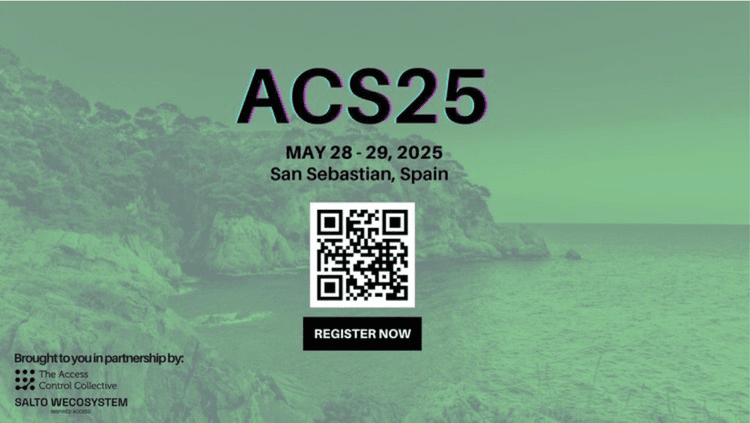
We launched this conference with a clear purpose: to give the industry the bold, unapologetic voice it truly needs. For too long, the conversation around innovation and progress has been stuck in a loop—an echo chamber of technical jargon and safe, sanitized talking points. We've seen a rise in corporate groupthink, where originality is stifled and genuine thought leadership is replaced with buzzwords and empty platitudes. This event is our answer to that. It's a space where real ideas can be shared without filters, where challenging the status quo is not just encouraged but expected, and where authenticity cuts through the noise. We're here to provoke, to inspire, and to reshape the conversation—because the future of this industry depends on it.
Join us May 28- 29th in San Sebastián, Spain. Register here.