Volume 20 | June 6, 2025
This Weeks Featured Articles & Media
Tony Dong | How to Hedge Your Single Stock Investments
The best hedge is proper position sizing, but tools like inverse ETFs or option collars can manage risk more precisely. Using Honeywell as an example, the author shows how to protect against market or company-specific losses while trading some upside for downside protection.
Mike Niola | Designing for Dignity and Safety: Rethinking Security in Youth Service Facilities
Effective security in youth service facilities should protect without feeling punitive, blending seamlessly into the environment to support safety, dignity, and development. Instead of relying solely on barriers and surveillance, thoughtful design and smart technology create spaces that foster trust, healing, and human connection.
Taylor Topper | Trade shows aren’t broken—but how we show up to them might be
Companies need to show up with intention, not just hardware and banners. With small, strategic shifts focused on engagement over exposure, even modest booths can create memorable brand experiences.
Kevin Spagone | Medium Awesome: Using Job Descriptions, Scorecards and making hiring decisions based on data…mostly.
Job descriptions outline responsibilities, but scorecards define success through measurable outcomes, helping align expectations and reduce bias. By combining both tools, organizations can hire more effectively, focusing on performance, culture fit, and real business impact.
Angie Barnes | What does Bluebell Ice-cream have to do with Proactive Monitoring?
Proactive security, like not buying ice cream to avoid temptation, prevents issues before they happen. Tools like access control and AI monitoring help protect people and property smarter, not just reactively.
The Access Control Collective | PhySecJobs.com
Below you will find all of the latest jobs in the physical security industry.
Find them all below!
When people ask me about hedging, I always start with this: the best hedge is position sizing. If you’re overexposed to a single stock, no amount of financial engineering will truly save you.
Sizing appropriately means allocating only as much capital as you're willing to lose without it compromising your overall portfolio or risk tolerance. That’s the cleanest, cheapest insurance there is.
The next-best hedge? That’s the “perfect” one, but it doesn’t exist. I explained why in a recent LinkedIn post, but for posterity:
“Everyone wants a hedge that pays them, protects downside, has no bleed, and moonshots in a crash. Congrats, you want a unicorn that farts gold bars.”
Until someone figures this out (and plenty of smarter people than me have tried and blown up a fund), you’ll have to pay for hedging. But there’s a smart way to go about it.
To illustrate, let’s use a fan favorite among industrials: Honeywell (HON), a soon-to-be broken-up industrial conglomerate that some of you may own.
Hedging Systematic Risk with Honeywell
One reason to hedge Honeywell is when you’re not doubting the company, but rather trying to insulate yourself from broad market risk. That’s systematic risk: the stuff that drags down even solid companies when the entire market sells off.
Bad inflation print? Hawkish Fed pivot? Surprise tariffs? Doesn’t matter. If the S&P 500 drops, HON will likely too. So how do we go about achieving this?
Let’s say you hold $10,000 worth of HON stock. Since HON has a beta of 1.06, you’re effectively holding $10,600 of S&P 500 exposure. To hedge that, you want something that moves opposite the S&P 500.
The capital-efficient way to do this is via a -3x inverse ETF like SPXU. Each dollar of SPXU provides -$3 of S&P 500 exposure. So, to hedge $10,600 of systematic risk, you’d only need to buy about $3,533 of SPXU. Simple as that.
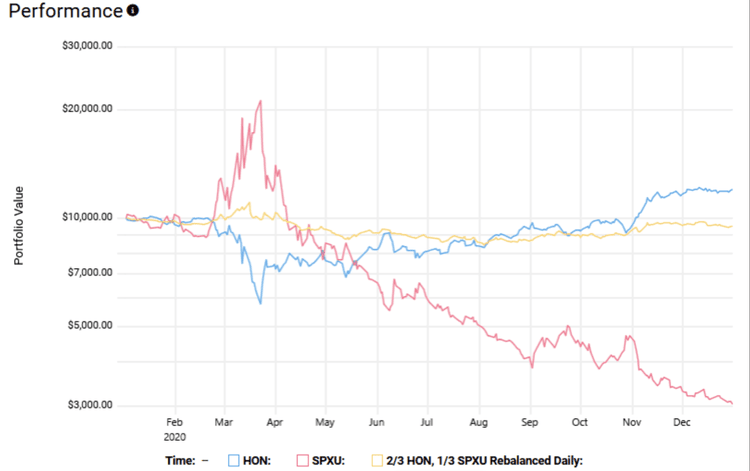
These ETFs are easy to trade, require no margin account, and let you dial in your hedge with minimal capital. When you hedge your $10,000 HON position with $3,533 of SPXU, your portfolio dynamics change:
-
If the market tanks, say in a sudden shock like COVID in March 2020, SPXU will rise sharply, offsetting the drop in Honeywell.
-
For example, if the S&P 500 falls 10% in a day, SPXU is designed to rise 30%. That means your $3,533 position becomes ~$4,593—a ~$1,060 gain.
-
Meanwhile, HON drops roughly 10.6%, taking your $10,000 down to ~$8,940—a ~$1,060 loss.
-
Net result: You’re flat. You’ve neutralized the market's blow.
-
-
If the market rises, the opposite happens. SPXU drops sharply, and you lose money on the hedge, while HON gains.
-
But here's the key: your HON stock goes up more than enough to cover the loss on the hedge. You still make money, just less than if you had gone unhedged.
-
This is the price of protection. You sacrifice a little upside to avoid big downside. But what if your concern isn’t with the market, and more to do with Honeywell itself?
Hedging Idiosyncratic Risk with Honeywell
Honeywell announced plans to break itself up into three companies: Automation, Aerospace, and Advanced Materials. The spinoffs are expected to happen sometime in the second half of 2026.
Historically, breakups like this can unlock value, but not always. Execution risk, tax complexity (despite their intention to make it tax-free), and post-breakup investor sentiment can create volatility. One or more segments might underperform, and you won’t know until it’s too late.
Maybe you want to stay long Honeywell, but limit the damage if the spinoff disappoints. And if the company performs well, you’d like to participate, though you may accept giving up some upside in exchange for downside protection. And since this is company-specific and not market-wide, an inverse ETF hedge isn’t ideal.
You therefore need to use options, which are financial contracts that let you buy or sell a stock at a specific price, by a specific date (in this case, June 18, 2026.
-
Put option (210P): Gives you the right to sell HON at $210 even if it falls far lower. That’s your insurance.
-
Call option (240C): You sell the right to someone else to buy HON from you at $240. That’s the trade-off where you cap your upside.
This setup is called a collar: long stock, long put, short call. It limits both downside and upside. As of May 23rd market close, HON trades at $222.03 per share. Assume you’re long 100 shares. To make this collar:
-
Buys a $210 put (protects downside)
-
Sells a $240 call (caps upside)
-
Net credit = $255, meaning you’re paid upfront
At expiration (June 18, 2026):
-
Max loss = $948 if HON closes at or below $210
-
Max gain = $2,052 if HON closes at or above $240
-
Breakeven = $219.48 after accounting for the net credit
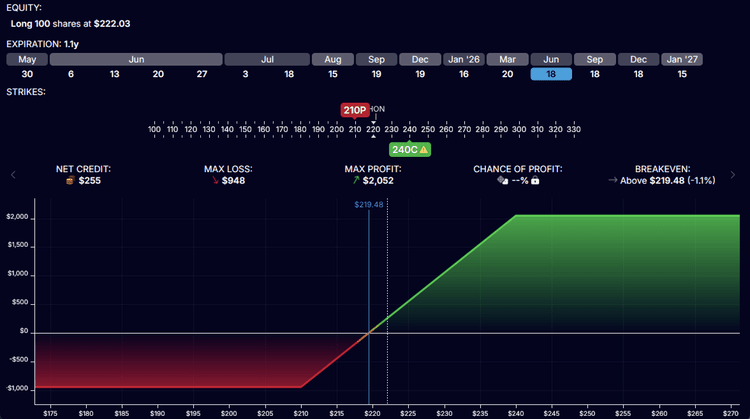
You’ve traded away potential upside beyond $2,052, but in exchange, you’ve capped your worst-case loss to less than $948.
This collar is perfect for protecting against Honeywell-specific uncertainty. If the market loves the breakup, your upside is capped, but you still gain. If the breakup goes poorly or any segment tanks, your floor is $210 no matter what.
And because you did it as a net credit trade, you’re not even paying for the insurance out-of-pocket. This is a textbook hedge against idiosyncratic risk. It protects your capital while letting you stay exposed to the potential reward.
Final thoughts on hedging
The best hedge is position sizing. If you're worried about a single name blowing up your portfolio, you’re already misallocated. Size your positions based on what you can afford to lose. This is the most effective and costless hedge there is.
The worst hedge is the one that doesn’t hedge at all, either because it’s poorly designed, mistimed, or misunderstood. Buying protection after a drawdown, holding the wrong instrument for the risk you're trying to mitigate, or trying to hedge without knowing what you’re actually afraid of—these are expensive mistakes.
The average hedge is one that’s too expensive or too blunt. A hedge that eats up return over time but only “works” during black swan events is like paying for flood insurance while living on a hilltop. You’ll resent the drag on performance every day until the one time you need it, and then maybe it still doesn’t pay out as expected.
For risk professionals, especially in roles responsible for access control, asset integrity, or mission continuity, the lesson here is simple: Know what risk you’re hedging. Is it systematic? Is it idiosyncratic? Is it operational, reputational, or financial? Then choose a tool that precisely matches the risk profile, timeframe, and exposure.
Every hedge has a cost, whether it’s paid upfront in premiums or hidden in foregone upside. But a well-designed hedge should give you confidence to remain in your position.
In the world of security consulting, we often focus on protecting people and places by building barriers, adding surveillance, and designing systems to detect and deter. But when it comes to youth service facilities providing supportive housing, transitional, or rehabilitative functions, that mindset doesn’t always fit. These environments aren't correctional facilities, yet they face unique security challenges. The young people they serve need guidance, care, and opportunity, not to be made to feel like inmates. That’s where a different kind of security design comes in.
As a security and technology consultant, I’ve worked on a range of facilities, from hospitals and behavioral health centers to educational campuses and transitional housing. One area I’ve grown increasingly passionate about is how to design security that doesn’t feel like “security.” Instead, it becomes part of the architecture, supporting safety while promoting dignity, development, and trust.
Understanding the Mission of Youth Facilities
Youth services facilities are incredibly dynamic. These environments are expected to provide:
-
Recreational programming
-
Vocational and educational programs
-
Residential or transitional housing
-
Communal amenities that promote socialization
-
Support services, including mentoring and counseling
-
Security infrastructure, without creating an institutional feel
In some states, these facilities are part of what’s called TAY Housing, Transitional Age Youth housing, designed for teens and young adults who are aging out of foster care, recovering from trauma, have been adjudicated in the juvenile system, are navigating complex behavioral health needs, or are otherwise considered vulnerable and at risk. These facilities walk a fine line: they must be safe and secure, but they also need to feel like home.
Security cannot be an afterthought, nor can it dominate the environment. Instead, the goal is to embed security into the experience of the facility in ways that feel natural, thoughtful, and affirming.
Security as Architecture: From Hard Barriers to Human Connection
One of the most important lessons we’ve learned through our consulting work is that you don’t always need more security equipment—you need smarter design. Many security issues can be solved with layout, sightlines, and human-centered planning rather than just technology.
For instance, because these facilities aren’t jails, doors can’t be locked in the path of egress. That means containment must be achieved through clear lines of sight, strategically placed mentor or security stations, and intelligent camera systems that detect unusual behavior—not just record it.
We often incorporate CPTED (Crime Prevention Through Environmental Design) principles, things like lighting, signage, landscaping, and visibility, not just for security, but for creating a sense of order, pride, and calm, which are also psychological drivers of behavior. You’d be surprised how effective a well-lit path and welcoming signage can be in deterring boundary-pushing behavior.
Landscaping, for example, can be used not only for aesthetics but to naturally guide movement and slow down potential exits. Lighting and art can make the space feel warm but also allow staff to maintain visibility and situational awareness. These are simple things that support both dignity and control.
Technology That Works with People, Not Instead of Them
We are often asked how much of the monitoring and control should be done through technology versus human supervision. My answer: let the technology do the tedious work so that humans can do the important work.
With modern video analytics, staff no longer need to spend their days glued to a monitor watching camera feeds. Instead, software can notify staff when someone crosses a boundary or lingers in a restricted area. This means that security officers and mentors can spend their time building relationships, engaging with the youth, and creating a supportive environment.
In cases where an individual presents a higher security risk, we can integrate wearable tags or fobs that alert staff if someone tries to leave the facility or enter unauthorized areas. These tools are used in behavioral health and memory care settings, and while not yet commonly implemented in TAY environments, they are always an option when thoughtfully applied.
But technology shouldn’t stop at surveillance and access control. It should also be used to create positive engagement. Digital signage, entertainment systems, and interactive learning environments show young people that they are valued. These elements can help make the facility feel modern and connected to the world they live in, especially important for a generation that has grown up with smartphones, streaming media, and constant connectivity.
The Role of the Security Consultant
What sets apart a great security design for youth facilities is the ability to think beyond traditional barriers and recognize the emotional and social context of the space. A security consultant who understands these environments works hand-in-hand with architects to:
-
Protect without oppressing
-
Monitor without isolating
-
Empower without enabling escape
The consultant’s role isn’t to just drop in cameras and badge readers. It’s to help program the space, to collaborate with mentors and behavioral health staff, and to ensure that every security decision aligns with the mission of youth development. That means asking questions like:
-
How does the layout support mentorship?
-
Where can we reduce the need for supervision by increasing natural surveillance?
-
What kind of security presence feels supportive instead of punitive?
When we approach these facilities as living, breathing environments, we design systems that support safety, therapy, and growth all at once.
Final Thoughts: Security That Supports Healing
We don’t often think of security systems as having the potential to heal—but in youth services, they absolutely can. A child in one of these facilities is likely facing difficult circumstances. When they see that someone has taken the time to make their environment modern, welcoming, and safe—not cold, punitive, or institutional—they notice.
A well-designed youth facility can communicate a powerful message: You matter. We care. And you’re safe here. That’s what security and technology should be doing in these spaces—not locking people down, but lifting people up.
Trade shows aren’t broken—but how we show up to them might be.
You don’t always need a massive budget or flashy build to create meaningful engagement. Sometimes, small, strategic shifts are what move the needle—especially when you’re up against internal skepticism about whether you should be at a show in the first place.
Marketing is often handed a 10x10 booth, a tight budget, and a product lineup to squeeze in—then expected to deliver bold results. Sales wants leads. Product wants attention. Leadership wants ROI. And too often, the outcome is a booth filled with hardware, a pull-up banner, and a tablecloth that nobody wants to stand behind—or walk up to.
But the problem isn’t the table. It’s the lack of intention behind the experience.
Trade shows shouldn’t be treated like temporary showrooms. They’re an opportunity to spark curiosity, start conversations, and create a lasting brand impression. And that doesn’t always require a total overhaul—it just requires rethinking the default.
One example: instead of simply displaying our T1000 dispenser, we used it to hand out swag. People came over for a freebie and discovered they had to push a button to get it. That one interaction showed how intuitive the product was. It got them talking. And it gave us just enough time to start a meaningful conversation.
Not every visitor turned into a lead—but many walked away pleasantly surprised. And more importantly, they remembered the experience. They remembered the InVue name. That’s a win.
Trade shows should be about engagement, not just exposure. Connection, not just content. And when marketing, sales, and product align around that idea—it shows.
Do values align? Does the culture fit? What’s arbitrary? What’s with all of
the questions?? It’s all right there in the job description, right?
Responsibilities, experience required, technical acumen, education. Job
descriptions tell us what someone will do. Scorecards define what success actually looks like — with measurable outcomes. A scorecard tells us several critical things that a job description does not, especially around performance, expectations, and success criteria.
As anyone who has asked a teenager to empty the dishwasher knows- Logic isn’t like gravity...It doesn’t always win. Crafting job descriptions that accurately reflect the goals of an organization is clearly important but
matching them requires some alchemy that isn’t just based on intuition.
Stakeholders, hiring managers and anyone involved in the hiring process
should agree on a scorecard used in conjunction with a traditional job
description.
Crafting a scorecard will focus the interview on performance, it creates
consistency and reduces bias. I’m partial to the Topgrading/WHO Hiring
Method that aligns a few simple categories to create scorecards for
whatever role you’re hiring for:
-
Mission- A clear, concise statement of why the role exists- What
problem does it solve? What challenge will it address? -
Clarify “Success”: Outcomes/specific goals. Connect the hire to real
business impact and be sure it aligns with overall strategy. Identify
3–5 measurable, time-bound results expected from the role with a
target deadline -
Competencies (Behavioral and Soft Skills). Define 5–7 key traits or
behaviors required to succeed: Results-oriented, Cross-functional
collaboration, adaptability, etc. -
Compensation, Culture Fit & Values Alignment
Try benchmarking a ‘Model candidate’ (Use a REAL person...it can be
someone inside or outside of your organization)...We find this especially
useful when a few different leaders are crafting a description and it begins to morph into a ‘wish list’ or a ‘unicorn’. Tie the scorecard to top performers in your company- or currently with a close competitor you admire- so it stays rooted in reality.
Don’t get me wrong...It’s OK to push the limits. the Status quo is our
biggest competitor...but ask your stakeholders- Is your organization really
optimized to support someone who pushes that boundary? In her excellent book, Radical Candor- Tech executive Kim Scott address the important distinction between “rock stars” and “Superstars” and what it means for managing team growth. She identifies rock stars as those that are ‘solid as a rock’ and form the backbone of your team. The Superstars are those who you’ll be lucky to hold on to for long, and that’s OK...Truly progressive organizations require both types.
When interviewing, a candidate's value system often gets revealed when
discussing moments of change in their lives...Your organization is no
different. Critical hires are not necessarily static needs that can be
‘matched’ to two dimensional lists. The ‘perfect fit’ is as fluid as the day-to-day challenges that face your business.
What if I could prevent myself from eating that bowl of ice cream before I opened the freezer and grabbed the Blue Bell carton for my evening snack! Laughing. I know what you all are thinking. Uh Angie, that is called self-control, right? Yes, but also it might be helpful if I was proactive and never bought it to put in my freezer. That is thinking smart and preventing me from losing that self-control. Better yet, what if my Instacart app, flagged my checkout cart, with a “Not allowed to purchase” based on my settings I have established. My parental control for Bluebell Ice Cream, laughing. Well, it certainly would be proactive on my part, wouldn’t it.
I have shared a few times before the reason I joined Evolon was the fact that I felt the industry was making a shift to a proactive versus a reactive strategy when developing solutions. The goal would be to stop the crime before it happens. You are no longer as reliant on forensics and research once a crime happens, if you have the ability to prevent it. Most of us don’t even realize that proactive security has been in place for a long time…. It’s called Access Control. My dear friend Lindsay Martin-Nez at BadgePass, reminded me when I did her podcast last month, “Angie, geez (I added that!) that is what we have been doing all along, preventing access, therefore stopping a potential intrusion or access before it ever breeches the building, parking lots, etc.…. Areas that are restricted.” I was like, that is so right?? Access Control is the innovator of Proactive Security! Now don’t quote me on that since someone I am sure has already made that claim, but it is true. We are using Proactive security every time we walk into our office buildings, or use a code entry to open our garage, etc.…. Pretty smart huh! Lindsay, you are brilliant!
Well in saying that, if Access Control had a younger cousin, it might be cousin proactive video monitoring that is taking some lessons from Access Control. To create a world where we change the way we look at video and perimeter protection of our people and our property. Do you have a RING Doorbell? If you do, they use proactive video as well. Easy peasy, just turn on the perimeter functions, set up a schedule, sign up for virtual guarding, and every night when you go to bed, you just hit a button that says, I am home and it will let the Monitoring Center know, keep an eye out for my house where I have established the boundaries. Super easy and honestly, using the way over used term “Peace of Mind”, it does just that. When I am traveling, when I am home, etc.… I know now in an emergency, I just hit a quick SOS and I will get help quickly. Great stuff, isn’t it?
That is what we are doing in the industry, where the human guard is great when you get a best-in-class company, and you have a healthy budget. I don’t think people guarding is going to go away, I think they just need better tools to supplement their efforts, and AI Monitoring is that tool. It also allows the small guys, a better option, than when I leave my business at night, I will have video in case a break in. There you go, it’s the just in case plan, to buy the 15K VMS system just in case I need it. Now, forensics is important, so I am not saying it needs to go away, it just needs to work in conjunction with the other tools. Just like you need a fork, a knife and a spoon, they all serve different functions. As we continue to see our industry innovate and build these technology roadmaps, it will be important that we use all the tools for the best outcome. You can’t have a video system without a camera, right? It will be the same thing on monitoring your property and using AI for identification and triggers using the cameras as that smart tool to prevent a crime before it happens.
Restricting your Bluebell Ice cream, Access Control being the innovator of Proactive Monitoring and building your toolbox with all the right tools will lead to a solution driven roadmap. We all need to continue to drive our industry to excellence and strive to achieve in our own small patch of the earth. Sometimes the solutions have existed all along, we just need to recognize that and continue to drive that innovation car down the road.
Below are the highlighted jobs and companies this week.
-
Kastle is a leading provider of property technology solutions, protecting commercial real estate, multi-family residential, global enterprises, educational institutions, and critical government facilities. Every day, tens of thousands of businesses use Kastle’s state-of-the-art access control, video surveillance, visitor management, and identity management technology solutions to enable a smarter built environment.
-
Project Manager, Implementations - apply here
-
VP of Product Strategy, Multifamily - apply here
-
Service Technician II (Access Control) - apply here
-
Service Technician - apply here
-
Project Coordinator - apply here
-
Senior IT Solutions and Integration Engineer - apply here
-
Manager, Project Manager, Install and Service - apply here
-
Pre-Sales Security Systems Engineer - Access Control and CCTV - apply here
-
Project Engineer - apply here
-