
Volume 23 | June 27, 2025
This Weeks Featured Articles & Media
Tony Dong | Quiet Compounders: What the Market’s Best-Kept Secrets Have in Common
Some of the best-performing long-term investments aren’t flashy tech giants but boring, under-the-radar companies with disciplined capital allocation, strong reinvestment strategies, and management focused on long-term value, not short-term earnings. This approach, seen in companies like O'Reilly, Rollins, TransDigm, and Waste Management, highlights how consistent execution, smart acquisitions, and ignoring market noise can quietly compound wealth over decades.
Angie Barnes | What If Your Booth Was the One They Remembered?
Working a security tradeshow reminded me just how exhausting — yet rewarding — the hustle can be, even if my feet and back beg to differ. Despite the long hours, there's nothing like standing out, building connections, and knowing you made your presence count.
Brian Karas | AV1 > H.265?
Working a security tradeshow reminded me just how exhausting — yet rewarding — the hustle can be, even if my feet and back beg to differ. Despite the long hours, there's nothing like standing out, building connections, and knowing you made your presence count.
The Access Control Collective & acre security | Access The Future
In the latest Access the Future episode, host Lee Odess talks with CPO Sarah Rodrigues about platform thinking and how to move from legacy systems to future-ready solutions.
The Access Control Collective & RX & SIA | West to East
West to East is a podcast from the Access Control Executive Brief, RX, and SIA, connecting the energy of ISC West with the insights of ISC East.
The Access Control Collective | The ACS Recap
Every week, we will highlight insights, observations, and speakers from ACS 2025.
The Access Control Collective | PhySecJobs.com
Below you will find all of the latest jobs in the physical security industry.
Find them all below!

Let’s acknowledge the survivorship bias right up front. It’s easy to look back at the best-performing stocks and pretend there was a clear path all along. But here’s the thing: some of the top stocks over the last two decades weren’t in the Magnificent Seven or riding some hyped-up tech narrative.
They were boring businesses. Companies with no buzz, no flashy headlines, just a steady grind of compounding intrinsic value, often available at a reasonable multiple of earnings if you were paying attention and looked beyond the top holdings of the S&P 500.
Now, I’m not saying you should go out and buy these names today. Of the four highlighted in the chart below —O’Reilly (ORLY), Rollins (ROL), TransDigm (TDG), and Waste Management (WM)—I only own two, and neither are what I’d consider reasonably valued right now.
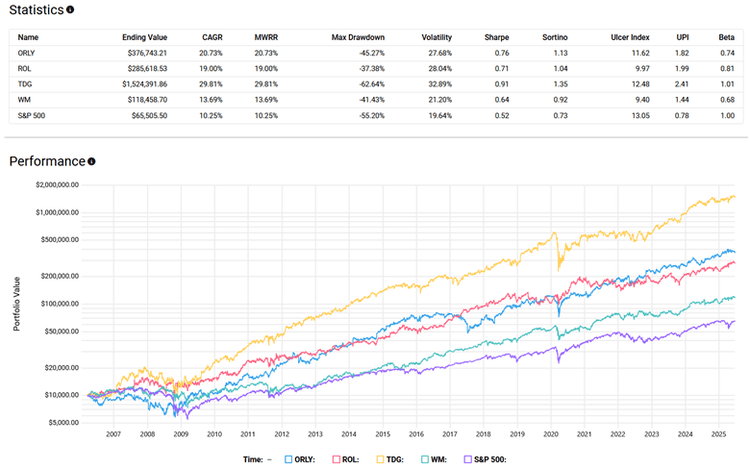
But the point isn’t about timing or specific tickers. It’s about principles. There are consistent, repeatable traits that show up again and again in the best businesses, ones you can actually go out and look for if you’re willing to do the work.
You don’t need to believe in some fantasy that markets are perfectly efficient and everything is fully priced in. That mindset is as delusional as people who claim we can’t recognize asset bubbles, which Michael Burry rightfully mocked as nonsense.
I’ll keep the jargon to a minimum and the numbers light. We’re not going to obsess over return on invested capital, the cash conversion cycle, or whether their operating leverage scales with top-line growth. That stuff has a place, but the bigger picture matters more.
Because when you zoom out, the best unknown investments share some very specific characteristics, ones that are surprisingly easy to spot once you train your eye.
Disciplined use of retained earnings
None of these stocks pay a dividend yield higher than the S&P 500 average right now. A couple don’t pay dividends at all. That’s not a fluke.
It’s by design. When a company starts paying a dividend, what it’s really saying is, “We don’t have any better ideas to do with this money right now.”
Management is tacitly admitting they don’t see a way to reinvest that capital internally at a return greater than the company’s cost of capital, so they hand it back to you.
Which sounds fine, except most investors then turn around and reinvest it right back into the same company. That’s asinine. If anything, you should be using them to deploy in new investments.
To be clear, dividends aren’t inherently bad. There are plenty of cases where they’re justified. One is exactly the scenario I just described, when internal reinvestment options dry up.
Another is when you’re in a structurally challenged industry that could vanish overnight. Take Altria Group (MO), for example, a tobacco company.
Their dividend payout ratio hovers around 80% of free cash flow. They do that because management knows the business model has an expiry date, so it makes sense to return most of the cash to shareholders while they still can.
But outside of those edge cases, if a company believes it can reinvest retained earnings at a high return, whether through organic growth, acquisitions, or even buying back its own stock at a discount, I want them to go for it.
And that’s exactly what these four companies have done. Not only do they retain the bulk of their cash flows, but they also consistently redeploy them with discipline and precision in one of two ways.
Tuck in and roll-up acquisitions
Take a company like McDonald’s. It’s a Dividend Aristocrat, it’s globally recognized, and it’s basically a blue-chip religion for a certain class of income investor. But today? It’s a stagnant, overpriced business with slowing real growth and ballooning debt, all in the name of “returning value to shareholders.” It gets harder every year to maintain that illusion.
Why? Because McDonald’s has already hit the limits of what mature businesses can do. They can hike dividends. They can buy back stock. But both of those draw on free cash flow, or worse, require borrowing. And that’s because the avenues for organic growth are tapped out.
International expansion is saturated. Domestic growth? You’re stuck with trying to increase same-store sales, which means either raising prices (tough when your customer base is highly price sensitive) or squeezing out more volume, which is capped by both demographics and rising operational costs.
Now contrast that with the four companies I mentioned earlier. Their industries and operating models are naturally built for bolt-on acquisitions. They’re constantly buying up smaller competitors, quietly, steadily, and integrating them with very little fanfare.
And because they operate in niche or fragmented sectors, they can keep doing this for a long time without attracting the kind of regulatory attention that, say, a Google or Amazon would provoke if they tried the same.
Let’s define some terms quickly:
-
A tuck-in acquisition is when a larger company buys a smaller, adjacent player, usually with minimal product or geographic overlap, and absorbs them to strengthen existing operations.
Think of Rollins, which owns Orkin. The pest control space is littered with small regional players, and Rollins methodically acquires them, folds them into the parent brand, and gains scale and market share without reinventing the wheel. Integration is fast and usually non-disruptive because the operations are already similar.
-
A roll-up is more aggressive. It’s when a company repeatedly buys up many small competitors in a fragmented industry, aiming to consolidate the market.
TransDigm is the textbook example. They’re essentially a holding company of aerospace parts suppliers, which are tiny monopolies within the larger aerospace supply chain. Each acquisition is niche, but together they form a highly specialized empire with pricing power and recurring revenue.
Now, are there risks? Absolutely. Executing a successful roll-up strategy requires top-tier management discipline. Cultural integration, pricing, supply chain coordination, all of it has to work. But when done well, this approach is a far better use of capital than endlessly juicing buybacks or doling out dividends simply to appease shareholders in the short term.
Because here’s the reality: when organic growth starts to stall—and it will—you need to either acquire intelligently or enter the slow decline cycle masked by financial engineering. The best quiet compounders figured this out years ago and built their playbooks around it.
The kind of management mentality required
And this brings us to the crux of the issue. Ever since companies started reporting how much money they made per rotation of the Earth—four times a year—investor expectations have been warped beyond recognition. Quarterly earnings turned corporate stewardship into a short-term popularity contest.
Today, most investors obsess over whether earnings per share (a highly manipulable number, by the way) rose by the exact percentage that some analyst predicted three months ago. And whether management’s forecast lines up with the next quarter’s whisper number.
None of this matters. It’s a distraction. Good capital allocation decisions don’t show up in next quarter’s earnings. They show up in the decade-long compound annual return.
I don’t care what happens over the next three months or the three after that. I care about whether the decision being made today adds value to the business five, ten, twenty years from now.
But when Wall Street, and by extension, shareholders start judging companies by short-term EPS beats, you better believe management will play along. That’s why you see buybacks and layoffs timed around earnings cycles. That’s why GAAP earnings get massaged into “adjusted” this and “non-recurring” that.
The best companies ignore that noise. The four we’ve been talking about run their businesses like they’re private. They don’t court the media. They rarely show up on CNBC. Investor presentations are minimal, if they exist at all. Some don’t even take questions on earnings calls.
They don’t care. Because they’re not trying to entertain you—they’re trying to build something that lasts. And that’s exactly the tone at the top you need to make bold, accretive moves. The kind of transformative deals Warren Buffett would call “needle-moving.”
You don’t get that kind of execution from a management team constantly looking over its shoulder at the next earnings report. You get it from operators who understand capital allocation, ignore the circus, and focus entirely on increasing the long-term intrinsic value of the business per share.

Oh my goodness, if you ever want to start to feel your age, just work at a security tradeshow booth for a few days! Lordy, I had forgotten how much energy is needed for the networking muscles, padded carpet and the 20-hour days that had dominated my younger days in the business. This week there were quite a few amazing shows on my radar, Expo Seguridad (Go SIA Startup’s!) in Mexico City, and the NRF LP Protect, where our team spent time in two amazing booths with great partners. The days were long and exhausting but if I was perfectly honest, the tradeshow hours were nothing compared to the 9 hours days I would work early in my career. But man, I am tired. In saying that, Angie was it worth it?
Heck yes it was worth it. My body might not say so today, but my mind and follow up list says, it was worth every minute of it. I know quite a few of the amazing tradeshow warriors at these shows, not because of any popularity, I have just showed up with them for years in a row trying to make the investment our company spent worth it. There were many times I admit the lemon was just not worth the squeeze, but we kept coming back.
Why did we always come back you might ask? That is a good question, there are times, that question is asked and answered with, I am not always sure but the fear of not showing up and NOT being seen might just be worse? FOMO, and I am not sure some years we made the right move with the gazillion dollar (exaggerating) investment of booth, people and entertainment. But we kept doing it, and hindsight being twenty twenty, we made nothing into something great most days. Angie, isn’t a tradeshow really about the hard work and prep you put into it? The amazing buzzworthy speakers, products or service with Hollywood set worthy booths. Your bound to have an amazing show, right? Those are all especially important, but it is also about the audience isn’t it. Whose attending, relationship bridges willing to be built and your delivery of our favorite term, WIFM, (What’s in it for me!) in 15 seconds or less.
How do you stand out in the crowd Angie Barnes and be that booth they get home, unpack the business cards, swag, etc. and go, I am putting them on top of my list for next steps. (As soon as I sleep a few days, laughing.) Years ago, I always wore this obnoxious chartreuse jacket, I called it my tradeshow jacket, and everyone knew how to find me at the show. There was a time I thought it was fashionable, then it just became a tradeshow thing, and I went with it. I also brought a Big Bertha Driver, and a bowl for business cards for a raffle to win and take that baby home. It was always a hit, and I would stand in the aisles and swing it to grab someone who was willing to talk to the lady in green. Smile. Guess what? It worked, and off I went to demo my safes, or talk about being the best darn security integrator in the universe. We stood out, we thought out of the box, we had a product that given a chance was one that would gain a call back once they knew and saw it. It takes some ingenuity, and the marketing teams that always stood in front of me made it happen, but you have to be committed to also creating the experience YOU bring and you alone.
It is changing, though, and trade shows are really going away in some fashion, and networking shows and events like my amazing friends at SIA and TalkLP (Shout out Amber Bradley!) are killing it and making that investment worth it every time. Getting old does provide some tradeshow wisdom I promise, like wear ugly Dr. Scholl shoes and remembering that every hour on a tradeshow floor deserves your best effort. You want them telling others go see the lady in the green jacket, with the “Big Bertha Driver”, and when asked the question, “What booth do you remember?” it’s always, Angie Barnes at Evolon. Onward!

Axis, which has historically been a leader in video surveillance, is pushing AV1 video encoding as a successor to current H.264 and H.265 video codecs. Will AV1 become the new standard in video codecs, and if so, when?
A Quick Background on Video Codecs
Over the years IP cameras have progressed through a number of standards for streaming video. The earliest cameras often used MJPEG, or some variant of JPEG streaming. Then H.264 came along in the early 2000’s, and was seeing widespread adoption by 2010. H.264 offered better compression, which meant reduced bandwidth and storage needs. Several manufacturers, including Axis, also developed forms of H.264 “smart codecs”, which offered increased compression. H.264 is/was a patented technology, but royalties were relatively low and easily managed, you paid a couple of dollars to the singular licensing body and things were good. Next, H.265 came about in 2014, with claims of even better compression, at a trade off of increased computational requirements, particularly for clients/decoders. But more importantly, H.265 has been a patent nightmare from the beginning. There are 3 separate licensing bodies you need to pay if you want to implement H.265, in many cases the fees can wind up being much higher than H.264, and in some cases can be less predictable. H.265 came about just as video streaming online was becoming popular, and the general consensus is that the H.265 patent holders were rent seeking.
Today, 10+ years after H.265 has been released, support for H.265 encoding (eg: in cameras) and decoding (eg: in browsers and software) is still mixed at best. In many cases H.265 implementations are clunky, or have various performance side effects that discourage use of the technology.
Why AV1?
The biggest thing AV1 has going for it is that it is not patent encumbered, it uses patented technologies, but they are typically offered license-free for most applications. This has caused most of the video streaming industry to adopt AV1, pretty much killing off H.265 in those applications. Lack of licensing also means that operating systems and browsers, for example, can include native AV1 support without worry of being sued or having to pay a fee for every download/installation.
From a video quality standing, AV1 is really no better, or worse, than H.265. Like any codec, much of the quality of the output is dependent on the implementation and other tuning, so you can find online examples that show AV1 being tremendously better, or completely worse, than H.265.
When Will AV1 Take Over?
Two main things are needed for any kind of encoding scheme to become widespread:
-
Widespread availability of encoders
-
Widespread availability of decoders
(hopefully you weren’t expecting a complex list there).
Item #2 has been solved for a while, Intel, AMD, and others have been shipping processors with native AV1 decoding for a few years now.
Item #1 has barely been addressed in the video surveillance market. Axis led the way here, advertising AV1 encoding support in their latest ARTPEC-9 chipset.
Video encoding is a fairly intensive task, the common approach is to make it a core part of the chipset, not part of the software/OS running on that chipset. What this means is that you’re not going to see AV1 support added to existing cameras via a firmware upgrade, it is going to need to be embedded into the chipset. In other words, if your camera does not support AV1 today, odds are it never will.
Ambarella, generally considered to be the preeminent supplier of SoCs for security cameras, still has not announced support for AV1 in their most recent shipsets. Hanwha also has made no mention of AV1 support in their latest Wisenet 9 SoC. This leaves Axis a bit alone in AV1 support, and it is worth mentioning AV1 was only added to Axis’ latest SoC, which is only in a very small number of cameras at this point.
IPConfigure has added AV1 support in their latest software, and it is likely other VMSes will follow, but it is hard to say how much priority AV1 support will be given.
This means it will likely be 5 or more years before we start to see AV1 starting to gain any widespread traction in security applications. There simply is not a lot of awareness, or demand, around AV1, and to the average user there is not a lot of obvious benefit, most people probably have no idea what codec is in use in their surveillance system.
Will AV1 Give Axis An Edge?
I think it will. Maybe not like a “massive unfair advantage” edge, but it does provide a slight advantage in terms of more widespread support, particularly for mobile devices, which are becoming a popular way for even enterprise users to view live and recorded video. If Axis manages to get specifications written around AV1 it becomes the kind of blocker that competitors can’t easily add with some quick software work, because it relies on the cameras having the right chipset at their core. So don’t be surprised when you see Axis beginning to hype this previously-unheard-of-in-security codec more and more as they expand their product line built on the ARTPEC-9 SoC.

Has your organization been relying on the same physical security system for over 30 years? You’re not alone—and this message is for you.
In the latest episode of Access the Future, host Lee Odess sits down with Chief Product Officer at acre Security, Sarah Rodrigues, to explore platform thinking—what it is, why it matters, and how organizations can transition from outdated legacy systems to future-ready solutions.
In this episode, they discuss:
-
Why legacy systems are still so common—and where they fall short
-
How platform thinking is more than a tech upgrade—it’s a shift in mindset
-
Acre’s approach: enabling transformation through smart integrations, not full rip-and-replace overhaul.
Tune in to hear Sarah’s insights in “Why Security Is Becoming a Platform, Not a Product.”
If you're navigating digital transformation in the security space, this episode is a must-listen.
Click here to watch the full episode.

Episode 2 of the West to East Podcast—presented by The Access Control Executive Brief and ISC Security Events—is live!
We’re connecting the dots between ISCWest and ISCEast, diving into real conversations about the trends, innovations, and people shaping the future of access control.
This month, Lee sat down with Mary Beth Shaughnessy and Trish Moubayed of RX Global—two industry leaders who’ve been shaping ISC West together for over 30 years.
They unpacked:
-
ISC West 2025 by the numbers (29K+ attendees and record-breaking conference growth)
-
Smart, strategic scaling
-
Why more end users and execs are showing up—and what that means for the industry
If you’re in security and want to understand what’s really driving impact at ISC, give this one a listen.
Click here to hear the full episode.
THE ACS RECAP

"𝑰’𝒎 𝒑𝒂𝒓𝒕𝒊𝒄𝒖𝒍𝒂𝒓𝒍𝒚 𝒊𝒏𝒕𝒆𝒓𝒆𝒔𝒕𝒆𝒅 𝒊𝒏 𝒕𝒉𝒆 𝒖𝒔𝒆 𝒐𝒇 𝑨𝑰 𝒕𝒐 𝒍𝒐𝒘𝒆𝒓 𝒕𝒉𝒆 𝒃𝒂𝒓𝒓𝒊𝒆𝒓 𝒐𝒇 𝒊𝒏𝒕𝒆𝒓𝒂𝒄𝒕𝒊𝒏𝒈 𝒘𝒊𝒕𝒉 𝒂𝒄𝒄𝒆𝒔𝒔 𝒄𝒐𝒏𝒕𝒓𝒐𝒍, 𝒔𝒐 𝒕𝒉𝒂𝒕 𝒎𝒐𝒓𝒆 𝒑𝒆𝒐𝒑𝒍𝒆 𝒄𝒂𝒏 𝒅𝒐 𝒕𝒉𝒊𝒏𝒈𝒔.”
That line stuck with me during my 1:1 at ACS25 with Marc Handels of SALTO WECOSYSTEM
Because it cuts to the heart of what we all talk about, but rarely act on: using technology to make things simpler, not more complicated.
Marc explained how Salto is applying AI, mobile credentials, and even facial recognition - not just as buzzwords - but as tools to actually make access control easier for the end user.
And more importantly, how they’re building powerful tech while opening it up for others in the industry to use.
That mindset (collaborate, integrate, and move the whole ecosystem forward) is what we need more of.
Want access to full sessions, recaps, and behind-the-scenes moments from ACS? Join the community.

Below are the highlighted jobs and companies this week. New jobs are bolded.
-
Acre Security - Material Master Data Specialist, NAM - apply here
-
Nedap - Key Account Sales Executive - apply here
-
ZKTeco USA - Sales Support Engineer - apply here
-
Ambient.ai - Field Engineer - Integrations - apply here
-
-
Product Manager, Credentials Technology - apply here
-
Pre-Sales Consultant - apply here
-
Firmware Engineer - apply here
-
Director, Product Management-Readers - apply here
-
-
-
Project Manager, Implementations - apply here
-
VP of Product Strategy, Multifamily - apply here
-
Service Technician II (Access Control) - apply here
-
Service Technician - apply here
-
Project Coordinator - apply here
-
Senior IT Solutions and Integration Engineer - apply here
-
Manager, Project Manager, Install and Service - apply here
-
Pre-Sales Security Systems Engineer - Access Control and CCTV - apply here
-
Project Engineer - apply here
-