Volume 26 | July 18, 2025
This Weeks Featured Articles & Media
Lindsay Martin-Nez | Virtual Badges or Physical Badges: Why Not Both?
In today’s security landscape, organizations no longer have to choose between physical and virtual ID badges—combining both offers a smarter, more flexible solution that enhances security, convenience, and adaptability across diverse environments.
Lee Odess | ASSA ABLOY’s Q2 2025
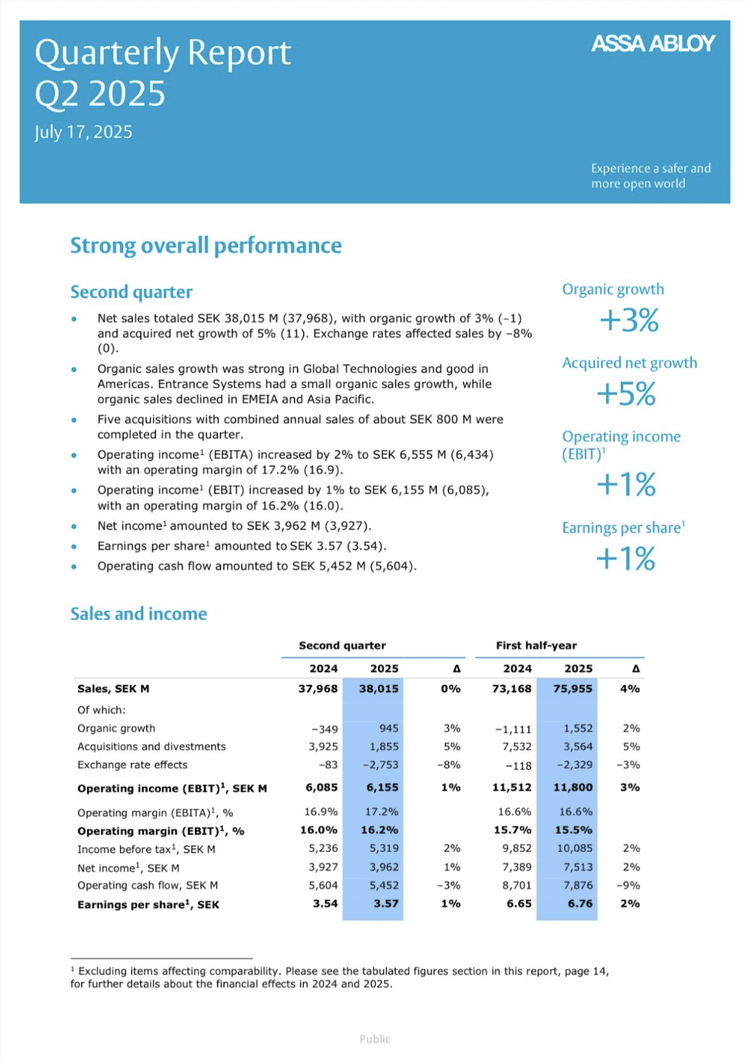
ASSA ABLOY’s Q2 2025 results show strong growth in Global Technologies and digital upgrades, but overall momentum is stalled due to flat sales, currency headwinds, regional weakness, and soft performance in Entrance Systems, putting pressure on recent acquisitions and digital initiatives to drive future growth.
Ivan Kravchenko | AI Regulations for Security Manufacturers
With the EU AI Act now classifying physical security as high-risk, any AI system making access or alert decisions must meet strict standards for transparency, human oversight, and accountability—shifting the focus from AI’s capabilities to how it’s actually integrated into security systems.
James Dice | Why Facility Maintenance Tech Fails—and How Engagement Design Can Fix It
Facility maintenance tech like CMMS often fails due to low frontline engagement, but applying gamification and behavioral design—borrowed from social media—offers a promising path to make these tools more habit-forming and effective.
The Access Control Collective | PhySecJobs.com
Below you will find all of the latest jobs in the physical security industry.
Find them all below!
Some debates just aren’t worth having.
Coke or Pepsi? Beach or mountains? Pineapple on pizza?
Virtual badges or physical badges? That’s a trick question.
Despite what security industry marketing might lead you to believe, you really don’t have to choose.
In the world of ID badging, we are officially past the point of this either/or debate. It’s not a question of virtual or physical. The smart move is combining both options and letting your badge issuance system work harder (and smarter) for you.
At BadgePass, we’ve always believed the badge is more than just a piece of plastic or a credential; it’s the foundation of a layered security approach that includes identity, access, and security. And no matter how much we love physical ID badges, we truly believe that organizations don’t have to pick sides.
Let’s break it down:
Physical Badges
Tried-and-true. Tangible. A visual representation of personal identity that works in almost every setting including schools, hospitals, corporations, government agencies, and anywhere else where it is helpful to see who someone is and confirm they belong – not to mention an opportunity to create a sense of community among team members and foster better recognition and engagement company-wide. With a quick glance, a physical badge can tell you (almost) everything you need to know including name, photo, role, department, certifications, and more.
Virtual Badges
Virtual credentials bring convenience, speed, and flexibility to badge issuance. Employees or members can use a badge on their phone as their identifying credential, carry fewer cards, and potentially even access doors.
But here’s the magic (and the part we seem to be leaving out of most conversations within the security industry): When you combine the two, and offer both physical and virtual badges, you create a solution that covers every scenario.
Let’s be real. Every organization is different. Some always need a visible ID badge, while others want the convenience of mobile. Truthfully, most facilities can benefit from both.
Combining physical and virtual credentials enhances security and simplifies the entire badge experience for both cardholders and system admins.
Whether you are a school issuing student IDs, a hospital managing multiple badge types for doctors, nurses, and other staff, or a corporation streamlining card access privileges across multiple locations, flexibility and freedom to choose the credential type that best suits your workflows and processes is the best way to future-proof your system.
Sure, this short article might have oversimplified things a little bit, and every scenario is nuanced in some way. But we’re more than happy to get in the weeds on this discussion with anybody who is interested!
ASSA ABLOY Q2 2025 Results
Original LinkedIn post by Lee Odess
🚨Breaking: ASSA ABLOY’s Q2 2025 results just posted. Here’s what they tell us:
Some strong points:
➡️ Global Technologies is leading the way with 8% organic growth and 18.5% EBIT margin.
➡️ Demand for electromechanical and digital upgrades continues to grow (up 12% this quarter).
➡️ Five acquisitions closed, including moves into senior care and access control hardware.
➡️ Operating leverage and margin discipline held up despite headwinds.
But flat total sales is flat. Foreign exchange hit hard at –8%, and we saw weak organic performance in EMEIA and Asia Pacific (both –1%). Operating cash flow dropped 3%, and Entrance Systems is soft with only 1% organic growth and lower margin.
The business is solid, but showing stalled momentum. Foreign exchange will weigh again next quarter, so growth from acquisitions and digital transitions needs to show up fast.
More to come in The Access Control Executive Brief Member slack.
Original LinkedIn post by Ivan Kravchenko
Physical security is officially marked as high-risk with the new EU AI Act.
That means if your system uses AI to make decisions on who gets in, what triggers an alert, and when to escalate, it has to meet some very clear standards:
🔹 Every decision needs to be logged
🔹 Someone needs to be able to review it
🔹 And a human must be able to step in and reverse it if needed
This shifts the conversation from what AI can do to how it is actually built into your systems.
We talked about this at TSE 2025 with Lee Odess — not in theory, but from what we’re seeing in the field. Take a moment to watch this part of the panel if you're building for Europe or anywhere regulation is catching up.
Keep an eye out, because I will soon be sharing a blog post called “Bringing AI into Physical Security Without Breaking the Rules.” I will drop the link here once it is live.
Original post by James Dice
Technology for facility maintenance has long struggled with engagement from the boots on the ground.
Platforms like computerized maintenance management systems (CMMS) promise a “single source of truth” for work orders and equipment data, but too often, the people doing the actual work barely use them.
That’s a huge problem for building owners spending money on these tools—if technicians aren’t inputting data, the system can’t reflect reality. The bigger problem is what this gap represents: ineffective maintenance programs leading to missed work, undocumented issues, and reactive repairs.
One Accruent survey found that only 39% of businesses consistently use a CMMS to track maintenance tasks (the rest resort to spreadsheets or even pen and paper). This low adoption means many preventive tasks fall through the cracks, contributing to growing maintenance backlogs and costly breakdowns.
There are some good reasons for this poor engagement:
1. 𝗙𝗿𝗼𝗻𝘁𝗹𝗶𝗻𝗲 𝗼𝗽𝗲𝗿𝗮𝘁𝗼𝗿𝘀 𝗮𝗻𝗱 𝘁𝗲𝗰𝗵𝗻𝗶𝗰𝗶𝗮𝗻𝘀 𝗮𝗿𝗲𝗻’𝘁 𝗴𝗲𝗻𝗲𝗿𝗮𝗹𝗹𝘆 𝘁𝗲𝗰𝗵-𝘀𝗮𝘃𝘃𝘆.
2. 𝗧𝗵𝗲𝘆’𝗿𝗲 𝗲𝘅𝘁𝗿𝗲𝗺𝗲𝗹𝘆 𝗯𝘂𝘀𝘆.
3. 𝗧𝗵𝗲 𝘀𝗼𝗳𝘁𝘄𝗮𝗿𝗲 𝗵𝗮𝘀𝗻’𝘁 𝗺𝗲𝘁 𝘁𝗵𝗲𝗺 𝗵𝗮𝗹𝗳𝘄𝗮𝘆.
In short, today’s tools have not been very user-centric for the people on the ground, so those people ignore them—and the hoped-for efficiency and data insights never materialize.
Now that’s starting to change. Gamification, AI, and behavioral psychology principles influence users to return frequently, spend more time on the platform, and even enjoy doing so. Vendors aim to make facility software “sticky”—something folks habitually use, not dutifully avoid.
If that playbook sounds familiar, it’s because it’s the same engagement strategy that consumer tech (especially social media) has mastered over the last 20 years. Social media platforms leverage gamification tactics like:
• 𝗟𝗶𝗸𝗲𝘀 𝗮𝗻𝗱 𝘂𝗽𝘃𝗼𝘁𝗲𝘀—instant feedback loops that trigger a dopamine hit in the brain’s reward center.
• 𝗙𝗼𝗹𝗹𝗼𝘄𝗲𝗿 𝗰𝗼𝘂𝗻𝘁𝘀 𝗮𝗻𝗱 𝗯𝗮𝗱𝗴𝗲𝘀—visible status symbols and achievement markers.
• 𝗦𝘁𝗿𝗲𝗮𝗸𝘀 (𝗲.𝗴. 𝘁𝗵𝗲 𝗦𝗻𝗮𝗽𝗰𝗵𝗮𝘁 𝘀𝘁𝗿𝗲𝗮𝗸 𝗳𝗲𝗮𝘁𝘂𝗿𝗲)—daily challenges that tap into our desire for consistency and fear of loss if we break the streak.
These techniques, as described by author Nir Eyal’s popular Hook Model, create habit-forming loops of trigger → action → variable reward → investment.
They cue you to engage, reward you in unpredictable ways that keep you guessing, and encourage you to put something of yourself into the system (time, effort, personal data) so you’re more invested in coming back.
Go deeper: https://lnkd.in/dVnQNRbV

Below are the highlighted jobs and companies this week. New jobs are bolded.
-
KIWI.KI GmbH - Mid-Level Fullstack Developer - apply here
-
Triton - Regional Sales Manager - Southeast - apply here
-
Acre Security - Material Master Data Specialist, NAM - apply here
-
Nedap - Key Account Sales Executive - apply here
-
ZKTeco USA - Sales Support Engineer - apply here
-
- Senior Software Engineer Java – apply here
-Pre-Sales Consultant – apply here
-Staff Engineer – apply here
-Channel Account Manager DACH – apply here
-End User BDM - Emerging Technologies – apply here
-Director of Quality – apply here
-Director of Product Management - Readers – apply here
-Sales Development Representative – apply here
-Product Manager, Credentials – apply here
-Business Development Leader, Controller Apps – apply here
-
Kastle - Project Manager, Implementations - apply here