Volume 38 | November 14, 2025
This Week’s Featured Articles & Media
Karsten Nölling | From Metal Keys to Minimalist Design: The Security Dealer of the Future
The locksmith’s wall of keys is giving way to the digital access showroom. As door security moves from metal to mobile, Karsten looks at how dealers can evolve from key-cutters to Digital Access Consultants, creating modern, experience-driven spaces that help customers see, feel and trust the future of keyless entry.
Teresa Wu | The Strategic Imperative for Security Convergence: Building Resilience in a Hybrid World
The age of siloed security is over. As AI-driven, hybrid and post-quantum threats redefine risk, security convergence (uniting identity, access, and operations under one adaptive framework) has become a strategic imperative. Teresa considers how a unified, identity-based approach strengthens Zero Trust, simplifies user experience, and future-proofs protection across digital and physical environments.
Phillip Heaton | Powering Possibilities with Peripherals
Modern security is evolving from isolated detection to connected intelligence. YourSix sees peripherals as the missing link. Philip looks at how they’re bringing sensors, cameras and controls together so every signal not only detects, but verifies and responds in real time.
Lee Odess | TSE Asia Recap: If It Works Here, It’ll Work Anywhere
Lee just wrapped up three packed days at The Security Event Asia (TSE) in Singapore. His biggest takeaway: The Asia security market is showing what’s possible when speed meets structure. Read more on why the region might just be the proving ground for what comes next in physical security.
November 18-20 | ISC East Trends Pavilion
The Trends Pavilion is where ISC East attendees get a first look at the technologies reshaping critical infrastructure. We’ll be hosting the session, The Big Trend and the Idea: Five Minutes Each on Shaping the Future, on Wednesday at 12:10pm ET and Thursday at 11:30am ET. Find us on the show floor by The Bridge Stage.
The Access Control Collective | PhySecJobs.com
Visit PhySecJobs.com to see the latest jobs in the physical security industry.
Find them all below!
When you think of a traditional security dealer or locksmith shop, a very specific image likely comes to mind: a small store, often decades old, with overflowing display cases, utilitarian shelving, and, most prominently, a vast, complex wall of metal keys, locks, and cylinders. For decades, the security dealer’s physical presence has remained largely unchanged, reflecting the mechanical nature of their trade.
But the industry is fundamentally shifting. Digital door access is no longer a niche concept; it is becoming the new standard for residential, commercial, and mixed-use properties. Digital access will feel much more like any other tech-consumer product (as it already does for many Smart Lock customers) and much less like the known metal key. And with this change comes an urgent need for the sales environment (the channel partner, the security dealer etc) to evolve. While this is most importantly a shift in mindset, it is interesting to look at the physical store as a tangible representation of this necessary evolution.
The Locksmith’s Cave is Closing
Regardless if you are in NYC or Berlin, if you need anything around opening doors, your search will still often lead you to a shop defined by rows of blank metal keys, much like the store your grandparents faced. This legacy sales model is becoming irrelevant for modern access control. Why?
When a customer walks in today, they are less and less looking for a piece of precision-cut brass; they are looking for a solution, a seamless, keyless experience for their specific use case. The traditional shop setting is poorly equipped to demonstrate the power, convenience, and long-term security of a modern, fully digital access system. It is a space designed for transaction, not for experience; a limitation that often holds true for the mindset of most owners, too.
The Digital Access Showroom: A New Retail Standard
The future of the security dealership is a radical departure from the past. Imagine walking into a store that feels less like a dusty hardware shop and more like a small, specialized technology hub.
Here's a glimpse of what these next-generation showrooms will be defined by:
-
Minimalist Design: Clean lines, ample lighting, and uncluttered display areas. The focus is on a few core solutions rather than hundreds of mechanical components. The aesthetic conveys competence and confidence.
-
Digital Experience Focus: Physical product displays are secondary to interactive screens, live software demonstrations, and demonstration doors that showcase keyless entry in action. The customer needs to see and feel the digital access user journey from app to a transponder to an automated log and explore the many facets of modern digital access that are hard to grasp through an online-only purchase experience.
-
Consultative Selling: The dealer transitions from a key-cutter to a Digital Access Consultant. Their new role is to architect both simple and complex systems and provide long-term service contracts. They move up the value chain by selling (software) expertise and recurring maintenance, not just hardware.
Energy companies like 1KOMMA5° and others are already proving in Europe and beyond that this kind of purchasing experience is not limited to consumer products like iPhones. They have set the standard for what a modern, experience-driven showroom can look like for other building technology sectors. This clean, educational, and high-touch model is exactly what the security industry needs to adopt. This new model requires innovative products to support it - a commitment we share and strive for at KIWI.
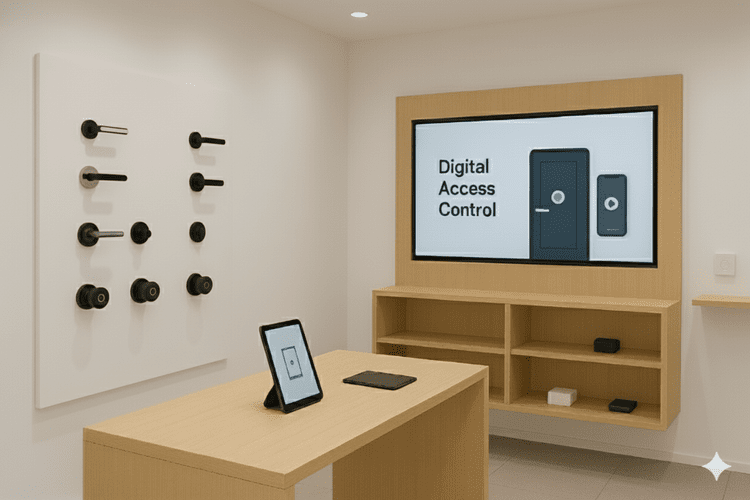
Picture Credit: Gemini AI
The Digital Differentiator
For security dealers to thrive in the digital age, their storefront must reflect the technology they sell. It's about demystifying digital access and making customers comfortable with the shift away from physical keys. A modern showroom conveys competence, professionalism, and forward-thinking expertise. It signals to property managers, HOAs, commercial clients etc. that this dealer is ready to be their partner in the digital future.
The transformation is inevitable. The dealers who embrace this shift, prioritizing the digital customer experience and consultative solutions over the inventory of legacy mechanical parts, will not just survive but become the authoritative channel partners for the next era of access control.
In today’s rapidly evolving digital landscape, enterprises face a barrage of security challenges. The rise of generative AI, post-quantum computing, and agentic AI has transformed the threat environment, making traditional siloed security approaches increasingly obsolete. As workforces become more dispersed and cyber-physical systems more intertwined, organizations must rethink how they protect their people, data, and facilities. The answer lies in security convergence—integrating identity, access, and security operations into a unified, adaptive framework.
The New Reality: Why Security Convergence Matters
Imagine a global enterprise where employees access critical systems and secure facilities from home offices, airports, coffee shops, or corporate campuses. In this context, a single stolen credential can trigger chaos: sensitive data siphoned off in a deepfake phishing attack, an account hijacked via a weak recovery question, or unauthorized entry compromising a data center. These scenarios are not hypothetical—they are daily realities for many organizations.
Recent industry reports highlight the urgency:
-
Darktrace observed a 135% increase in AI-driven social engineering attacks in early 2023, coinciding with the rise of generative AI tools.
-
Okta’s State of Secure Identity Report notes a 28% increase in account takeover attacks in 2024, often exploiting weak recovery mechanisms.
-
The 2024 Verizon Data Breach Investigations Report found that 38% of breaches involved stolen credentials in 2023, a trend exacerbated by remote and hybrid work.
Security convergence—unifying cybersecurity, physical security, and identity management—offers a path to resilience. By focusing on employee identity and access credentials, organizations can address Zero Trust complexities, mitigate threats, and prepare for a post-quantum future.
The Stakes: Hybrid Attacks and the Expanding Attack Surface
Every employee login, physical access attempt, or account recovery request is a potential opening for a breach. As cybersecurity measures and physical access systems have become more sophisticated, the workforce itself becomes part of the attack surface. Malpractice and weak controls create vulnerabilities that social engineering attacks exploit with devastating precision.
CISA’s Cybersecurity and Physical Security Convergence Action Guide warns of “hybrid attacks targeting both physical and cyber assets,” while ASIS International notes that physical security breaches—such as tailgating, stolen badges, or deliberate circumvention of procedures—accounted for 38% of facility-related incidents in 2023. Meanwhile, hacker groups like Scattered Spider systematically exploit vulnerabilities in identity and access management, targeting usernames, login credentials, and multifactor authentication tokens. The impact: lost revenue, disrupted operations, reputational harm, legal expenses, and recovery costs that can reach into billions of Dollars.
The Human-Centered Approach: Employee Identity and Access Credentials
Security convergence starts with employee identity and access credentials. By anchoring security in identity, organizations can enhance their posture without degrading the employee experience. After all, excessive friction in security controls can incentivize employees to bypass them, creating new risks. Identity serves as the anchor for Zero Trust, enabling phishing-resistant authentication, least-privilege access, and secure account recovery.
Converged identity systems streamline physical access, allowing employees to use a single credential—such as a biometric smart card or digital credential—for both building entry and system logins. This improves efficiency and reduces the risk posed by lost or stolen badges. Secure account recovery processes using high-assurance mechanisms like biometrics or digitally verifiable credentials, prevent unauthorized resets while maintaining user convenience.
Technologies That Future-Proof Security
A robust security convergence strategy leverages advanced technologies to fortify the identity lifecycle:
- High-Assurance Identity Proofing
Onboarding starts with high-assurance identity proofing, using biometrics, liveness detection, and document authentication. Government-issued, digitally verifiable credentials—such as mobile driver’s licenses (mDLs)—provide strong foundations for both digital and physical access.
- Biometric Authentication
Biometric technologies, including facial recognition, fingerprints, and iris scans, offer secure verification for both digital systems and physical entry points. Biometric-enabled smart cards or mobile credentials can be used at entry points equipped with facial recognition or fingerprint scanners, ensuring only verified employees access sensitive areas.
-
Digital Document Authentication
AI and optical character recognition (OCR) verify government-issued IDs by analyzing holograms and electronic chips, ensuring authenticity. Cryptographically signed digital IDs, such as mDLs, enhance privacy and reduce fraud. -
Phishing-Resistant Authentication and Secure Recovery
FIDO2 security keys and passkeys provide phishing-resistant authentication. Liveness detection prevents deepfake spoofing, while multifactor authentication (MFA) and cryptographic signatures verify identity and reduce account takeovers. Secure recovery processes use mDLs, biometric credentials, or FIDO keys to authenticate requests, replacing less secure methods like security questions or email links. -
Integrated Physical Access Controls
Physical access credentials derived from government-issued digital verifiable credentials allow employees to unlock doors or gates via NFC-enabled readers, seamlessly integrating with digital identity and access management (IAM) systems.
Charting a Course: Implementation Roadmap
CISA’s convergence framework calls for communication, coordination, and collaboration. Enterprises can start by assessing their current state, using tools like CISA’s Security Road Map Assessment to identify gaps in identity access management, onboarding, physical access control, and account recovery.
Key steps include:
-
Implementing deepfake-resistant identity proofing during onboarding, incorporating biometrics, document authentication, and digital credentials.
-
Deploying phishing-resistant account recovery mechanisms, such as biometric-based MFA or mDL-verified recovery portals.
-
Integrating physical access control systems—biometric readers, video analytics—with digital IAM platforms.
-
Linking physical and digital access management under a single identity framework.
|
By integrating identity management systems for physical access controls with those governing access permissions for systems and data, enterprises can protect both digital and physical assets under a unified framework. The Business Case: Market Trends and Investment The global cybersecurity market is projected to reach $500 billion by 2030, with worldwide end-user spending on information security expected to total $212 billion in 2025. The adoption of AI and generative AI continues to drive investments in application security, data security, privacy, and infrastructure protection. Gen AI will trigger a spike in the cybersecurity resources required to secure it. Technology providers who deliver converged platforms—integrating identity, access, and security operations—will lead the market. Enterprises that embrace security convergence will be better positioned to navigate the complexities of Zero Trust, hybrid work, and post-quantum threats. Conclusion: Security Convergence as a Strategic Imperative The stakes have never been higher. AI-driven threats, post-quantum risks, and hybrid attacks are evolving rapidly. Security convergence is no longer optional—it is a strategic imperative. By integrating identity management systems for physical and digital access under a unified framework, organizations can transform vulnerabilities into strengths, ensuring trust and resilience across all operations. A unified identity framework, powered by industry-leading technologies, lays the foundation for a resilient, agile, and future-ready security posture. Enterprises that embrace converged security solutions will be equipped to meet the challenges of tomorrow, protecting their people, data, and facilities in an increasingly complex world. |
-
Cybersecurity and Physical Security Convergence Action Guide – CISA
-
SC Media: An Identity Security Crisis Looms in the Age of Agentic AI

For too long, traditional alarm components like glass break detectors, smoke sensors, and panic buttons have lived separately from visual evidence—video, radar, and analytics. Peripherals change that.
By integrating digital input and output signals, modern security gains a unified, layered approach. Sensors detect what cameras can’t; cameras verify what sensors trigger. Together, they provide context, accuracy, and operational efficiency.
Input peripherals capture unseen activity—detecting motion in the dark, monitoring restricted areas, or signaling emergencies without invading privacy. Output peripherals go a step further, enabling active deterrence and control—sirens, strobes, lights, and door locks all responding in real time.
This isn’t about replacing cameras or analytics—it’s about expanding awareness. A smoke detector triggering an alarm can now be verified instantly by nearby cameras. A panic button pressed can activate lights and record events for audit trails. Every signal tells part of the story; together, they reveal the full picture.
Modern security is no longer just about watching—it’s about understanding. At YourSix we believe peripherals are the missing link between detection, verification, and response. Our Platform is built on this belief.

I just wrapped up three packed days at The Security Event Asia (TSE), and the through-line was clear: Physical security is officially stepping into its business platform era.
Across video, access control and biometrics, the conversation isn’t about hardware anymore. It’s about data, connectivity, and outcomes. What used to be “tools for protection” are now sensors and enterprise data assets powering broader business value.
And in Southeast Asia, that shift feels like it’s moving faster than almost anywhere else.
The pace of innovation here is real. One speaker said it best:
“If it works here, it can work anywhere.”
That’s not just bravado. It’s because the region’s diversity and greenfield growth create a test bed for new ideas. With fewer legacy constraints, there’s space to experiment, build fast and deploy at scale.
And while many talk about “Asia” or “APAC” as a single market, that oversimplifies things. The reality? It’s fragmented by regulation, infrastructure and culture. Data sovereignty is the big through-line. Every market has its own data laws and storage rules, forcing a localized approach to global standards. If you want to scale here, you have to build globally but deploy locally.
The next wave of innovation seems to be driven by public-private collaboration, startups and local system integrators (SIs). It’s not unlike what we’ve seen in São Paulo or Mexico City: homegrown ecosystems forming around cloud, APIs, and modular platforms that can scale regionally and beyond.
Another quote stuck with me:
“Edge for speed. Cloud for scale. Fusion for value.”
It sums up the mindset perfectly. Use each layer of technology for what it does best, then connect them for business outcomes.
Biometric adoption varies widely across APAC. Cost is still the main driver, but trust and privacy-by-design are increasingly shaping the conversation. Singapore’s airport, for example, is a masterclass in multimodal, risk-adaptive authentication.
On the business side, I noticed more conversations around outcome-based pricing with billing tied to events or value delivered rather than per-device licenses. Early days, but the direction is clear.
Oh—and let’s not forget the drone food delivery startups that take meals to ships waiting offshore. Maybe not “security tech,” but a perfect reminder of how automation, logistics and trust all intersect in this region.
The standout on Day 2 for me was the panel on Human Factors & Trust with Telaris and Apollo Security.
One quote captured it perfectly:
“AI cannot…apologize. As users, we still expect feedback from another human.”
As automation takes over more of the workflow, trust still starts with people. Technology can make systems smarter, but empathy, training, and communication are what make them reliable.
The other recurring theme at TSE was the idea of data as both the engine and the exposure. We’re all excited about analytics, predictive insights, and operational efficiency. But are we really ready for the privacy, governance and security implications that come with it?
A number of panels also echoed something we all know but still struggle to execute: Plan interoperability early. Don’t bolt it on later. That means open APIs, SDKs, and platform-first design from the start. And everyone, it seems, is calling for better standards, both globally and locally.
Beyond the content, it was energizing to see new voices sharing the stage alongside the familiar ones. The conversations felt more local and global than ever, a continuation of what we saw at ACS LATAM, but with an APAC twist.
The Takeaway
The Asia security market is showing what’s possible when speed meets structure. Innovation here isn’t just about tech. It’s about trust, context, and local fit.
We’re watching physical security evolve from a toolset into a business platform, and Southeast Asia might just be the proving ground for what comes next.
If it works here, it really can work anywhere.