Volume 4 | February 14, 2025
Welcome to Volume 4 of The Security Breakdown!
I'm excited to share three insightful pieces from industry experts who continue to push the boundaries of security technology and thought leadership.
A new contributor, Jon Polly, Chief Solutions Officer at ProTecht Solutions Partners, LLC, leads our coverage and delivers a detailed "Security Technology Deep Dive" on Sentry Enterprises. His analysis reveals how this innovative company transforms physical access control through its groundbreaking Sentry Card, featuring advanced biometric technology. With over 100 patents, Sentry Enterprises is making waves across the physical security, banking, and cryptocurrency sectors.
Next, we welcome back Brian Karas, Director of Marketing and Eastern Region Sales at Actuate. He returns with his "Vicon Next Preview," offering an exclusive look at Vicon's revolutionary NEXT camera. This innovative device challenges traditional design conventions with its unique form factor and introduces the cutting-edge HAILO chipset, promising to reshape video surveillance capabilities.
Rounding out our features, Angie Barnes, CRO of Evolon, from Tales of an Impatient Sales Lady returns and presents "Is the S for Superman or Security Integrator," a thought-provoking exploration of industry terminology. Drawing from nearly two decades of experience, Angie examines whether our current nomenclature captures security integrators' evolving role in today's complex landscape.
Our contributor network and readership continue to expand, with exciting new voices joining to share technical deep dives, market analyses, and practical insights. If you want to contribute your expertise to future editions, I'd love to hear from you at [email protected].
PS: I am sure some of you may forward this, but please do so sparingly and encourage others to sign up here. Thank you!
-Lee M Odess
Security Technology Deep Dive – Sentry Enterprises
Written by Jon Polly, Chief Solutions Officer at ProTecht Solutions Partners, LLC
The security industry has been introduced to the fact that physical access control credentials (badges, fobs, etc.) are problematic. Even the most encrypted smart card technologies can be accessed and exploited. This has made most in the mobile credential space eager to promote the mobile wallet as the only solution. The problem is that globally, no one knows how many physical access control credentials are in use, though they are estimated to be more than 1 billion; and more than 1.25 billion people have at least one credit card, with most having two or three. While mobile wallets are gaining traction, the physical card; either access control or credit card is not going away anytime soon. The answer is to make a better badge.
Sentry Enterprises is banking on that concept. Sentry Enterprises (https://sentryenterprises.com/) is a deep-tech company in the research and development space that has spawned more than 100 patents. Sentry Enterprises, it should be mentioned is not a security industry company. They see the products that they make as being very useful and highly sought after by not only access control end-users, but to manufacturers and end-users who are looking for immutable security for banking, IT, and cryptographic security solutions. This caused them some shortfalls in the beginning, not knowing the space as well as they should have; but now they seem to have a renewed sense of resolve to deliver to not only the physical security industry but to every possible aspect of security.
Here's how. Sentry Enterprises completed its acquisition of X-Core Technologies in August 2023. X-Core patents provided Sentry Enterprises with two primary solutions. The first, the encapsulation of circuitry with a proprietary vacuuming system. The second was the creation of a flexible, paper-thin encapsulated battery-powered circuit board that is heat-resistive; a proprietary process they call ThinTech. Next, Sentry Enterprises uses a hot lamination process, exactly the same system credit card manufacturers use, to laminate the circuit board with whatever the lamination requirements are. The lamination requirement could be a physical access control credential, a credit card, or even an organic light-emitting diode (OLED). The primary difference between cold lamination and hot lamination is that cold lamination is typically more expensive, and it has a much lower success rate of approximately 65%. Hot lamination has a 99.4% success rate. Hot lamination offers the benefit as well that the physical card is molecularly bonded together; able to withstand freezing temperatures, acid, or physical breakage. These are all problems that cold laminated products and a majority of Sentry Enterprises competitors face.
Sentry Enterprises has been around for a few years now, beginning with the creation of the Sentry Card, a physical credential with a biometric fingerprint sensor on the card. Sentry Enterprises, however, is a company about card and identity technologies on a mission to revolutionize all the security industries; including physical security, banking security, crypto-currency, and more. This bold statement has yet to be proven, but from a technology standpoint, they may just be capable. The OLED product is called Radiance and is coming to Original Equipment Manufacturers (OEM) partners worldwide offering card illumination when presented to a reader or payment station.
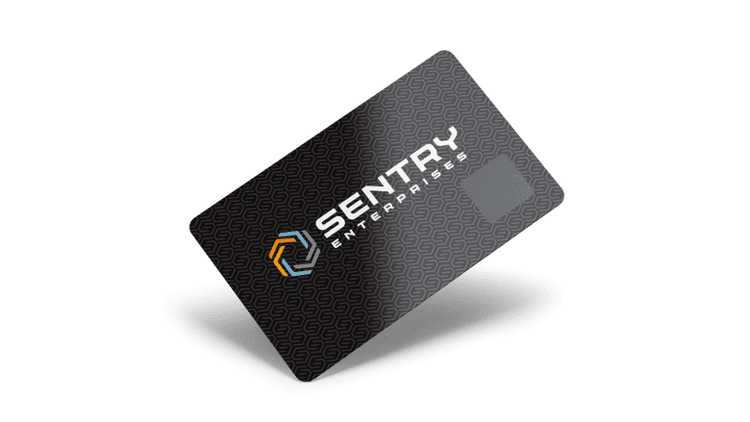
There are a lot of things happening with Sentry Enterprises, but let’s stop and look at just the Sentry Card. The Sentry Card is a physical credential with a biometric fingerprint sensor on the card. Once a user enrolls their fingerprint on the sensor, the card is “locked” to that fingerprint. There are no databases or biometric templates, and the data that is encrypted is no longer accessible. The single biometric signature is encrypted directly to the card using AES256 encryption. Since the biometric sensor is active, the sensor has to be powered to read a fingerprint. Once a fingerprint is read, it activates the smart card technology embedded in the card; allowing the use of the card. Where two-factor authentication is difficult to find adoption, the Sentry Card has it built-in.
One of the misses that Sentry Enterprises had early on was that the card reader had enough power through capacitance to power the Sentry Card. This however proved to both be the case and also unusable. The way the card reader cycled did not provide power all of the time. So how do they power the card if the capacitance of the reader cannot? The human body. The human body is theorized to generate, on average, more than 100 watts of power. This led Sentry Enterprises to wire and encapsulate a battery in the Sentry Card. This allowed the Sentry Card to work every time it was presented at the card reader, needing only a few milliamps of electrical current generated by the human body. Look for technology advancements to bring new innovations in 2025.
One concern that is always brought up with biometric solutions is how to account for liveness; and unlike other biometric products, the Sentry Card sensor is encrypted to a single live user (the sensor must be powered using a live person). It is possible, but highly unlikely due to the size of the sensor, that the sensor on Sentry Card could use the live finger of a person with a biometric signature of the cardholder. In a Mission: Impossible-type thought, could a latex glove or even a fingerprint adhesive allow use? It may be possible, but with each layer of non-capacitive film, the likelihood of the body generating enough power to power the battery gets exponentially less.
Sentry Enterprises created the Sentry Card to be technology agnostic. It can be ordered with the full HID or Dormakaba technology stack. The Sentry Card can also be ordered with FIDO2 compliance. Unlike other biometric technologies, the Sentry Card does not have any server hardware. From a hardware perspective, the Sentry Card works like any other physical access control credential, and yet it can turn any card reader into a biometric reader, for a fraction of the cost. Speaking of cost, the Sentry Card has an MSRP price of approximately $35.00; a much higher cost than most badges, but a significantly less cost than adding or replacing existing readers with biometric readers. As new technology advances create innovation, Sentry Card pricing is expected to become more in line with traditional badges, and will likely be less than most mobile credential wallet solutions.
Sentry Enterprises is a made-in-the-USA brand. They hold various privacy certifications; including Illinois Biometric Information Protection Act (BIPA) compliant, California Consumer Privacy Act (CCPA), Fast Identity Online (FIDO) Alliance, European Union General Data Protection Regulation (GDPR), National Defense Authorization Act (NDAA), and Trade Agreements Act (TAA) compliant.
If this report provided you insight and you would like to know more about this technology or other security technologies in our industry, we encourage you to reach out to Jon Polly directly at [email protected] or find him on LinkedIn at http://www.linkedin.com/in/JonPolly.
Vicon Next Preview
Written by Brian Karas, Director of Marketing and Eastern Region Sales at Actuate
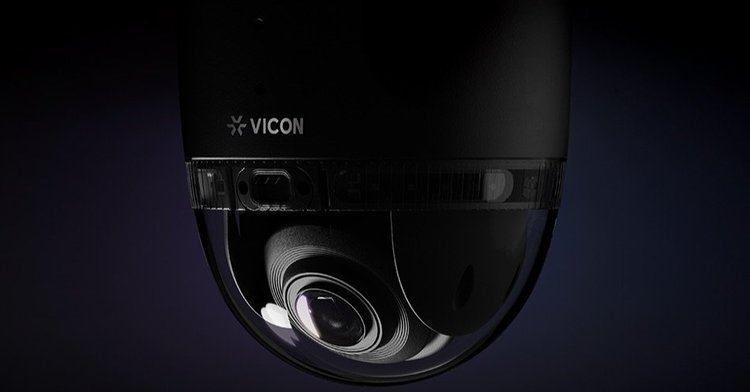
It has been a while since we have seen much innovation in security camera industrial design. The majority of the products you see follow the same page structure of a dome, turret, or bullet form factor that you bolt to a wall or ceiling. More or less a unified assembly, though some manufacturers offer custom backboxes that work for a variety of their cameras to make it a little easier to stock mounting equipment for techs. When I saw Vicon’s NEXT camera design at GSX 2024 it immediately stood out as being a little different in this regard.
One of my intentions for The Security Breakdown was to do some product testing and showcase new and innovating things in the industry. Vicon sent over a pre-production NEXT unit for me to check out, and in the coming weeks I will be publishing some tests and highlights of the product, as well as comparing it to other cameras.
If you have already seen some any of Vicon’s marketing around the NEXT camera, they are focusing heavily on the ease of install-ability, which frankly often seems like an afterthought with some products. I have put together a quick unboxing and assembly video, showing you the pieces in the kit and how they go together:
While the installability and design flexibility is an important factor, the camera has other features that I plan to highlight. The first, and potentially most significant, is that this is one of the first cameras being brought to market using the HAILO chipset. I first highlighted Hailo during my AI Summit at ISC West 2024, and I think this chip has the potential to disrupt market segments from both NVIDIA and Ambarella, so I am super excited to see it showing up in cameras and NVRs. We will do a future segment on Hailo in more depth.
The Vicon camera also has 4 configurable and programmable LEDs, which you can see at the end of the video above. These can be set to light solid or flash at different rates, from a variety of colors. These kinds of features can be very useful for remote guarding applications, or for providing local feedback when cameras are integrated with access control equipment, inventory management, or other functions. Again, it is nice to see some fresh takes on camera designs and features to extend the capabilities of security equipment.
Vicon is still finalizing the firmware, but next week I hope to highlight some of the features and functionality and dig into this camera in more detail.
Is the S for Superman or Security Integrator

So, no pressure, right? This is my second article for Security Breakdown, and I don’t know about you, but this is where I feel like I will either bring you back for more or have the potential to lose you for this weekly amazingness. Angie, its clearly time to buck up buttercup and bring the brilliance sister! So, let’s see what you got for us, huh! Well, if you have been following Lee “Yoda” Odess recently, then you might have caught the response and questions around does the name, Security Integrator, really provide an accurate description of the critical role they play in our industry? Deep in thought here with hand under chin thinking, is this really the right name for what they do today? I feel like my 19 years on the Security Integration side might provide a view from the other side, which if anyone knows me, knows that I always have an opinion, but I don’t always have to be right when expressing it!
I think that’s good, right? So, let’s start here, what does my favorite
CoPilot say a security integrator is? Well, their definition is “a company or individual that designs, implements, and manages security systems for various clients. These systems can include physical security products like surveillance cameras, access control systems, and alarm systems.” They also say, “security integrators typically assess a client's specific security needs,” or we use to say, develop a technology and solutions roadmap based on need and budget. You see integrators using a food analogy, are the middle of the cookie, in between the manufacturer and the end user or client. It was our job to take the product from our product toolbox, and design a plan, scope, and solution, to provide exactly what our amazing discovery had told us the client needed and could afford with a solid ROI. Shazam! Laughing, I wish it had been that easy, but truthfully, when integrator’s do it well, you have a high rate of success for your manufacturer partners and your clients.
So if you read my superhero story last week, and you follow the same line of thinking as in the Marvel Universe of Security, the integrators are the ones deciding which superhero to send, or deploy, based on their strengths and abilities to bring home the win. The win for the company, as well as the client, is a fully integrated solution that always catches the bad guys. Now, I think am stretching this theory a bit, but there is always room to include integrators in my Marvel Universe, because I say so, laughing.
The real subject that Lee touched on, and hit a good nerve, was does the name today, security integrator, really do it justice, and why are we not seeing that evolve to reflect the role they play in our industry. Hmm, this is such a great topic, and my original two cents was nobody wants to blaze the trail in fear it won’t be followed by others. Let’s face it, we are all followers in some capacity. Now, there is so much more here, but that was my gut instinct when I read the question. I also feel like an alternate description of an example like System’s Engineer or Solution Architect’s, etc. may be too limiting for some and be a stretch for other’s that haven’t developed all those muscles quite yet. In saying this, I feel like with the evolution of the single pane of glass, and all the disparate technologies that are in need of integration on one or few platforms, will require a superhero! You see how I just wove that in, laughing! But seriously, regardless of the name you choose, I have heard the ugly rumor that security integrators may not be needed like they used to be, and that is the biggest fallacy out there. Trusted advisors leading solution designs, technology roadmaps, project management, with stellar service and installation teams will always be needed, regardless of what you decide to call them. It’s really what they deliver to foster and advance their technology partners and provide the end user with the best-in-class experience that has been sold and asked for. I am not saying security integrators might need some rebranding, but the name needs to be a close to one size fit’s all, and in today’s world, that just might be hard to find.