
Volume 57 | May 1, 2026
🎙 Secured Podcast
West to East series | This week we are featuring:
Karl Hill
✍🏻 Articles
Meg A. Watt | You're Great at Security. Nobody Knows Who You Are.
Why small and mid-size integrators are sitting on a branding opportunity they keep ignoring.
Read below
Joelle Hushen | Technology Isn’t the Problem. The Environment Might Be.
We keep adding more technology to solve safety. But what if the real problem is the environment it’s being placed into?
Read below
Lindsay Martin-Nez | The End of the Badge? Not So Fast.
The badge isn’t dying. We’re just reading the data wrong.
Read below
🚨 Breaking News
Breaking & Exclusive: AMAG Technology and SwiftConnect expand their partnership, with SwiftConnect now powering Apple Wallet and Google Wallet activation across AMAG's portfolio.
Breaking: Breaking: ASSA ABLOY Group posts Q1 2026 sales of SEK 35.8B, down 6% from 2025 reported but up 2% organic, with EBIT margin expanding 40 bps to 15.3% despite a brutal 10% currency headwind.
Breaking: Quext and Geokey are merging to form OneQuext, positioning it as one of the most deeply integrated smart community platforms on the market.
Breaking: Allegion posted their Q1 2026 today with revenue of $1.03B, up 9.7% reported but only 2.6% organic, with adjusted operating margin compressing 150 bps to 21.2% as volume declines and pricing productivity net of Iminflation and investment headwinds offset price gains.
Breaking: Amadeus to acquire IDEMIA Public Security division for €1.2bn, expected to close mid-2027.
Scroll down to go deeper ↓

Podcast | Secured: Episode 12 is underway
There’s a lot to unpack in this one.
Keep an eye on the channel for the full episode drop. In the meantime, catch up on recent Secured episodes here.
From West to East, the conversation doesn’t stop at the show floor. This podcast series brings together 45 voices from across the industry to share what’s actually top of mind right now. You can stream right from the Secured Youtube channel.
Karl’s episode: here
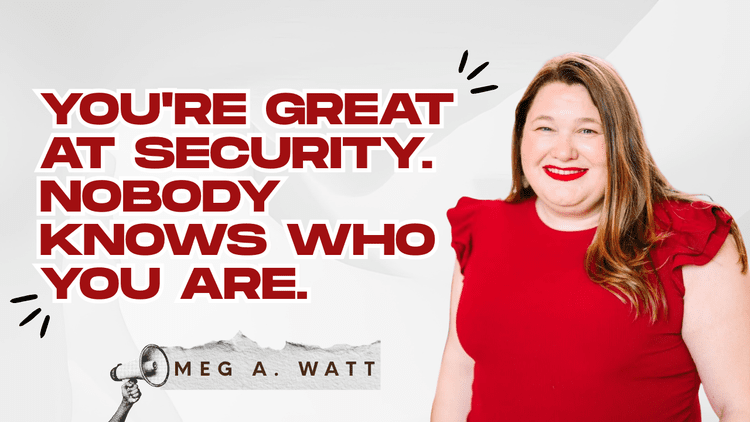
I spend a lot of time talking to integrators. And here's what I keep noticing: the ones who are genuinely excellent at their craft — fast installs, clean documentation, loyal customer base, referrals out the door — are often completely invisible outside their immediate zip code.
No real website presence. No defined voice. Nothing that would tell a prospective customer why them and not the next integrator on the list.
As a marketer, this drives me a little crazy — because the opportunity cost is enormous.
The "our work speaks for itself" trap
I get it. The instinct is to just do good work and let word of mouth handle the rest. And look — word of mouth does work. It's genuinely the best lead source in this industry. But it has a ceiling, and most integrators hit it faster than they realize.
When your only growth engine is referrals, you're entirely dependent on someone else thinking of you at exactly the right moment. That's a fragile position. And when a prospective customer does hear your name and goes to look you up — your website, your LinkedIn, your Google presence — what do they find? Often, not much.
That's not a sales problem. That's a branding problem.
What branding actually means for a small integrator
I'm not talking about logos and brand books. I'm talking about having a clear, consistent answer to one question: why you?
Are you the integrator who specializes in multi-site retail? Who knows healthcare compliance cold? Who treats service contracts like they matter? Who actually picks up the phone?
Whatever it is — own it. Say it out loud, on your website, in your proposals, when you introduce yourself at a trade show. That specificity is not limiting. It's a signal. It tells buyers you're the right fit before they even call you.
The integrators who resist this usually tell me they don't want to turn away business. I understand the instinct, but the logic works backwards. Being known for something specific doesn't close doors — it opens the right ones.
The bar is genuinely low
What frustrates me most? The competitive bar for marketing in this industry is remarkably low. Most integrators aren't doing it. Which means that a little consistency — showing up with a clear message, useful content, a website that actually explains what you do and who you do it for — puts you ahead of the pack almost immediately.
I'm not talking about a massive budget or a full marketing department. I'm talking about being intentional. A one-page positioning statement your whole team can recite. A website that doesn't make prospects work to understand what you do. A LinkedIn presence that shows you actually know this industry. Case studies — even one or two — that show the kind of work you're proud of.
These aren't big lifts. They're just neglected.
The window won't stay open forever
The security industry is consolidating. Larger players are getting more sophisticated about marketing. Private equity is bringing in people who know how to build brands at scale. The window where a small integrator can differentiate just by showing up with a clear identity — before their segment gets crowded — is real, but it won't last indefinitely.
The integrators who figure this out now won't just grow faster. They'll be in a much stronger position when the market gets harder — because their name will already mean something to someone.
You've done the hard work of building real expertise. The missed opportunity is letting it stay a secret.
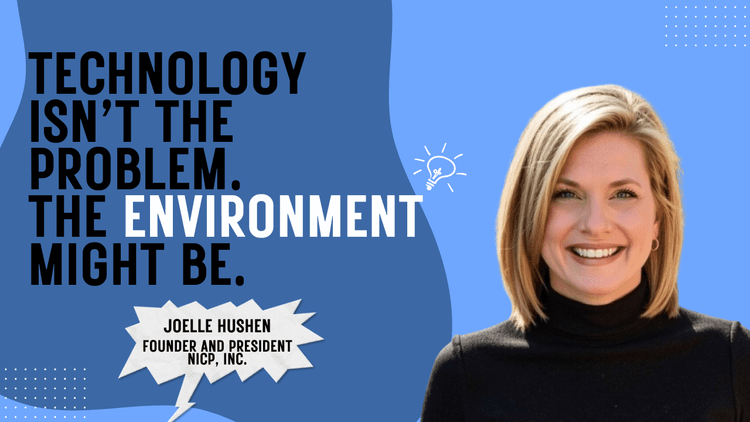
Are we solving safety with technology alone, or are we overlooking the role of the environment itself?
The industry is moving quickly. Conversations around AI, identity, and connected systems are reshaping how access is managed and how decisions are made. Technology is becoming more capable, more integrated, and more central to how we think about security.
But at the same time, many of the environments these systems are deployed into were never designed with safety in mind.
Walk through almost any campus, public space, or commercial property and you will see the same patterns. Blind corners. Poor lighting. Confusing pathways. Entrances that are difficult to read. Spaces where it is unclear who belongs and who does not.
These are not technology problems. They are design problems.
And yet, the default response is often to add more technology.
More cameras. More access control points. More systems layered on top of environments that are already working against them.
Technology can respond to risk. It can detect, alert, and record. But it does not always reduce the conditions that create the risk in the first place.
That gap is where a lot of friction in security systems actually comes from.
Crime Prevention Through Environmental Design, or CPTED, focuses on how the built environment influences behavior. It is based on a simple idea: people respond to their surroundings, and those surroundings can either reduce or increase opportunities for crime.
Clear sightlines improve visibility and natural surveillance. Well-defined entrances and pathways guide movement. Lighting supports both perception of safety and actual usability. Territorial reinforcement creates a sense of ownership and accountability.
None of these are new ideas. But they are often treated as secondary to technology, rather than foundational to it.
When environment and technology are aligned, systems tend to work better. Access control becomes more intuitive. Surveillance becomes more effective. Users understand how to move through a space without needing constant intervention.
When they are not aligned, technology often ends up compensating for underlying design issues. Systems become more complex, harder to manage, and less effective over time.
This becomes even more important as the industry moves toward more identity-driven and automated decision making.
If systems are going to act on behalf of users, make access decisions, or respond dynamically to behavior, then the environments those systems operate in need to support clear, predictable patterns of use.
Otherwise, we are scaling complexity rather than reducing it.
There is a real opportunity here for the industry to broaden the conversation.
Not just:
What can technology do?
But:
What kind of environment is that technology being asked to support?
Because safer places are not created by technology alone.
They are created when design, behavior, and technology work together in a way that makes sense for the people using those spaces every day.
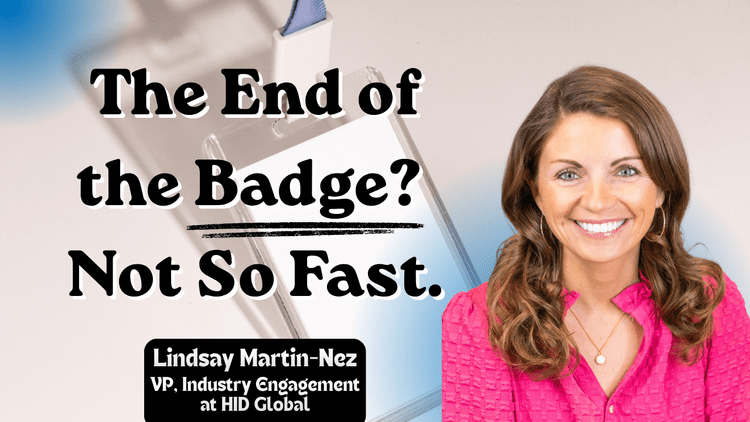
A survey made the rounds this week claiming the physical ID badge is on its way out. The coverage was hard to miss. One headline declared the days of the badge "may be numbered." The company’s CEO went on the news to say the era of the plastic card is ending.
I read the actual survey data though... And I have a few questions.
The headline finding: nearly 1 in 3 employees would prefer biometrics over a traditional badge for workplace access. That number was proclaimed as the kiss of death for the physical badge.
But let's review that data for a second. If 30% prefer biometrics, that means 70% do not. That's not a finding indicative of a revolution. That's a preference held by less than a third of the workforce surveyed, and even that number comes with major caveats around privacy concerns, distrust of surveillance technology, and a pronounced generational divide that the survey itself flagged.
The other stat that circulated: 46% of workers expect biometrics to replace most security requirements within the next five to ten years. Half the workforce thinks something might happen... eventually... within the next decade… That's not a massive trend. That's a guess about the future with a very wide margin for error.
None of this means biometric solutions aren't valuable. They absolutely are. Facial authentication, multi-factor access, mobile credentials - these are all technologies that are advancing fast and solving real problems. I'm not here to argue against any of that.
What I am pushing back on is the constant messaging that physical and digital identity are in competition with one another, and that one of those technologies must be the loser.
The physical badge does something that no app, no facial scan, and no mobile credential can fully replicate. It's an immediate, visual validation that informs everyone in the room who you are and if you belong there. That matters in a hospital hallway at 2 am. It matters in a school when a visitor walks through the front door. It matters on a manufacturing floor, in a government building, and at a conference or event.
It also does something more subtle that I believe is often dismissed too quickly. It connects people to a place. When an employee puts on a badge in the morning, there's a Public psychological signal that happens, telling the employee, “I'm here, I'm part of this, I belong to something.” That's not just me being nostalgic. That's organizational psychology.
The real story around this survey isn't the death of the physical badge. It's the expansion of the concept of identity and the types of credentials that organizations are open to. Corporations are adding layers to their identity and security systems. Those layers may include mobile credentials for select cardholders, biometrics for high-security zones, and smart cards that do more than just open doors.
But the physical badge still is a critical piece of that puzzle.
Thirty percent of employees preferring biometrics is worth paying attention to, sure. It tells us the workforce is evolving and expectations are shifting. But it is nowhere close to a death sentence for the badge.
The badge isn't going anywhere. This obituary was prematurely written.
👀 As Seen in the PhySec Community this Week:
#security-research
-
Salvatore D’Agostino shared
He Typed “../../../../../../../etc/passwd” After a Google Image URL. Google Paid Him $3,134.
#marketing-communications

The ALOA Convention & Security Expo is coming up fast. From technical training to meaningful connections, ALOA 2026 is where the people behind physical security come together to learn, connect, and move the industry forward. This is where the industry gets back to the fundamentals, real skills, real conversations, and the people who actually make security work every day. Learn more and register here.

ACS26, The Access Control Summit, is heading to New Zealand in 2026, hosted in collaboration with our city-host, Gallagher Security. Join us October 7–8, and sign up here to be notified first when registration goes live.
