
Volume 60 | May 22, 2026
🎙 Secured Podcast
Episode 16 | The Physical Security Industry Is Catching The Flu
This episode looks at how the operating model is becoming the product in physical security. Lee breaks down Ambient.ai, Aura, AI-native configuration, buyer fatigue, and why the companies reducing complexity may be the ones best positioned for what comes next.
YouTube: Listen here PodBean: Listen here
West to East series | This week we are featuring:
Jack Palmer, Jay Meier, Chris Herndon, and Naohiro Kawaji
✍🏻 Articles
Tim Miller | State of the Security Film Industry: The Lack of Transparency
Safety film on doors and windows is not the same problem. This piece calls for more transparency around what has actually been tested and what may be creating a false sense of security.
Read below
Paul Labow | Zero Trust Shouldn’t Stop at the Network. It should start at the door, any door.
Zero Trust should not stop at the network. Physical access needs to verify the person, not just the credential they present.
Read below
🚨 Breaking News
Breaking: AURA names Sareesha Beharilal CA(SA) Global Operations Director as It Scales Across Africa, UK, and US
Breaking: Ambient.ai is expanding Ambient Access Intelligence with two new agentic capabilities…
Scroll down to go deeper ↓
Podcast | Secured: Episode 16
This episode is about a shift Lee keeps coming back to: the operating model is becoming the product. He breaks down Ambient.ai’s new agentic access capabilities and Aura’s global expansion as two signs that value is moving away from hardware-first thinking and toward software, automation, response, and operational intelligence. Lee also gets into what AI-native configuration could do to access control, why disengaged and overloaded managers will not tolerate complex deployments, and how enterprise slowdowns, data center dependency, and supply chain pressure could hit different parts of the industry. The episode also features pieces from Tim Miller on transparency in the security film industry and Paul LeBeau on why Zero Trust should start at the door.
|
YouTube: Listen here PodBean: Listen here |
From West to East, the conversation doesn’t stop at the show floor. This podcast series brings together 45 voices from across the industry to share what’s actually top of mind right now. You can stream right from our Secured Youtube and Secured PodBean channels.
Jack’s episode: here
Jay’s episode: here
Chris’ episode: here
Naohiro’s episode: here
Secured Presents: XPod from The Security Event
Over two days at The Security Event in Birmingham, we set up a microphone, called it XPod, and sat down with more than forty operators, founders, and leaders from across the global physical security industry.
We asked everyone the same four questions. What came back was not a recap. It was a read on where the industry actually is, told through the people doing the work.
Three episodes. Three theses. Thirty-three voices.
This week’s episode- Intro: What We heard at TSE
You can stream directly from our Secured Youtube and Secured PodBean channels.
With all the conversation around safety and security films on doors and windows, one issue still does not get enough attention: doors and windows are not the same, yet they are often treated that way.
There are established standards for windows, but there is still a major gap when it comes to doors. Specifically, there is no official test for the use of structural adhesive or silicone as an anchoring system on doors. That matters because doors are built differently, used differently, and exposed to different forces than fixed windows.
In 2018, we conducted ANSI Z97.1 impact testing and later performed a break-in demonstration comparing different attachment methods. The results raised serious questions about whether common silicone anchoring methods are being presented with more confidence than the testing actually supports.
Many manufacturer specifications and bulletins state that structural adhesive or silicone anchoring systems are to be connected to the frame, excluding the glazing stop and compression gasket. Yet across the industry, methods that do not appear to meet those installation requirements continue to be used and described as acceptable.
That should concern all of us.
The bigger issue is not just technical. It is educational. Buyers are often relying on the security film industry to explain what works, what has been tested, and what the limitations are. If the information being shared is incomplete, unclear, or overly simplified, buyers may believe they are getting a level of protection that has not actually been proven.
This creates a false sense of security.
There are a few reasons this continues to happen. Buyers may be under pressure, working with limited information, or trying to check a box quickly after a safety concern. Sellers may be leaning on what has always been called the “industry standard,” even when that standard has not been tested in the specific application being sold.
That is where the industry has to be more honest.
If a method has not been tested for use on doors, we should not talk about it as if it has. If a system does not meet the installation requirements being referenced, we should not gloss over that detail. And if a customer is making a safety decision, they deserve clear information about what has been tested, what has not, and where the limitations are.
This is not about creating fear. It is about creating transparency.
The buyers in this space include schools, public facilities, businesses, and organizations trying to make real safety decisions. They are trusting our industry to help them understand the difference between a product, an installation method, and a tested security outcome.
We owe them more than vague claims and assumptions.
The security film industry has an opportunity to raise the standard. That starts with clearer testing, better education, and more honest conversations about what different anchoring methods can and cannot do, especially on doors.
Because if the industry wants to be trusted, it has to be willing to say the quiet part out loud:
Not every commonly used method has been properly tested for every application. And when safety is the promise, that distinction matters.
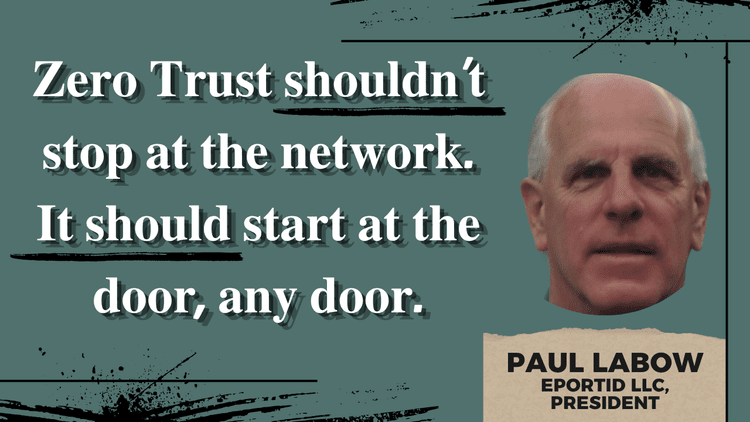
Zero Trust has become a common cybersecurity conversation, but it often stops too early.
Most organizations think about Zero Trust in terms of networks, devices, applications, and data. That makes sense, but it misses one of the most obvious parts of the security equation: the physical door.
If someone can physically access a server room, infrastructure area, operations center, lab, or restricted workplace, then physical access becomes part of the cybersecurity conversation too.
Traditional access credentials still carry a major weakness. Cards, fobs, PINs, phones, and watches authenticate what someone has, not necessarily who they are.
Cards can be lost, cloned, shared, or stolen. PINs can be guessed, watched, or passed along. Phones and wearables can be borrowed, relayed, hacked, or compromised.
That does not mean these credentials have no place. It means we need to be more honest about what they prove and what they do not.
In a modern threat environment, relying only on external credentials creates risk because the credential exists outside the person. Once that credential is transferred, copied, or compromised, the access decision becomes less about identity and more about possession.
That is where stronger identity verification needs to become part of the physical access conversation.
Biometrics are one example of how the model can shift from verifying the object someone carries to verifying the person requesting access. The more important point is not the specific technology. It is the security principle behind it.
Physical access should be evaluated with the same seriousness as digital access:
No inherited trust.
No assumption that possession equals identity.
No belief that being inside the building means someone is automatically trusted.
The physical layer matters because cybersecurity does not only happen behind a screen. It starts with controlling who can reach the systems, spaces, infrastructure, and people that organizations depend on.
The access control industry has an opportunity to bring Zero Trust thinking closer to the door. That means asking harder questions about credentials, identity, verification, and where trust is being assumed instead of proven.
The future of access control should not only be about what someone presents.
It should be about whether the system can confidently verify who is actually standing there.
👀 As Seen in the PhySec Community this Week:
#ai
-
Salvatore D’Agostino shared
-Google Chrome silently installs a 4 GB AI model on your device without consent
#deal-activity
#marketing-communications
#security-research
DHI All Access is headed to Nashville May 27–29, bringing together the architectural opening professionals helping shape what comes next for the industry.
We’ll be there attending and joining the conversation around how the opening is evolving from a door, frame, and lockset into an identity, software, and liability discussion. Register here.
Unify is coming up June 16-18, and we’ll be there joining the conversation on what Aliro could mean for the commercial sector.
Lee will be moderating a session on why commercial may be the next sector to move, covering interoperability, offline and online access, quantum readiness, multi-badge challenges, and what it takes to move Aliro from inevitable to deployed. Register here.

The ALOA Convention & Security Expo is coming up fast. From technical training to meaningful connections, ALOA 2026 is where the people behind physical security come together to learn, connect, and move the industry forward. This is where the industry gets back to the fundamentals, real skills, real conversations, and the people who actually make security work every day. Learn more and register here.
ACS26, The Access Control Summit, is heading to New Zealand in 2026, hosted in collaboration with our city-host, Gallagher Security. Join us October 7–8, and sign up here to be notified first when registration goes live.
