
Volume 63 | June 12, 2026
This Week’s Featured Media, Articles, & Breaking News
🎙 Secured Podcast
|
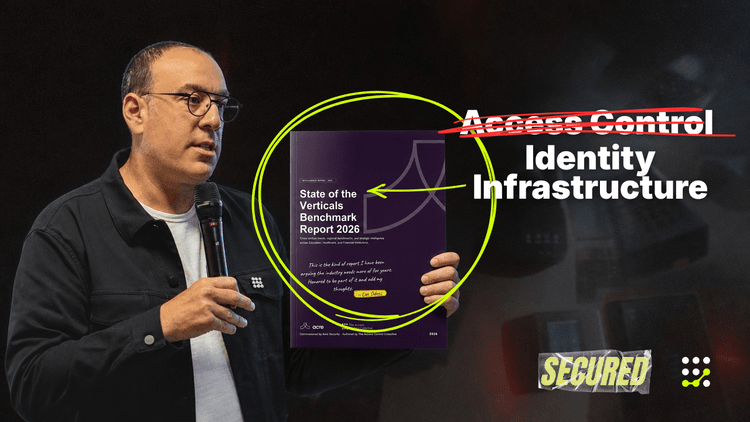
Episode 19 | Physical Access Control is Now Identity Infrastructure West to East series | This week we are featuring: ✍🏻 Articles Janet Fenner | Funded and Forgotten: Why PE-Backed Security Companies Leave Marketing on the Table. Scroll down to go deeper ↓
|
Podcast | Secured: Episode 19
This episode breaks down findings from the 2026 Acre State of the Verticals report across education, healthcare, and financial institutions. Each sector has different pressures, but the shift is the same: access control is becoming identity infrastructure connected to the larger systems organizations rely on every day.
YouTube: Listen here
From West to East, the conversation doesn’t stop at the show floor. This podcast series brings together 45 voices from across the industry to share what’s actually top of mind right now. You can stream right from our Secured Youtube channel.
Allen’s episode
Brett’s eisode
Heikki’s episode
Andrew’s episode
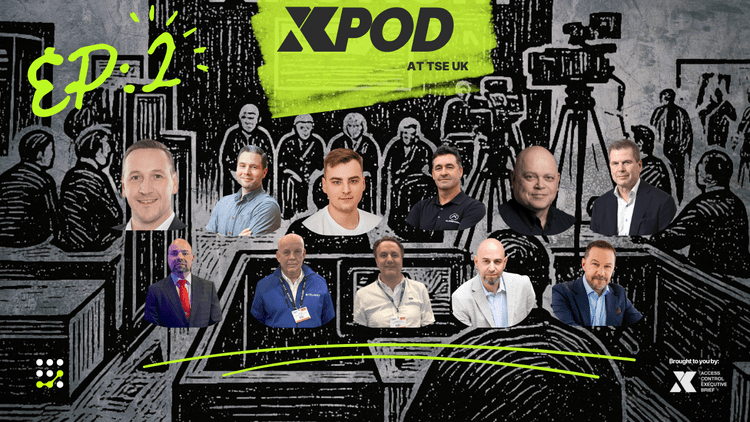
Secured Presents: XPod from The Security Event
Over two days at The Security Event in Birmingham, we set up a microphone, called it XPod, and sat down with more than forty operators, founders, and leaders from across the global physical security industry.
We asked everyone the same four questions. What came back was not a recap. It was a read on where the industry actually is, told through the people doing the work.
Three episodes. Three theses. Thirty-three voices.
This week: Episode 2: Regulation Is Not the Tax. It Is the Moat.
You’ll here from:
Gareth Robinson | 2N
Michael Lee | Nedap
Roman Bratishko | CoreWillSoft
Spencer Marshall | Gallagher
Nick Venuti | BraXos
Stephen Oliva | Altronix
Pete Jones | Third Millennium
Thomas Bertaux | XPR
Ian Law | Alarm.com
Heikki Hiltunen | iLOQ
Dick Clark | Telaeris
Don’t miss out on the previous episode’s!
Intro: What We heard at TSE
Episode 1- Identity Is The Center, Hardware Is The Floor.
You can stream directly from our Secured Youtube channel.
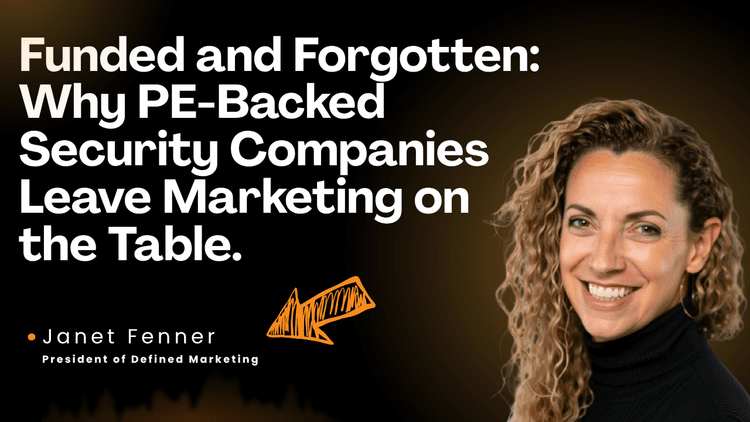
Private equity firms are disciplined operators. When they acquire a company, the playbook is well-worn: assess the balance sheet, restructure debt, optimize headcount, and identify cost efficiencies that move the EBITDA needle fast. These are not arbitrary priorities. They reflect the realities of a compressed investment timeline and the obligation to deliver returns to limited partners. The financial mechanics, by and large, get handled.
Marketing does not.
Across the physical security industry, PE-backed companies have become a fixture. Alarm monitoring centers, commercial integrators, managed access control and video surveillance providers, and dealer network aggregators have all attracted significant capital over the past decade. The investment rationale tends to be consistent: recurring monthly revenue, low customer churn, critical services with defensible margins, and a fragmented market full of acquisition targets. The thesis is usually right. The go-to-market strategy, more often than not, is an afterthought.
The Short-Term Trap
PE firms typically hold portfolio companies between three and seven years. That timeline creates a structural tension with marketing, which compounds over longer periods. Brand recognition, content authority, and organic search presence are not assets that appear after a single campaign or a quarterly push. They accumulate. A company that begins investing in market positioning in year one of a hold period looks meaningfully different by year five than a company that deferred that work until the exit process was already underway.
The measurement problem makes this worse. A CFO reviewing a quarterly board package can point to EBITDA, gross margin, and headcount ratios with precision. Marketing's contribution to pipeline velocity, customer lifetime value, or competitive positioning is harder to express in the same language, so it carries less weight in resource allocation conversations. The result is predictable: outbound sales gets funded, marketing does not, and the sales team works twice as hard to close deals that a stronger brand would have made easier.
What the Security Channel Actually Loses
In physical security, the buying decision is not transactional. Commercial end users, enterprise accounts, healthcare systems, and municipalities are not choosing an integrator or monitoring partner the way they choose a commodity supplier. They are choosing a company they will depend on for critical infrastructure, often under multi-year contracts. Trust and perceived expertise carry real weight in that evaluation.
That trust has to be built somewhere before the RFP lands. Organic lead generation stalls when there is no content infrastructure to support it. Companies that grew through referrals under previous ownership find those mechanisms don't scale without supporting digital presence and category authority. A monitoring center with strong operational metrics but no recognizable brand position is invisible to the CFO evaluating three proposals. An integrator pursuing enterprise accounts without a defined vertical focus is competing on price by default.
Consolidation strategies, which are central to many PE investment theses in the security channel, add another layer. Merging a regional integrator with a monitoring center means merging brands, customer expectations, and sales narratives. Without a deliberate marketing function managing that integration, the result is internal confusion and external silence at precisely the moment the combined entity should be telling a coherent story to the market.
Exit Valuation Is a Marketing Problem
Exit multiples are not purely a function of revenue and EBITDA. They reflect an acquirer's confidence in the company's ability to grow after the transaction closes. A business with a defined market position, measurable demand generation metrics, and a brand that carries recognition in its category gives a strategic buyer something concrete to underwrite. A company without those things asks the acquirer to take on that work themselves, and they price for it accordingly.
Customer acquisition cost and customer lifetime value are not just marketing metrics. They are financial inputs that allow investors to model growth scalability. A security company that can demonstrate a repeatable, cost-efficient path to new customers is a different asset from one that relies on relationships and the personal networks of its sales team.
Where the Work Starts
Integrating marketing into a value creation plan starts with a positioning audit: what does this company stand for, who does it serve best, and how does it sit relative to competitors. That foundation drives everything downstream, from sales materials and digital presence to the way a CEO speaks about the company in a trade publication.
Critically, the marketing function inside a PE-backed security company needs to understand the channel. The distinctions between a dealer and an integrator, the dynamics of RMR versus project revenue, the buying process inside a school district or a hospital system. These are not details any generalist marketer absorbs quickly. Firms that bring in marketing partners with existing channel expertise skip the education cycle entirely and move faster from strategy to execution.
Capital is a tool. What it does not do, on its own, is communicate value to the market. The security companies that exit investment cycles in the strongest position are not always the fastest growers or the most aggressively restructured. They are the ones who made certain the market understood exactly what they built, why it mattered, and who it was built for.
The gap between being funded and being known is a marketing problem. It has a marketing solution.
About Defined Marketing
Defined Marketing works exclusively inside the physical security channel, working with integrators, monitoring centers, dealers, and manufacturers. If your portfolio company or your own security business is carrying a strong operational story that the market hasn't heard yet, that gap has a cost. Let's talk about closing it. Connect with the team at definedmktg.com.
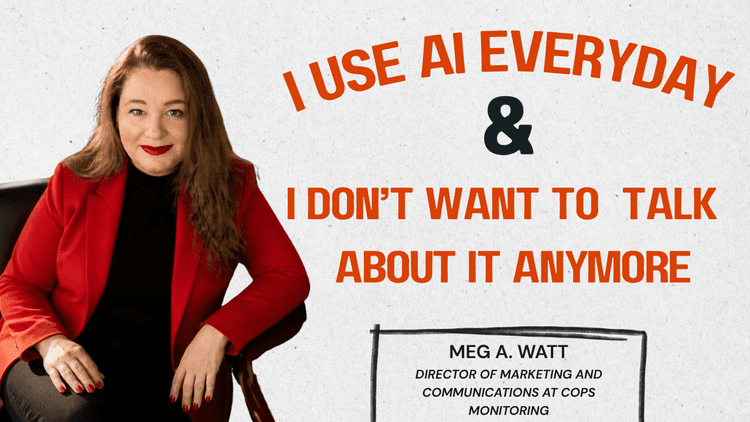
Let me start with what feels like an increasingly controversial statement:
I use AI every day.
Not occasionally. Not experimentally. Every day.
I use it to research, brainstorm, organize ideas, review drafts, summarize information, challenge assumptions, and occasionally tell me when I'm about to make a bad decision disguised as a good one.
And I don't want to talk about it anymore.
Not because I dislike it. Quite the opposite. I think AI is one of the most important technological developments of our lifetime. But somewhere between the breathless predictions, the endless webinars, and the daily stream of social media posts proclaiming that AI will either save civilization or destroy it, I realized something:
The most interesting thing about AI is that it's becoming uninteresting.
That may sound strange coming from someone who uses it constantly, but hear me out.
When a technology first arrives, we talk about the technology itself. When it matures, we stop talking about it and start talking about what we're accomplishing with it. Nobody introduces themselves by saying they use email. Nobody boasts about using cloud storage. Nobody writes thought leadership articles about their calculator.
The technology fades into the background. The outcomes become the story.
I think we're beginning to see that happen with AI.
Within the security industry, the conversation often feels stuck between two extremes. On one side are the people who believe AI will replace nearly every job. On the other are those who dismiss it as a passing trend or glorified autocomplete.
Meanwhile, most of the professionals I know are quietly doing something much less dramatic. They're simply incorporating AI into their workflows.
Marketing teams are using it to accelerate content creation. Operations leaders are using it to organize data and identify patterns. Sales teams are using it to prepare for meetings. Monitoring centers are exploring ways to surface information faster and improve efficiency. Across the industry, people are finding practical applications that help them work smarter without fundamentally changing who they are or what they do.
The reality is far less sensational than the headlines.
In the monitoring business, success has always depended on judgment. It depends on knowing when something deserves attention, when a situation is escalating, and when a customer needs a human being on the other end of the line. Those decisions require experience, context, and accountability.
AI can support those functions. It can help process information more quickly. It can identify trends that might otherwise be missed. It can eliminate repetitive administrative tasks that consume valuable time.
What it cannot do is replace responsibility.
The same principle applies across our industry. A dealer still needs to build trust with a customer. A technician still needs to solve problems in the field. A monitoring professional still needs to make sound decisions when seconds matter. AI may improve the tools we use, but it doesn't replace the expertise required to use them well.
In fact, I've become convinced that AI is doing something unexpected:
It's exposing the difference between knowledge and judgment.
Knowledge is increasingly available to everyone. AI can help anyone generate ideas, summarize information, and create first drafts. But judgment—the ability to evaluate information, recognize nuance, and make good decisions—remains stubbornly human.
That's why two people can use the same AI tool and produce dramatically different results.
One creates something insightful. The other creates something forgettable.
The technology isn't the differentiator. The human is.
That's why I find myself less interested in AI itself and more interested in how people are using it. The organizations gaining the most value aren't necessarily the ones investing the most money. They're the ones asking better questions. They're the ones experimenting thoughtfully. They're the ones treating AI as a tool rather than a strategy.
Because AI isn't a strategy.
It isn't a competitive advantage by itself.
It's an amplifier.
It amplifies efficiency. It amplifies creativity. It amplifies productivity. Unfortunately, it can also amplify poor thinking, weak processes, and bad assumptions.
The outcome still depends on the people behind the keyboard.
So yes, I use AI every day.
I suspect many of you do too, whether you realize it or not. Increasingly, AI is embedded in the software, platforms, and services we interact with throughout the workday.
And maybe that's exactly why I don't want to talk about it anymore.
I'd rather talk about how we're improving response times. How we're delivering better customer experiences. How we're helping dealers grow their businesses. How we're making our industry stronger, smarter, and more resilient.
The hammer was never the story.
What people built with it was.
AI is rapidly becoming the same thing: an incredibly powerful tool whose greatest achievement may be that, someday soon, we stop talking about it altogether.
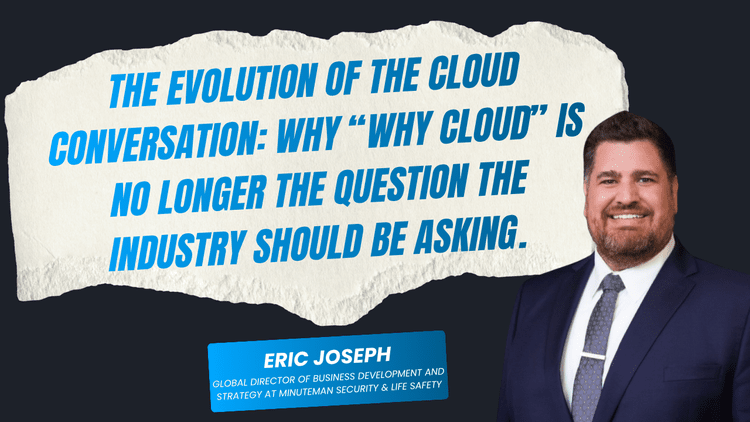
The conversation around Cloud in the security industry has been the topic of discussion for more than a decade and a half and while some people are still asking, or trying to answer, Why Cloud, the conversation has changed and there is no longer a need for such a debate.
Not because cloud has fully “won,” and not because every organization has already migrated. In fact, adoption is happening far slower than many manufacturers, analysts, and investors predicted. The industry moves at the industry speed, and is, and will likely always be, the steady turtle, not the dashing hare. But the direction is no longer really in question as cloud adoption is occurring and picking up speed every year.
The conversation has shifted from Why Cloud? to something much more practical:
When does cloud make sense for your organization, and how do you get there the right way?
The Industry Is Moving, Just at Its Own Pace
Cloud-based security management systems are no longer hypothetical. Tens of thousands of organizations are already using them, and most others are evaluating their timeline for migration.
The reality is simple: physical security is tied to infrastructure that moves slowly and budgets that take time to replenish.
Unlike many traditional IT systems, security environments are connected to doors, readers, locks, cameras, and field hardware with lifecycles that often stretch 7–15 years. That alone changes the pace of adoption. Costs to do a full migration out of cycle can be financially prohibitive, especially if they extend across a corporate enterprise.
And honestly, that’s okay.
The industry is moving to the cloud at the speed operational environments and security department budgets allow, not necessarily at the speed marketing decks predicted.
Small and Mid-Sized Organizations Are Leading the Way
For many smaller and mid-sized deployments, especially under a few hundred readers, cloud is becoming the obvious choice.
In commercial office environments, K-12, higher education, state and local government, and distributed enterprise environments, cloud often makes immediate operational and financial sense.
Especially for organizations moving into new buildings or replacing aging infrastructure, the decision becomes easier:
• Reduced infrastructure overhead
• Simplified updates and maintenance
• Anywhere access
• Modern interfaces
• Improved cybersecurity posture
• Easier scalability across multiple locations
In these environments, legacy infrastructure is often the biggest thing slowing adoption, not resistance to cloud itself. Organizations moving into new facilities is a significant driver for making this move.
Enterprise Customers Are Taking a Different Route
Enterprise organizations are approaching cloud differently.
Enterprise organizations have numerous sites, with thousands of end points, and multiple integrations, all of which require careful consideration as part of the cloud migration.
When enterprise users do decide to make the move to cloud, they have another decision to make. While smaller customers are often comfortable with manufacturer-hosted environments, larger organizations are also considering security platforms deployed within their own AWS, Azure, or Google Cloud environments.
That approach allows enterprise teams to:
• Maintain tighter control over data
• Align with broader IT and cybersecurity standards
• Leverage existing cloud provider relationships
• Integrate security into larger business ecosystems
This isn’t hesitation. It’s intentionality.
Different organizations are carefully evaluating different paths to the same destination.
Regulated Markets Still Have Real Concerns
There are still environments where full cloud adoption remains more complicated.
Airports, utilities, critical infrastructure, and highly regulated environments continue to move cautiously due to concerns around compliance, latency, resiliency, and data sovereignty.
Video also remains nuanced.
For some organizations, hybrid approaches that combine on-premises recording with cloud management or cloud storage continue to make the most sense, depending on bandwidth, retention requirements, and operational needs.
But even in these environments, cloud is increasingly part of the strategy.
The Real Challenge Isn’t the Cloud, It’s the Edge
One of the biggest misconceptions in the industry regarding the timeline to cloud migration is treating cloud as purely a software conversation.
Physical security doesn’t live entirely in the cloud. It lives at the edge:
• Control panels
• Readers
• Wireless locks
• Sensors
• Cameras
• Biometric devices
• I/O infrastructure
And much of that hardware was never originally designed for cloud-native operation. A significant amount is proprietary in nature and tethered to on-premise solutions.
That’s where the real complexity begins.
Modern cloud platforms are dynamic, integration-driven, and continuously evolving. Physical hardware is lifecycle-driven, proprietary, and expected to remain operational for years and sometimes decades.
Bridging those two worlds is where successful cloud strategies are won or lost.
The Questions We Should Actually Be Asking
The industry doesn’t need another generic “cloud vs. on-premise” debate.
The more important questions today are:
Who are you getting your Cloud from?
The provider of the cloud security solution is critically important. Long-term provider viability matters. So do certifications like SOC 2 Type II and ISO standards. Organizations need to deeply understand and fully vet their provider organizationally, as much as the functionality of their product, as they are who owns the data, who manages it, and who has access.
What’s your migration strategy?
Moving from on-premise to cloud isn’t just about flipping a switch. Migration costs, operational impact, historical data retention, and hardware upgrade strategies all matter. These migrations can take months to plan, and working with experts who have completed them before is critical to success.
Cloud Adoption Is Becoming More Practical and More Mature
A lot of the traditional barriers are steadily disappearing.
Migration tools are improving. Feature sets are catching up, and in some areas surpassing, traditional on-premise systems. Integration toolkits are becoming more robust, incorporating a variety of technology components, APIs, webhooks, SCIM, and cloud-native connectors. AI capabilities are being introduced faster in cloud-native environments.
Technologies from outside of the security industry, like MQTT, and more standardized IoT communication models will only accelerate this shift further by simplifying endpoint connectivity and interoperability.
And that’s probably the most important takeaway.
Cloud isn’t some future vision anymore. It’s a strategic direction the industry is actively moving toward, just with more realism, more complexity, and more operational nuance than early conversations suggested.
The question was never really just Why Cloud?
Now it’s about building the right path to get there and the time to do it.
👀 As Seen in the PhySec Community this Week:
#marketing-communications
#deal-activity
#shameless-plugs
-
Tony Dong shared
- Donate to the Cherryville FireWatch Society-Today I woke up to President Trump appointing Federal Housing Finance Agency
-The Bottom line up front: I am coming to my network today, hat in hand, to ask for donations. -
Auston Bunsen shared
-What has been your experience with AccessGrid? -
Matt Antos-Lewis shared
- Rhombus and LenelS2 Elements: Bringing AI-Powered Video and Cloud Access Control Together
-Insight-Driven And AI-Powered: Future Focused Security From LenelS2 And Rhombus. -
Andrew Kosinski shared
-The video channel for RiTA Technology Services, a technology consulting firm specializing in custom access control and video surveillance solutions.
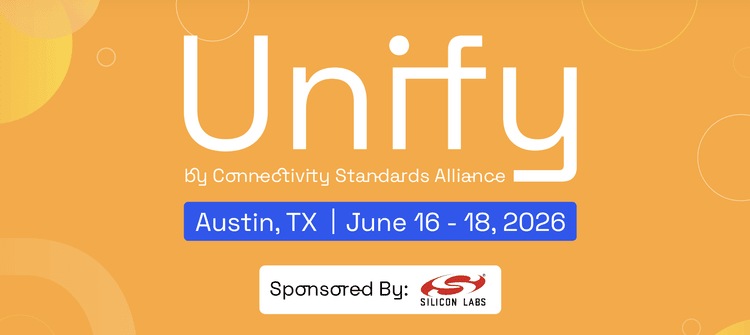
Unify is coming up June 16-18, and we’ll be there joining the conversation on what Aliro could mean for the commercial sector.
Lee will be moderating a session on why commercial may be the next sector to move, covering interoperability, offline and online access, quantum readiness, multi-badge challenges, and what it takes to move Aliro from inevitable to deployed. Register here.

The ALOA Convention & Security Expo is coming up fast. From technical training to meaningful connections, ALOA 2026 is where the people behind physical security come together to learn, connect, and move the industry forward. This is where the industry gets back to the fundamentals, real skills, real conversations, and the people who actually make security work every day. Learn more and register here.

ACS26, The Access Control Summit, is heading to New Zealand in 2026, hosted in collaboration with our city-host, Gallagher Security. Join us October 6–7, and sign up here to be notified first when registration goes live.
🗣️ Your Voice Matters.
Share your feedback, suggest topics, and tell us what questions we should be answering. Help us shape future issues and contribute to the conversations that move the industry forward.
