
Volume 118 | October 21, 2025

Click on the above image and use code sxst3gkbkn to hear the audio version.
Reminder to JOIN the The PhySec Collective community Slack channel to network, engage, and be part of something big! You can sign up here.
SNG, AMA, RAMP, and Tony’s Take on ADT
Hello! I’m excited to bring you Brief #118. I’m writing this as I wait to board my flight to São Paulo, Brazil, where we’ll be welcoming 180 attendees to ACS LATAM. This is our first regionally focused ACS, and we’re thrilled to be partnering with Google at their headquarters in São Paulo.
For the regional ACS model, we’re testing a new approach: offering free tickets supported by lead sponsors. For this one, we’re proud to have ASSA ABLOY and HID as the exclusive sponsor and grateful for Google to partner with us on ACS again (they did ACS24 in Zurich as well). What makes ACS LATAM special is its local and regional focus, reflected in the speaker lineup: most are from the region, work in the region, and can speak to its realities with depth and nuance. That’s exactly what we wanted from the regional ACS series. We plan to expand this format in 2026 alongside the global ACS. More on that soon, and we’ll share a full recap of ACS LATAM in an upcoming Brief.
After a quick review of Securing New Ground, our two Ask Me Anythings, and RAMP, I’m happy to have Tony Dong back with us. He takes another deep dive into global financial markets and how they connect to the security industry. Tony has a rare ability to turn market data into clear, actionable insight. I feel smarter every time I read his stuff here and online. In this Brief, he covers “Why Are Shares of ADT Up 22% Year to Date? A Fundamental and Technical Analysis,” and in a follow-on Brief, he’ll explore “Will Interest Rate Cuts Benefit ADT?” We plan to continue featuring Tony’s work. His expertise, clarity, and willingness to say what others won’t bring real value to our members and the wider community.
Have a great rest of the week, and if you’re in São Paulo, stop by and say hello!
Securing New Ground Recap
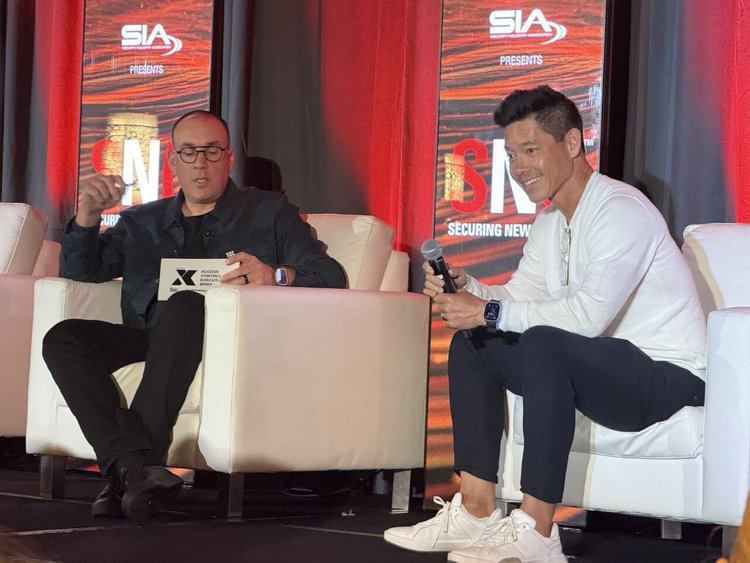
What a stretch it has been…event after event. Last week was Securing New Ground, hosted by SIA in New York. It’s always a strong event that brings together top executives from major U.S. and global brands. We supported the program by helping moderate and activate the lunchtime roundtables.
During lunch, a full room gathered for small-group discussions on key topics shaping our industry. We tried to cap each table at ten participants, but we were thrilled to see the interest over flow the tables. The energy was real. Leaders debating openly, sharing insights, and enjoying genuine peer-to-peer conversation instead of just listening. It was exactly what we were hoping for.
Here is an overview of the SNG Roundtable Topics, Hosts and Table Point of Views, plus I share mine:
Hans Kahler of Eagle Eye Networks – “Security Data Is the New Gold, But Who Owns the Gold?”
Hans’s view: it’s the end user. Security teams should use data legally and ethically to improve safety, experience, and operations. The question shouldn’t be who owns it but what can we do with it. We’re a data industry applied to security. It is time to move from talk to action.
My view: I agree the data ownership ultimately belongs to the individual. The way forward is stronger regulation around ownership, portability, and accountability. Those need to be paired with business models that give individuals transparency, consent, and shared value. As awareness rises, cultural expectations will shift toward greater personal agency over digital footprints.
Albert Lin of Vivotek – “How Well Is Video Surveillance Really Making the Transition to Video-as-a-Service?”
Albert’s table saw the industry slowly moving from capex to opex, with AI as the coming accelerator. End users are adopting faster than the channel.
My view: I went to our members for insights. Collectively, they see progress but uneven execution. Some, like Brian Karas and Ryan Knoll, note that success depends on expectations. Video-as-a-service becomes “visual data-as-a-service” when enterprises monetize insights such as customer behavior or operational efficiency. Others, like Jacob Hengel and Mark Schweitzer, emphasize reliability, proactive support, and genuine service models. The verdict: adoption is growing, but few deliver a true “as a service” experience yet.
Annie Lan of Egis Capital Partners – “Where the Smart Money Is Placing Its Bets”
Annie’s view: both video and access because video is access and access is video. It’s all about lifetime value and shorter lifecycles.
My view: smart money is flowing into access control and related platforms. It’s targeting legacy firms that can evolve into enterprise software companies, deep vertical solutions that dominate niches, and platforms that can become the operating system for the built environment. The opportunity lies in transformation where we are turning hardware into recurring revenue and fragmented markets into scalable ecosystems.
Mark Folmer of RAD Security – “Why AI Is Going to Rewrite the Rules of Traditional Monitoring”
Mark’s table called AI a complete redefinition of monitoring. Customers want smart workflows, not more guards.
My view: AI changes the economics as much as the outcomes. It lowers cost of ownership and shifts monitoring from reactive to proactive. The tension now is between what’s proven and what’s still aspirational, but that tension will define how fast AI replaces the traditional model.
Michael Wong of Genea – “It’s Finally Time for Real Estate to Become Intelligent.”
Michael’s view: it’s not “finally,” it already has been. The key is delivering real value. Real estate wants intelligence; security provides the foundation.
My view: intelligent real estate has moved from aspiration to necessity. The difference now is that technology and data are mature enough to deliver it at scale. But real estate still moves slowly, and Big Tech is always nearby.
Overall, feedback was excellent. People loved the engagement and the rapid-fire recap on stage afterward. SIA has a gem with SNG. It’s filled with executives, highly networked, and worth the time. The opportunity is there…you just have to make the most of it.
PhySec Community Member-Only AMAs (Have you joined one yet?)


If you’re receiving this Brief, you have access to our Ask Me Anythings from the past two weeks. These sessions are where I ask direct questions to leaders like Verkada’s Abraham and Wavelynx’s Rob Lydic: no filters, full engagement and sparked by questions from the community such as “is that timeline feature real?” and “is LEAF really open?.” Each ran 30 minutes, covering topics members submitted in advance.
Watch them here:
• Verkada with Abraham Alvarez: AMA Video in Google Drive
• Wavelynx with Robert Lydic: AMA Video on YouTube
To join future AMAs, make sure you join the PhySec Community Slack.That’s where announcements, links go out, ask the questions, and share the videos.
And if you’d like to be in the AMA hot seat, let me know!
RAMP Recap

We also launched RAMP last week, a new single-day conference for marketing and communications for proptech and the physical security. It was the first of its kind and the response was overwhelmingly positive.
Held across two venues in New York, first at PENN 1 for the Morning of Ideas and the to Lutron Electronics for the Afternoon of Action, RAMP brought together 70 of the top marketers, communicators, and brand leaders in our industry.
The day opened with the message “no sales. no specs. but sparks.” It was a reminder that marketing is about connection and emotion, not just data and features. From thought-provoking talks in the morning to collaborative workshops in the afternoon, the program moved the industry from ideas to action.
Speakers included Chelsea Lavin (The Malin), Julie Roehm(Convergint), Josh Dorfman (Supercool), Sam Mallikarjunan (Agent.ai) Heidi Patalano (National Mortgage News) and David Von Hollweg (Rudd Management). and afternoon facilitators were Tim Norris, Jenna Hardie, and Brian Karas. Each speaker and facilitator shared practical insights on brand, creativity, and authenticity.
One attendee summed it up perfectly: “It’s totally revitalized my passion for what’s possible in marketing.”
Our goal was more than a conference. We really want this to be a movement that flexes what marketing can do. RAMP proved that marketing in security and proptech is evolving fast, powered by creativity, collaboration, and community. We’ll be doing it again in 2026.
Why Are Shares of ADT Up 22% Year to Date? A Fundamental & Technical Analysis
As written by Tony Dong, MSc, CETF
I keep a tab on a dozen publicly traded companies tied to the security and access control industry, and ADT Inc. (NYSE: ADT) is one of them. It’s also been a standout performer this year, up 22.85% year to date as of October 16. If you include reinvested dividends from its 2.57% yield, the total return is even higher.
Naturally, a question I often get from some of you is why certain companies in our space are doing particularly well—or poorly—at a given time. This post is my attempt to walk you through what’s essentially a post-mortem of ADT’s stock performance so far this year.
We’ll look at both fundamental and technical factors to understand what’s driving the move. The fundamentals matter most to long-term investors focused on earnings power and balance-sheet strength, while the technicals help short-term traders spot trends and momentum.
And because past data alone doesn’t tell the whole story, I’ll also include a valuation model at the end to help frame where ADT might go from here.
ADT: Fundamental Analysis
I don’t put much weight on earnings-per-share (EPS) growth, unlike most analysts who obsess over it. EPS is easy to manipulate with accounting adjustments, “one-time” exclusions, and all the usual adjusted-this, non-GAAP-that tricks companies use to dress up the numbers.
What actually matters is cash—how much real money the business generates after expenses, and what management decides to do with it. Every dollar of free cash flow can only go three places: it can be retained as reserves, distributed as dividends, or used to buy back shares. That’s it. Everything else is noise.
Looking at the following chart, you can see ADT’s free cash flow (FCF) rising steadily through 2025, reaching about $1.38 billion by mid-October. That kind of growth gives management options.
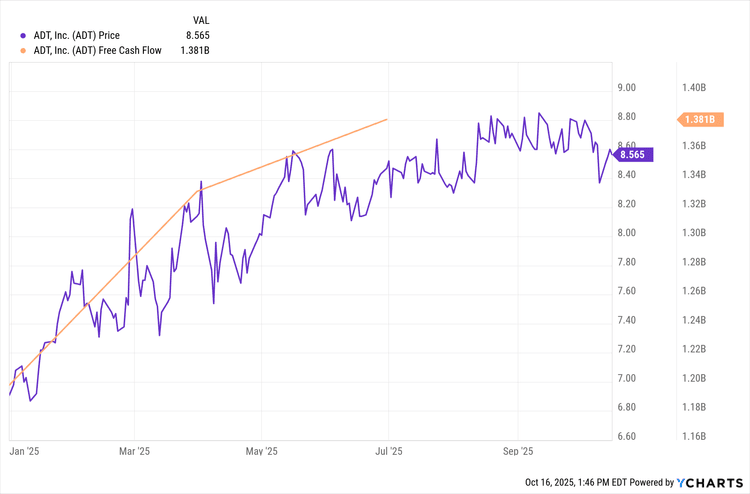
With stronger free cash flow generation, a company can either raise its dividend—sharing profits directly with investors—or repurchase shares, which reduces the share count and boosts earnings per share over time.
ADT’s leadership has made its choice clear. The dividend has remained flat, while the company has been aggressive on buybacks, retiring roughly 65 million shares so far this year with authorization left to repurchase about 100 million more.
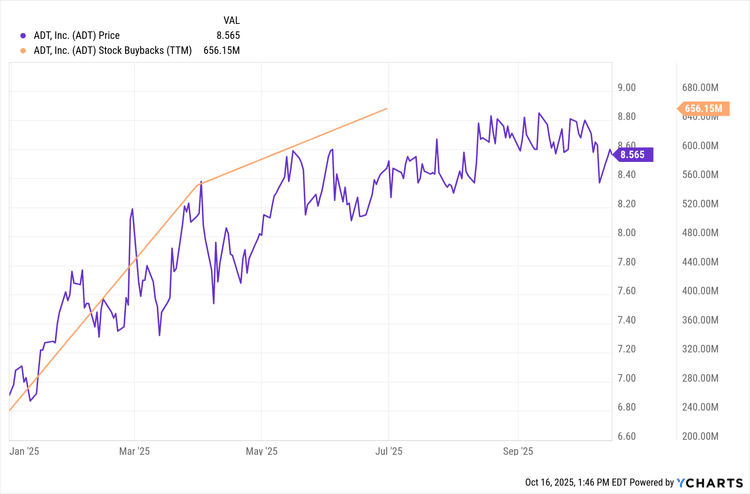
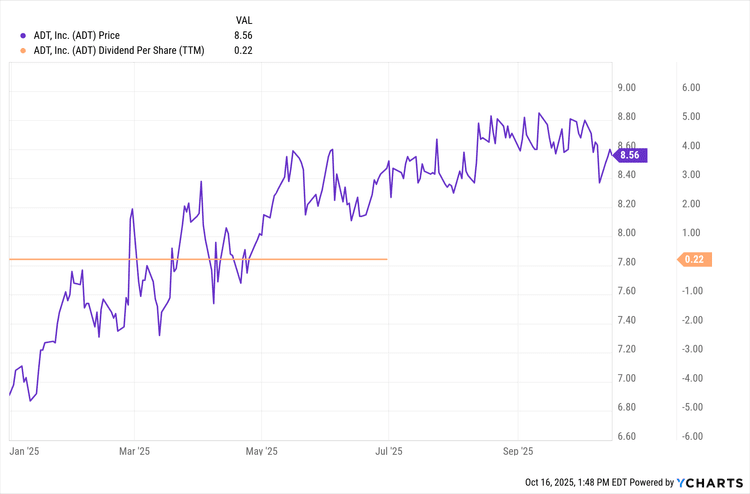
This signals a preference for reinvesting in itself rather than handing out higher cash payouts. Management is effectively saying they view ADT’s shares as undervalued and that the return on buying them back exceeds what investors could earn if that cash were distributed.
It’s a classic capital allocation call: prioritize internal value creation first, reward shareholders later once the valuation gap closes.
ADT: Technical Analysis
When it comes to short-term positioning, I do use technical analysis—but only as a complement to the fundamentals, not as a replacement. Most of my capital sits in long-term holdings, but I reserve a slice of the portfolio for tactical trades, usually through options. In that context, technicals can be useful.
Not the sort that involves drawing triangles and head-and-shoulders patterns, but the kind that uses quantitative indicators to make a more probabilistic call on where momentum might carry a stock next.
Momentum is a genuine market factor, not a myth. Decades of academic research show that stocks with strong recent performance often continue outperforming in the near term.
That persistence stems from behavioral biases—investors anchor to old information, institutions move in waves, and retail traders chase what’s been working. In a retail-heavy market like today’s, that self-reinforcing cycle can stretch for months before reversing.
When I apply TA, it’s never to justify a position but to refine timing. If my valuation work tells me a company looks cheap, I’ll check the charts to avoid walking into a falling knife.
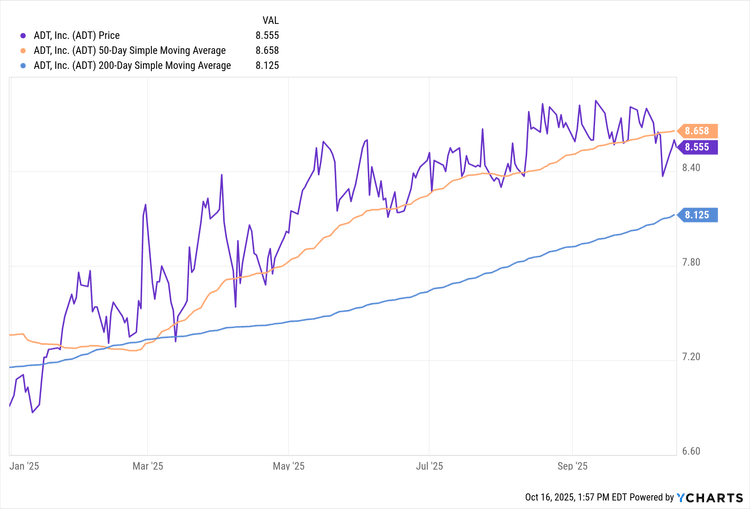
In ADT’s case, the trend over 2025 still looks constructive, though the short-term picture has cooled off. The stock trades just below its 50-day moving average of $8.66, while the longer-term 200-day sits at $8.13. The gap between the two shows the broader uptrend remains intact, but the recent price slip under the 50-day suggests short-term momentum has flattened.
The relative strength index (RSI) tells a similar story. At roughly 48, ADT isn’t showing either overbought exuberance or capitulation. It’s a middle-of-the-road reading that usually corresponds to a period of consolidation—buyers and sellers taking turns without a clear breakout.
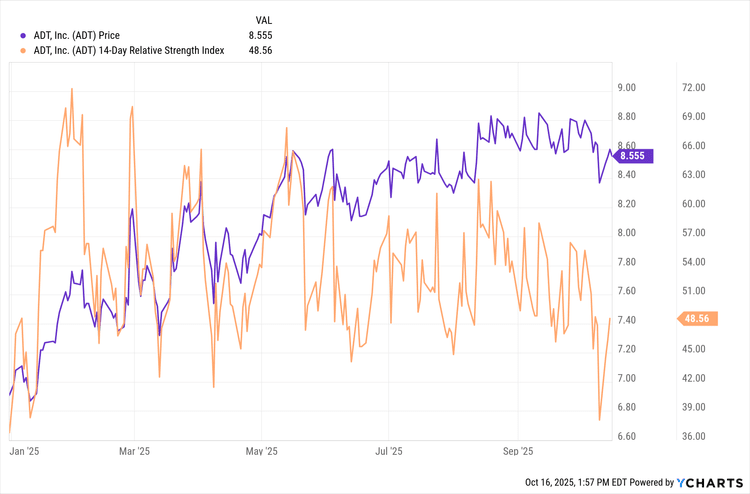
In plain terms, ADT looks like a stock catching its breath after a strong run. For anyone building a position, that can be a healthy setup: the trend hasn’t broken, but the froth has come off, leaving room for a measured re-entry once momentum turns back up.
Next up: Will Interest Rate Cuts Benefit ADT?
PS: I am sure some of you may forward this, but please do so sparingly and encourage others to sign up here. Thank you!
