
Volume 34 | September 12, 2025
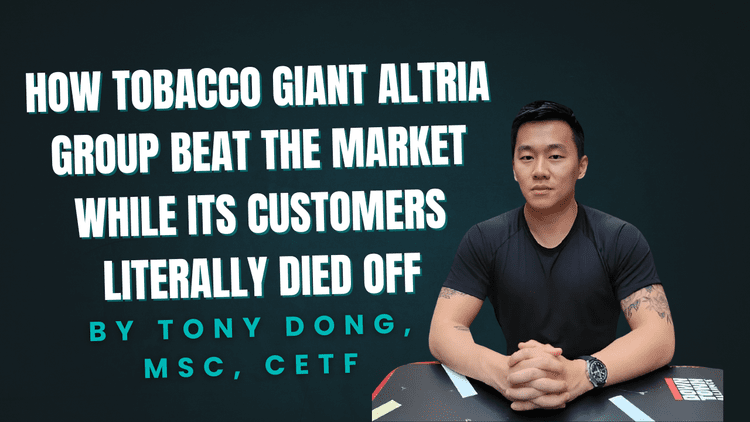
Tony Dong | How Tobacco Giant Altria Group Beat the Market While Its Customers Literally Died Off
Allegion’s steadily rising dividend and recent slowdown in buybacks hint at management’s belief that shareholders are better served with direct cash returns than aggressive reinvestment. That approach echoes tobacco giant Altria, which turned declining cigarette sales and a shrinking customer base into decades of market-beating returns by prioritizing dividends and buybacks. In a market obsessed with growth-at-all-costs, these examples raise the question: when is it smarter for companies to shovel cash back to shareholders instead of chasing the next big thing?
Josh Dempsey | AI Won’t Replace You. But People Using AI Will.
This article kicks off a new series for the Access Control Executive Brief on practical ways AI is shaping security roles today. Think of it as a guide we’ll build together over the next few installments.
RealSense x The Access Control Collective | RealSense WhitePaper: The Ethical Application of Facial Authentication in Enterprise Access Control
Think facial authentication and ethics can’t coexist? This white paper challenges that assumption—revealing how smart regulation might be the secret to unlocking secure, privacy-first access control. If you care about the future of identity tech, this is a must-read.
The Access Control Collective | ACS LATAM
The Access Control Collective is heading to São Paulo for ACS LATAM 2025! In partnership with Google and with support from HID and ASSA ABLOY, this event is set to be a cornerstone gathering for the region. Don’t miss it. Find the link to register below.
The Access Control Collective x Bloxspring | RAMP: The Conference for Marketing Leaders in Security and Protech
Speakers announced!!!! RAMP 2025 is a conference designed specifically for marketers in built environment technology and security—bringing industry leaders together in New York City for a full day of insight, innovation, and meaningful connection. Find the link to register below.
The Access Control Collective | PhySecJobs.com
Below you will find all of the latest jobs in the physical security industry.
Find them all below!
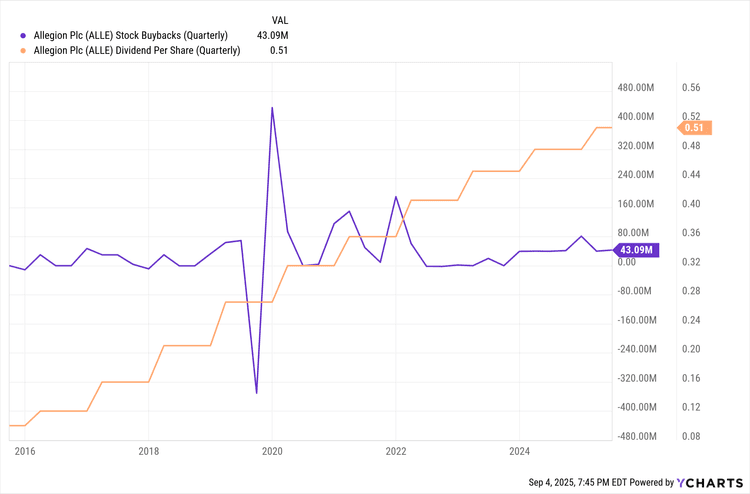
In The PhySec Collective (editor note: this is new name for the online community portion of the Access Control Executive Brief) Slack group, specifically the “Deal Activity” channel, Lee pointed out Allegion (ALLE) and its upcoming $0.51 per share quarterly dividend.
After digging a little deeper, I noticed Allegion’s dividend has been growing at a brisk pace, faster than the company’s free cash flow though still comfortably covered in dollar terms.

What really stood out was that buybacks have slowed down. To me, that signals Allegion’s management believes the cash is better off in shareholders’ pockets than spent repurchasing stock. That says a lot about how they see the current valuation (a “wonderful company at a fair price,” to quote the late Charlie Munger). I’m not surprised to see Berkshire Hathaway initiating a stake recently.
That said, I bring this up because, while Allegion isn’t in any trouble, there’s a long-standing precedent of other companies ramping up cash returns to shareholders when they’re in existential decline. And no company illustrates this better than tobacco giant Altria Group (MO).
Despite facing relentless headwinds of declining cigarette sales, regulatory pressure, a shrinking customer base that is quite literally dying by the day, Altria’s total return has crushed the S&P 500 index (a difficult feat) over the long run.
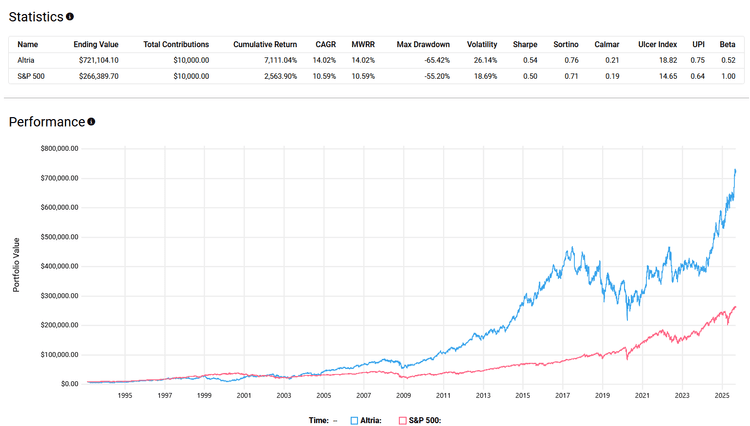
It has achieved this by funneling nearly all of its profits back to shareholders through generous dividends and consistent buybacks. Today, it’s one of the 30+ odd companies that still holds Dividend Monarch status, having raised its annual payout every year for over 50 consecutive years.
I’m bringing this up because in a market where valuations are inflated and companies are obsessed with reinvesting in R&D, moonshots, and growth-at-all-costs strategies, it’s worth asking: are some businesses better off just shoveling cash back to shareholders instead? I think so, and here’s why.
A superficial decline
At first glance, Altria's revenue looks like a textbook case of long-term secular decline. Following its early 2000s peak, the company’s quarterly sales appear to collapse, then stagnate below $6 billion per quarter. This would send most shareholders fleeing for the doors.
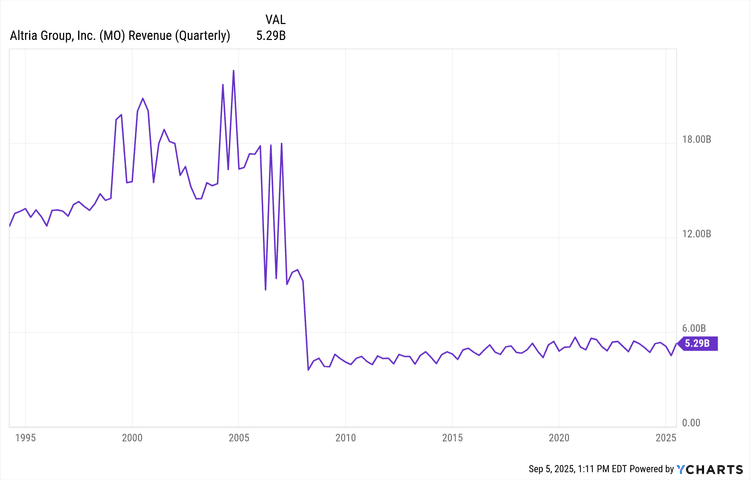
This period coincides with massive changes in the U.S. tobacco landscape. Cigarette volumes fell, taxes rose, and smoking bans expanded across states. The 2009 Family Smoking Prevention and Tobacco Control Act handed sweeping regulatory authority to the FDA. Consumer sentiment also shifted against combustibles as nicotine alternatives entered the market.
But that steep revenue drop is mostly accounting noise. It reflects spin-offs like Philip Morris International (PM) in 2008 and Kraft Foods earlier. What remained was the U.S. business, which looked smaller on paper but was still enormously profitable. Despite fewer smokers, the business did the right thing (financially, not ethically) by raising prices and reducing costs fast enough to keep margins fat.
This is where the real story begins. While total revenue flatlined, revenue per employee tripled. After the PM spinoff and subsequent workforce reductions, Altria got lean. Fewer moving parts in non-revenue generating functions (cost centers) meant less bloat.
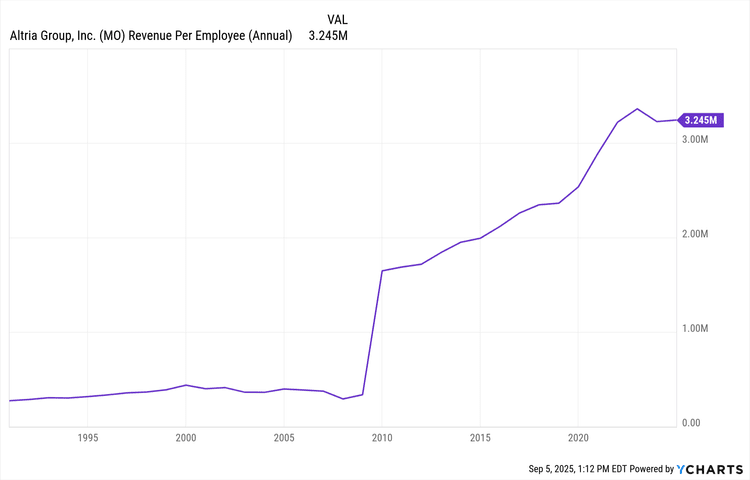
Moreover, despite inflation and rising input costs, COGS shrank. Altria was able to squeeze more profit out of each sale while selling less product. That takes pricing power and extreme cost discipline, which most industries and companies lack.
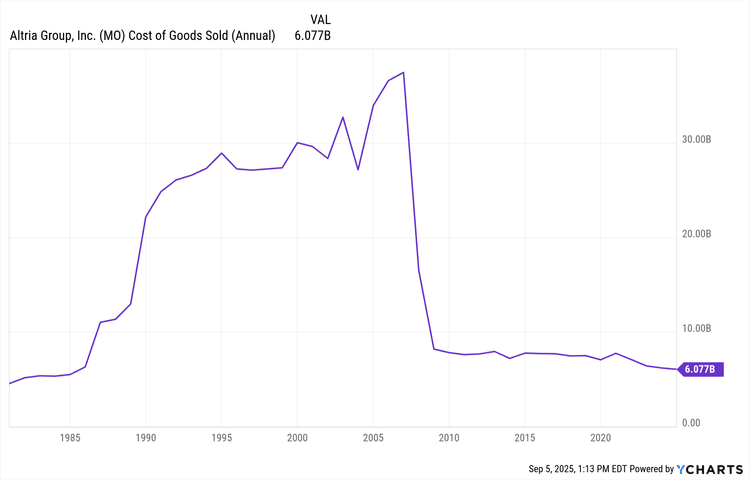
Essentially, Altria focused on extracting as much value as possible from its core U.S. cigarette franchise. It did this by narrowing its portfolio, standardizing operations, and aggressively raising prices. There was little discussion about the “future of tobacco” amongst management. The firm essentially went from growth mode to harvest mode, and did so with surgical, textbook efficiency.
Prioritizing shareholder yield
The superficial story is that Altria’s revenue went nowhere. The real story is that shareholder value went up anyway because management was realistic and played the hand they were dealt optimally.
Importantly, Altria’s free cash flow didn’t grow, but it didn’t collapse either. That alone is impressive for a business that sells fewer units each year to a literally dying customer base.
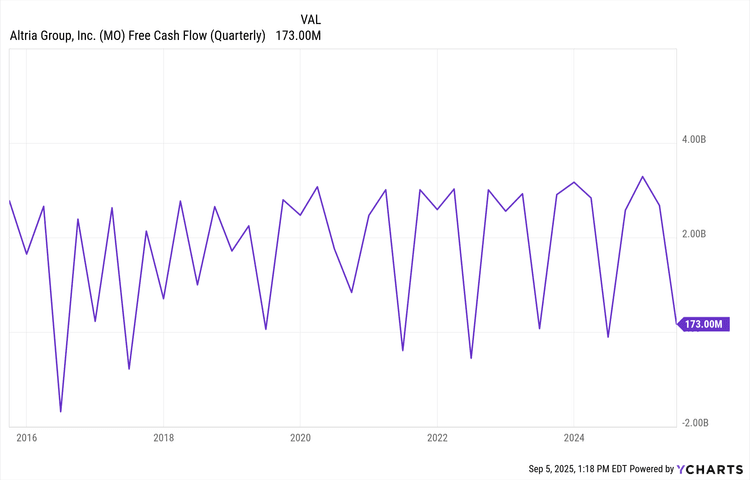
Management leaned out the operation and jacked up prices, knowing full well that nicotine addicts aren’t exactly price sensitive. The end result was flat free cash flow on both declining sales volumes and a shrinking total addressable market, an incredibly hard feat to achieve.
This was largely the result of both product mix management (selling fewer but more expensive units) and organizational design (shrinking overhead, consolidating facilities, streamlining logistics). And what did Altria do with that cash? Gave it all back. The chart below shows what that looked like.
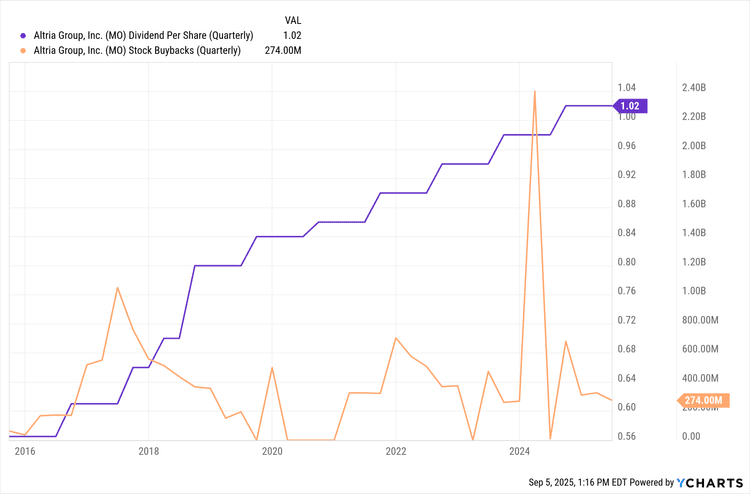
Dividends marched higher nearly every single year, buybacks came and went sporadically (usually executed at good valuations), but the message stayed the same: if we can’t reinvest at a high return and be assure the business will be around in a decade, we’re handing it over to you.
In a world that increasingly penalized its core product, Altria responded not with R&D arms races or splashy acquisitions (save for a few missteps like JUUL), but by turning inward. It did the hard, boring work of cost control, financial engineering, and capital return.
Why finding the next Altria will be hard but worth pursuing
To save you the trouble, I don’t think we’re going to see another dark horse story like Altria anytime soon. The conditions that made it possible are hard to replicate today.
Altria had its back against the wall, but it also had a few things going for it. The most important was pricing power. It sold a product so addictive that demand stayed sticky no matter what.
That kind of inelastic consumer behavior gave it rare control over unit economics. Even as volumes declined, Altria could raise prices and still retain its customer base. That’s not something most legacy businesses can count on.
Being in a sunset industry isn't enough. Take the oil majors. Some investors think they’re the next big dividend machines, but the fundamentals don’t line up. Their products are heavily influenced by geopolitics and macro cycles. Balance sheets aren’t nearly as clean, and the capital requirements are brutal, especially for exploration and production heavy firms.
Same goes for cannabis. Even though it faces similar regulatory friction, the sector has been far too fragmented to reach sustainable profitability. Big Tobacco got there through ruthless consolidation and cost discipline. Weed hasn’t.
If there’s a lesson here, it’s this: when you see a company aggressively returning cash to shareholders, take a closer look at the numbers and story.
Ask yourself: is management doing this because they don’t know what else to do? Or are they like Altria - fully aware of the writing on the wall and making the most of the time they have left by maximizing shareholder value while they still can? The difference matters.
At its core, investing is just discounting future cash flows: estimating what a company will return to you, and figuring out if the multiple you pay today clears your hurdle rate. When a company like Altria chooses to give most of its cash back, the math becomes simpler.
As long as you can look past the headlines about declining revenue and a dying product, the answer is often a resounding yes. The returns are right there, if you know where to look.

This article kicks off a new series for the Access Control Executive Brief on practical ways AI is shaping security roles today. Think of it as a guide we’ll build together over the next few installments.
Jason Veiock recently shared a podcast episode with me that really made me stop and think. It was Shopify’s CRO talking about how AI is reshaping sales. The points he made deeply resonated because the possibilities are endless no matter which role you play in an organization.
And it’s evolving rapidly.
Hiring in the Age of AI
Here’s something people aren’t saying out loud yet, but it’s coming.Job descriptions are going to start saying AI native required. Not “nice to have.”Interviews won’t just be about, “tell me about a time when…”
They’ll include scenarios like: “Take this challenge, show me which AI tools you’d use to solve it? How many layers deep can you go?
”We’re already seeing companies hire AI Strategy roles that are dedicated positions. That tells you everything. If organizations are putting budgets toward people whose sole focus is to figure out how to leverage AI, it’s no longer a side project. It’s a core skill set.And in a few years? If you’re not fluent in this, you’ll be the outlier in the room.
Right now, we’ve basically got three camps:
-
AI natives – the ones who are already tinkering, building small tools, experimenting daily.
-
AI curious – they’ve played with ChatGPT, maybe written an email or two, but haven’t applied it to real work yet.
-
AI ignorant – the ones who don’t believe it matters or are hoping they can just keep doing what they’ve always done.
And yeah, there’s a small anti-AI group too. The ones who whisper, “If I lean into this, am I just automating myself out of a job?”
Here’s the uncomfortable truth: AI won’t replace you. But the people who know how to use it will.
Why Prompt Engineering Is Your New Core Skill
This is where the rubber meets the road.
I’ve been working with my SIA Rise mentee on this exact thing. We’ll sit down and run through prompts. Not surface-level stuff, but real scenarios with tips, tricks, and new techniques. Every week it feels like there’s some new insight on how best to prompt.
There’s even the joke of a “prompstitute” as someone who experiments endlessly with prompts just to squeeze out the best outputs. Silly? Maybe. But it shows how much tinkering matters right now.
That mentee of mine built something recently that would’ve taken him months in the past. Instead, it took him about an hour. And it was better than what he would’ve produced on his own. That’s the difference between dabbling and going deep.
For his generation, this won’t be optional. Prompt engineering is going to be table stakes. If you’re part of SIA Rise today, you’re building your career with this as second nature.But you can’t just copy and paste. We’ve all seen the “AI slop.”
-
Emails with weirdly long hyphens.
-
The overuse of words like ensure.
-
Random bolded text.
-
Perfectly polished sentences that somehow feel soulless.
People notice. Especially in our industry. Security runs on trust. If your communication feels fake or hollow, you lose credibility.
What Customers Expect (and How AI Helps You Deliver)
AI doesn’t lower the bar with customers. It raises it.
They want three things:
-
Know my business – not just that I run a school or a hospital, but the risks, the partners, the financial pressures. And they want you to know it deeply. AI can help with that.
-
Know my technology – not just your product, but how it connects with the rest of my ecosystem.
-
Make an expert recommendation – clear, trusted guidance. Not fluff. Not a feature dump.
The good news is with the right AI resources, all three become easier to deliver with real depth.We’ll go deeper into this in a future installment with examples of specific tools that can help you prepare, present, and deliver in a way your audience can feel.
Guardrails and Sharing What Works
Now, there’s another side to this that no organization has fully figured out.
Some companies are starting to build AI vaults so employees can use AI without risking sensitive data leaking into the wrong places. Smart move. Because let’s be honest, we’ve all got personal AI tools on our laptops and phones. And sometimes people paste in things they really shouldn’t.
That’s why governance can’t just live at the top. It’s also about creating safe spaces for employees to share what’s working. At Shopify they literally run a Slack channel just for AI use cases. I love this idea. Imagine a Teams channel where frontline employees post:
-
“I just used AI to cut my report writing time in half.”
-
“I prepped for a customer meeting in record time and spotted a use case we’d never have noticed.”
That’s how you spread adoption. That’s how you democratize it. Not by keeping AI in a corner, but by letting the people closest to the work teach each other what’s possible.
Organizations love building processes that turn into ruts. We pour cement around how we do things today…and then bam, the future shows up and we’re stuck.
AI is moving too fast for that. Build some guardrails, sure. But leave yourself room to adapt.In later parts of this series, I’ll share more practical examples of how companies are balancing governance with freedom to experiment.
Where This Leaves Us
So where are we in the security industry?
A workforce that ranges from excited to skeptical. Customers who are only going to demand more. Organizations scrambling to figure out their strategy.
You don’t need to be an expert right now. You just need to move.
ChatGPT is great, and I’ve heard a few organizations rolling out Notebook LM. But don’t stop there. Try Claude, Perplexity, Grok, Gemini. Gamma.app is amazing. You can even try building your own agent or custom GPT. There’s no shortage of tools, and no matter your current experience level, there’s something out there to help you grow.
Practice your prompting. Share what’s working with your peers.
-
Which camp are you in right now?
-
Are you an AI native, already tinkering and building?
-
AI curious, still dipping your toes in?
-
Or maybe even AI ignorant, hoping this whole thing blows over?
Wherever you land today, ask yourself one question: What’s the next step I can take this week to move forward?
Because the future isn’t waiting. And neither are the people already using AI to pull ahead.
This article is the first part of a practical guide to AI in the security industry. In the next installment, we’ll go deeper into customer expectations and explore real-world tools like Gamma.app and Claude to show how they can transform how you prepare, present, and deliver. Step by step, we’ll cut through the hype and get into practice because that’s what will matter most.
What if the very regulations you believed were slowing down the adoption of facial authentication... were actually the foundation for doing it right?
That’s the surprising insight at the heart of our latest white paper, developed in partnership with The Access Control Collective and the team at RealSense:
The Ethical Application of Facial Authentication in Enterprise Access Control in Western Markets.
This paper explores how privacy laws and regulatory frameworks—often viewed as obstacles—can actually guide the responsible and scalable implementation of facial authentication technologies in enterprise environments.
Special thanks to Mike Nielsen, Eyal Rond, Penny Malsch, and the entire RealSense team for their invaluable collaboration on this important project.
Now available for download — click here.
Welcome to edition #3, episode #3, issue #3? Let’s go with that. Issue #3. I mentioned in issue #2 that I am a superhero and comic book fan, so just like comic books have issues, Security Agents of Change will have issue numbers. I will do my best to ensure the issues do not have issues.
As I mentioned in issue #2, Security Agents of Change are poised to be innovators to make change, creating the Art of the Possible – NOW!
While Security Agents of Change will primarily focus on tech companies driving innovative advancements in the security space, this issue will feature an organization making a significant impact in the security industry.
Cue the superhero reveal…
I have been involved in several security industry organizations for the last 20-plus years. Most are ones that every security practitioner has heard of. But there is a new kid on the block that is making some waves I want to give my nod to them, because they are bringing innovation and change to the security industry. The organization is the Life Safety Alliance (https://www.lifesafetyalliance.org/) or LSA.
I first heard about these folks, like many in the security industry, in July 2024 when they released their “Top 40 Leaders in Security & Life Safety” for 2024. A quick read through the winners was a veritable” who’s who” of the security industry. Selfishly, I wanted to know more. So I sought them out. Reached out to the organization. What I found was two-fold intriguing. First, not all of the Top 40 winners were part of the LSA. In fact, only a few were. Second, the mission, vision, and promise of the LSA were very intriguing.
Mission: "To be a global resource and authority on best practices for the Security & Life Safety industry through cooperation with trade associations, academic institutions, and members."
Vision: "To bring Security & Life Safety professionals together in the interest of International collaboration."
Promise: "To provide expert support in the areas of industry standards, professional growth, technology innovation, research, and certification."
WAIT! What?! A global security organization that values bringing together thought leadership to promote support and change in the security industry! To give members a stage to collaborate and create actual industry action, awareness, and facilitate more than just showing up to a meeting? Sign me up.
So that’s what I did. I asked to join the LSA. But here is the interesting thing. You don’t just join the LSA. You have to be sponsored. Thank you, Michael Gips, for taking a chance on me. The Life Safety Alliance is not for everyone, and not everyone is for the LSA, although I encourage everyone to see if we are for you. While they want to grow their membership, just giving them yearly membership dues is not enough. You have to be committed to more. And embarrassingly, I have not done what maybe I needed to have done over the last 10 months. The Life Safety Alliance is an Agent of Change, and I want to be an Agent of Change. The LSA is just one way I am attempting to do that.
The membership of LSA is still small, partly because it has only been active for a few years, and partly because it is intentionally limited. Because of their size and intentional limitations, everyone who joins is vetted to be an expert in their field. But here’s the thing, it’s not the good ol’ boys club that has plagued the industry, but rather thought leaders who actually are doing something. One thing that was also interesting to me, having been a part of a few industry organizations that have struggled with leadership, unlike other organizations, the leadership of LSA is unpaid and completely volunteer-led; typically, the first sticking point with any organization. What the LSA is doing is bringing thought leadership, including risk management, security technology, cybersecurity, life safety, and more to the table. It is not just an organization focused on physical security, and the members help tie together the neighboring industries of Life Safety and Cybersecurity. Wait, what? You mean there is an organization that is willing to reach across the aisles to leverage thought leadership from Life Safety and Cybersecurity into what Physical Security is doing? Hmm… “with great power comes great responsibility”.
The Life Safety Alliance is an Agent of Change. I think they are just beginning to break the ice on what could be a whole new chapter in thought leadership that leads the security industry.
Top 40 Leaders in Security and Life Safety
I mentioned earlier that I originally found the LSA because of the Top 40 Leaders in Security and Life Safety. Here’s what I also found out about that award. Two things. One, unlike other security industry “awards,” the Top 40 is not a pay-to-play award. Yes, you heard me. There are awards out there that, for the right money, you too can be an award winner. If you remember from “In Living Color”, “Homey don’t play that.” Two, membership in the LSA does not merit a Top 40 Leader. Membership in LSA does not mean you are guaranteed a spot as a top 40 Leader, although there are a few members who did receive Top 40 Leader in 2025.
The Top 40 Leader award was created to be a merit-driven award for security industry leaders. The Life Safety Alliance in 2024 identified more than 120 people who were providing thought leadership in the security industry. In 2025, that number jumped to more than 200 people who either registered or were invited by the LSA to submit. LSA Submission is not for the faint of heart, either. To be considered, applicants had to submit detailed information to the LSA for the previous calendar year. Each category and response was weighted, and most importantly, it was evaluated blind by a third party. The LSA took every step possible to prevent any chance of favoritism.
Categories for evaluation per calendar year (June-May) included:
Academic Positions, Authored Articles, Awards & Honors, Blog Posts (Non-LinkedIn), Board Positions, Books Written, Book Chapters Authored, Citations and Quotes, Fellowships, In-Person Presentations, LinkedIn Posts, LinkedIn Shared Content, Podcasts, Public Reports and Studies, Trainings Conducted, Volunteer Leadership Roles, Webinar Panels.
I don’t think it had anything to do with it, but I added in Industry Events like the @wineandsecurity event that @protechtsolutionspartners hosts at ISC West. If you are interested in that event, please send me a DM.
I am honored to have been one of the recipients of the Top 40 Leader award for 2025, and I hope to do enough to have a repeat in 2026. I would highly encourage anyone who is producing thought leadership to apply. Registration link is here: http://www.lifesafetyalliance.org/top40
Congratulations again and also to the rest of the 2025 Top 40 Leaders in Security and Life Safety
Obadare Peter Adewale Professor of Practice - Cybersecurity Melissa Agnes Farah B. Garry Bergin PC MSc CSyP MSI CPP SRMCP CTSP F.Sec.I.I FSyI F.ISRM Dave Cohen RPP M.ISRM Mike Croll Chris Cubbage CPP, CISA, GAICD Terry Cutler Shawnee Delaney Nicholas Dynon Jane Frankland MBE ✨ Michael Gips Alex Goldenberg Scott Goldfine Florian Haacke Yolanda Hamblen Kasia Hanson Mike Hurst, CPP® CPOI Eduardo Jany Kathy Lavinder Kirk MacDowell Taylor May, MBA Tim McCreight Bruce McIndoe Don Morron, MBA Fredrik Nilsson Kevin Palacios Elizabeth Parks Paul Sarnese, CHPA, MSE,MAS,CAPM Tyler Schmoker, MPA, LSSYB, PROSCI Dr. Gavriel (Gav) Schneider Gaston Hernan Schulmeister Jeffrey A. Slotnick, CPP, PSP Confidence Staveley Christopher Stitt Tino Urbina Tim Wenzel, CPP Alfredo Yuncoza DHC. CSSM. CPOI. CPO. CRM Matthew Porcelli, MSc, CPP, MSI, F.ISRM, FSyl
I also highly encourage anyone who is active in the physical security, life safety, or cybersecurity industries to look at the Life Safety Alliance as a place to share that thought leadership. It's not a perfect organization, but the things that the LSA is doing, getting involved with, and has on the roadmap is both important and industry-changing as well.
The Art of the Possible is NOW. It is exciting to see the @Life Safety Alliance and their members have that mindset of becoming Agents of Change, offering a fresh take on what we as a security industry can do. I make no apologies, I want to be an Agent of Change, not to tear down the security industry, but to help change mindsets and focus, before the industry gets left behind. Let's learn from the lessons of old, but be willing to grow using that knowledge.
ProTecht Solutions Partners, LLC is your security advocate: a security technology consulting firm dedicated to helping companies keep people and assets safe. We realize security technologies are part of a larger solution for most companies, with requirements to bring business intelligence, sustainability, and more. With ProTecht Solutions Partners, LLC, the system you implement is always tailored to the specific needs of your company. If this, or any of the technologies mentioned in Security Agents of Change, are interesting to your company, please reach out for a more in-depth discussion.


Below are the highlighted jobs and companies this week. New jobs are bolded.
-
- Regional Sales Manager - South - apply here
- Director of Sales - apply here
-
Lockmasters, Inc. - VP of Specialty Door Division - apply here
-
EyeOTmonitor - Account Executive - apply here
-
- Senior Product Manager, Government Solutions-North America – apply here
- Product Manager, Mercury Controllers – apply here
- Senior Product Manager, Readers – apply here
- Senior Product Manager, Biometric Readers – apply here
- Senior Software Engineer Java – apply here
-Pre-Sales Consultant – apply here
-Staff Engineer – apply here
-Channel Account Manager DACH – apply here
-End User BDM - Emerging Technologies – apply here
-Director of Quality – apply here
-Director of Product Management - Readers – apply here
-Sales Development Representative – apply here
-Product Manager, Credentials – apply here
-Business Development Leader, Controller Apps – apply here
-
Kastle - Project Manager, Implementations - apply here
